India Seeks Repatriation of Vagdevi Idol from Britain
Source:etvbharat ↗
Why It Matters
The repatriation of antiquities is a major priority in India's soft power diplomacy. The explicit connection to the Bhojshala complex, Raja Bhoj, and the Paramara Dynasty makes it highly relevant for the Madhya Pradesh history and culture sections of the MPPSC State Service Prelims.
Summary
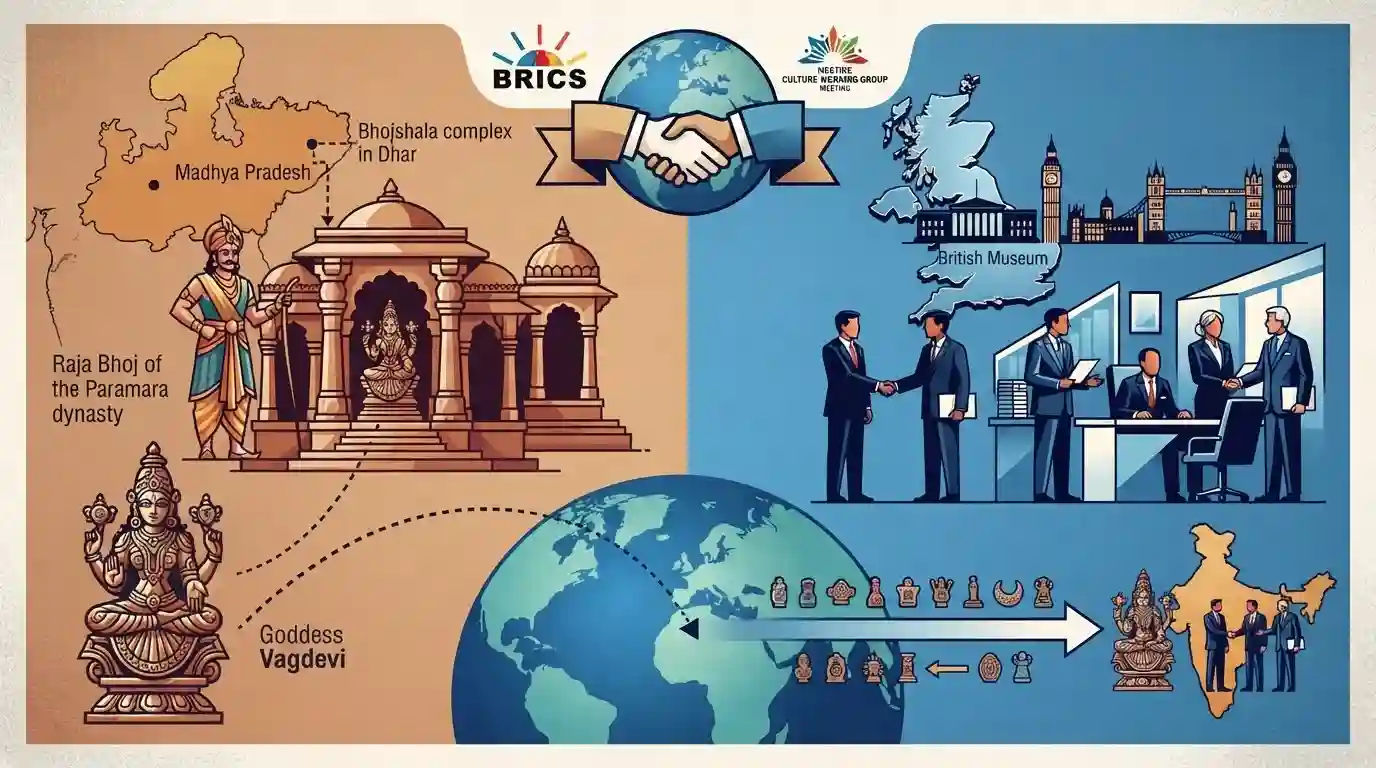
The Government of India is actively engaged in diplomatic and legal efforts to repatriate the ancient idol of Goddess Vagdevi from Britain. The idol, originally installed at the historic Bhojshala complex in Dhar by Raja Bhoj of the Paramara dynasty, has been missing for over a century. The announcement was made in the context of the BRICS Culture Working Group and Culture Ministers' meeting in Bhopal, which has prioritized the return of stolen cultural heritage. Since 2014, India has successfully retrieved over 650 ancient artefacts from abroad.
Key Points
- The Government of India is utilizing diplomatic and legal channels to repatriate the ancient idol of Goddess Vagdevi from Britain to the historic Bhojshala complex in Dhar.
- The Bhojshala complex in Madhya Pradesh was established by Raja Bhoj of the Paramara Dynasty, where the Vagdevi (Saraswati) idol was originally installed before going missing nearly a century ago.
- The repatriation of cultural heritage and antiquities is a key focus area at the BRICS Culture Working Group and Culture Ministers' meeting being hosted in Bhopal.
- India has successfully brought back over 650 stolen antiquities and ancient artefacts from various countries since 2014.
Important Terms
Goddess Vagdevi

An idol of the Hindu goddess of knowledge (Saraswati) originally installed at the historic Bhojshala complex in Dhar, Madhya Pradesh by Raja Bhoj. It has been kept at the British Museum for over a century and is the subject of repatriation efforts.
UPSC context
Important for GS Paper 1 (Art and Culture), illustrating the historical significance of the Paramara dynasty and ongoing efforts to repatriate stolen cultural heritage.
Union Ministry of Culture
The Union Ministry of Culture is a government body in India responsible for preserving and promoting India's art, culture, and heritage. It plays a key role in diplomatic efforts to retrieve stolen historical artifacts.
UPSC context
Important for GS Paper 2 (Governance), focusing on government initiatives and policies for protecting and retrieving India's cultural heritage.
BRICS Culture Working Group
A formal group comprising member states of the BRICS grouping that collaborates on issues relating to cultural cooperation, preservation of shared heritage, and repatriation of cultural properties.
UPSC context
Relevant for GS Paper 2 (International Relations), highlighting India's engagement in multilateral forums to safeguard and reclaim cultural assets.
Ashmolean Museum
The University of Oxford's museum of art and archaeology in Britain. It recently bypassed federal strictures to return a 16th-century bronze idol stolen from Tamil Nadu back to India.
UPSC context
Relevant for GS Paper 1 and 2, illustrating successful instances of museum-level cooperation and cultural repatriation bypassing broader diplomatic disputes.
Prelims Trap
Under the Antiquities Act, 1972, all historical items, including manuscripts and documents, must be at least 100 years old to qualify as antiquities.
The Act distinguishes timelines: physical sculptures or art objects must be at least 100 years old, whereas manuscripts, records, or documents require only 75 years to qualify.
Static Concepts Connected
Who was Raja Bhoj and what is his cultural legacy?
- Paramara Dynasty: He ruled Malwa from Dhar (1010-1055 CE), succeeding Ujjain, and was a legendary patron of arts, literature, and learning.
- Literary Treatises: Authored celebrated texts like Samarangana Sutradhara (on temple architecture and vastu) and Saraswatikanthabharana (on Sanskrit grammar and poetics).
- Bhojshala Complex: Established a major Sanskrit learning center at Dhar, featuring unique Sarpabandha (serpentine) grammatical inscriptions on pillars.
What are the key provisions of the Antiquities and Art Treasures Act, 1972?
- Age Thresholds: Classifies sculptures and art objects older than 100 years as antiquities, but lowers the threshold to 75 years for manuscripts or documents.
- Export Ban: Strictly prohibits export of any antiquity by private individuals; only the Central Government or its authorized agencies can export them.
- Compulsory Licensing: Mandates that private owners and dealers of specified antiquities must register their collections with the government to monitor domestic movement.
Cross-Topic Patterns
Cultural Repatriation as Soft Power
India leverages multilateral forums like BRICS alongside UNESCO’s 1970 Convention to weave the restitution of stolen heritage into its proactive cultural diplomacy.
Epigraphic pedagogies of ancient India
Inscriptions like Bhojshala’s Sarpabandha and Uttiramerur’s temple walls illustrate how ancient public monuments functioned as active grammatical and civic textbooks.

Raja Bhoj’s literary treatises paired with the statutory timelines of the 1972 Antiquities Act will likely feature in a 2026 question.
Linked PYQs · 1
Linked PYQs · 1
- 2019MPPSC_PRELIMSGS1
Which among the following source throw light on the history of Parmar Dynasty ?
