Andhra Pradesh allocates funds to eradicate tribal doli system
Source:The Hindu ↗
Why It Matters
The 'doli' system is a stark example of how infrastructure deficits lead to the denial of basic human rights, particularly healthcare access for vulnerable groups like tribal populations and pregnant women. Understanding these grassroots governance challenges is crucial for answering questions on inclusive growth, welfare schemes, and the role of infrastructure in social development.
Summary
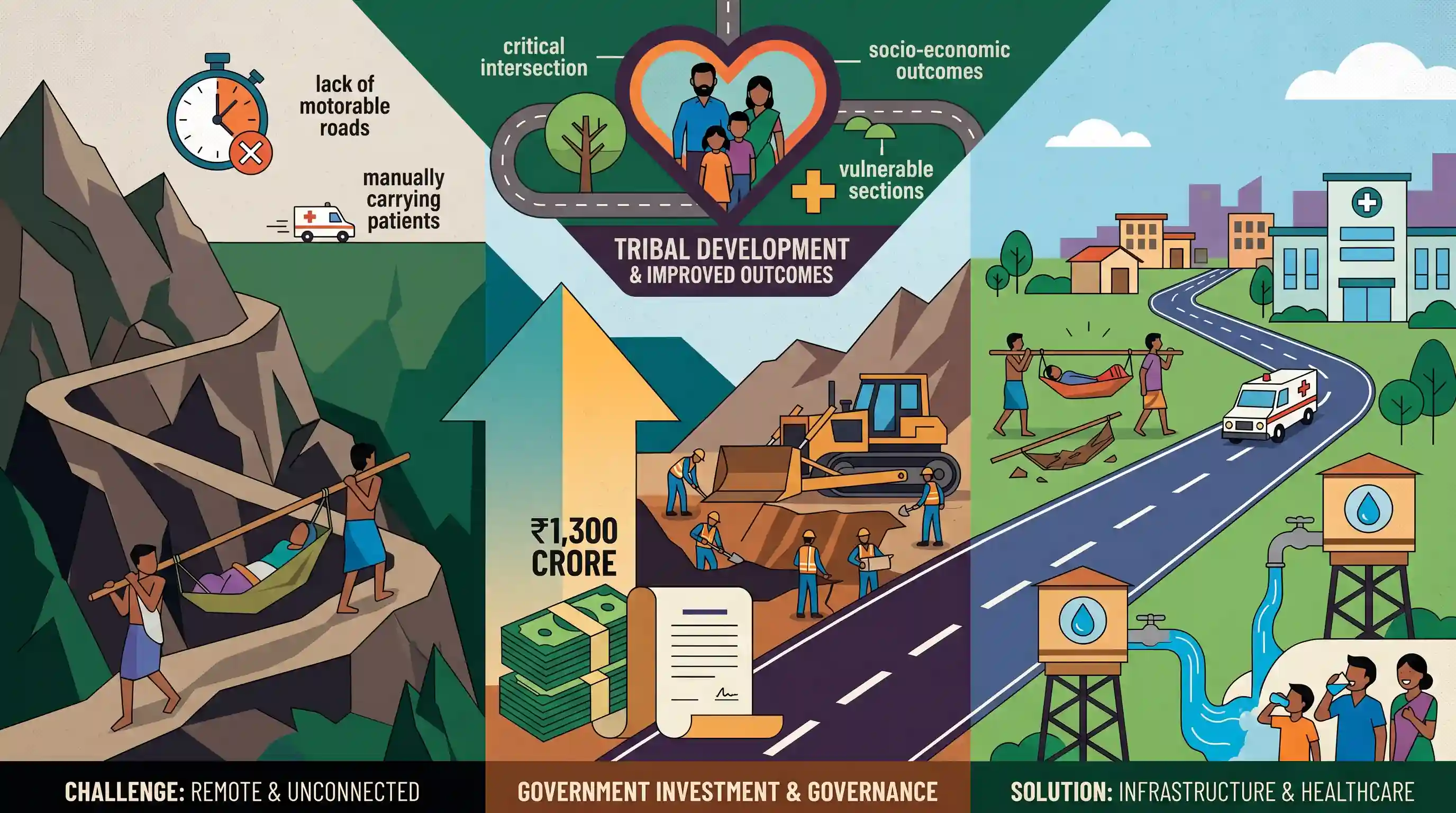
The Andhra Pradesh government is investing ₹1,300 crore in road construction across tribal habitations to eliminate the 'doli' system, a perilous practice of manually carrying patients to hospitals due to lack of motorable roads. Minister Gummadi Sandhya Rani emphasized that basic infrastructure like roads and safe drinking water is being prioritized to improve healthcare access and prevent disease outbreaks in remote areas like Parvatipuram Manyam district. This highlights the critical intersection between physical infrastructure and socio-economic outcomes for vulnerable tribal populations.
Key Points
- The Andhra Pradesh government has allocated ₹1,300 crore to construct roads in tribal habitations to address severe infrastructure deficits.
- The initiative aims to permanently eradicate the 'doli' system, a practice where tribal people, including pregnant women and critical patients, are carried manually for long distances on palanquins or stretchers to reach the nearest healthcare facility.
- Alongside road connectivity, the government is prioritizing safe drinking water facilities to prevent seasonal diseases in these remote tribal pockets.
- Poor physical connectivity in tribal areas is a major impediment to inclusive development, leading to exclusion from basic health and administrative services.
Important Terms
Doli System

A makeshift stretcher made of poles and cloth used to manually carry patients across hilly terrain in remote areas lacking motorable road connectivity.
UPSC context
GS Paper 2: Issues relating to development and management of Social Sector/Services relating to Health and Infrastructure.
PM-JANMAN
A central mission launched to provide 11 essential services, including road connectivity and healthcare, to 75 identified Particularly Vulnerable Tribal Groups across India.
UPSC context
GS Paper 2: Welfare schemes for vulnerable sections of the population by the Centre and States.
Particularly Vulnerable Tribal Groups (PVTGs)
A subset of Scheduled Tribes identified by the Dhebar Commission (1973) based on criteria like pre-agricultural technology, low literacy, and declining or stagnant population.
UPSC context
GS Paper 2: Welfare schemes for vulnerable sections; GS Paper 1: Social empowerment.
Integrated Tribal Development Agency (ITDA)
A specialized administrative body responsible for the socio-economic development of tribal populations within a specific region (Scheduled Area) through integrated planning and single-line administration.
UPSC context
GS Paper 2: Governance, administration of Scheduled Areas, and institutional framework for tribal development.
Adavi Thalli Bata
A flagship road-building initiative by the Andhra Pradesh government aimed at providing all-weather road connectivity to remote tribal habitations.
UPSC context
GS Paper 3: Infrastructure (Roads); GS Paper 2: State-specific welfare interventions.
Scheduled Areas
Areas designated under the Fifth Schedule of the Constitution where the Governor has special powers to protect tribal land and interests.
UPSC context
GS Paper 2: Indian Constitution (5th Schedule); Administrative and legislative provisions for tribal regions.
Prelims Trap
"The 'Doli system' is a traditional cultural practice of PVTGs protected under the Fifth Schedule."
It is a forced coping mechanism—carrying patients on makeshift stretchers—due to severe road deficits, not a protected cultural tradition.
Static Concepts Connected
What are the core objectives of the PM-JANMAN scheme?
- Target Group: Specifically targets 75 Particularly Vulnerable Tribal Groups (PVTGs) across India to holistically improve their socio-economic conditions.
- Key Interventions: Mandates 11 critical interventions including all-weather roads, safe drinking water, rural housing, and Mobile Medical Units (MMUs).
How is infrastructure funded in tribal Scheduled Areas?
- Article 275(1): Provides constitutional grants-in-aid from the Consolidated Fund of India to states specifically for promoting ST welfare and administration.
- Tribal Sub-Plan: Mandates the routing of plan funds proportionate to the ST population for dedicated developmental works, including roads and water.
Cross-Topic Patterns
Infrastructure as a Health Determinant
The 'doli' system exemplifies how physical connectivity (GS3) directly dictates socio-economic and health outcomes like Maternal Mortality Rates (GS2) in remote terrain.
LWE and Administrative Vacuums
Poor road networks in districts like Parvatipuram Manyam restrict health access and create administrative vacuums historically exploited by Left-Wing Extremism (LWE).

Expect a 2026 GS2 Mains question linking physical infrastructure deficits directly to maternal mortality and tribal marginalization.
Linked PYQs · 3
Linked PYQs · 3
- 2018MainsGS2
Appropriate local community-level healthcare intervention is a prerequisite to achieve 'Health for All' in India. Explain.
- 2021MainsGS2
“Besides being a moral imperative of a Welfare State, primary health structure is a necessary precondition for sustainable development.” Analyze.
- 2021MainsGS3
“Investment in infrastructure is essential for more rapid and inclusive economic growth.” Discuss in the light of India's experience.
