Higher education requires shift towards skill based frameworks
Source:The Hindu ↗
Why It Matters
Provides critical insights into structural issues within India's higher education system and outlines necessary policy reforms—such as competency-based learning and apprenticeships—to harness the demographic dividend and solve employment mismatches.
Summary
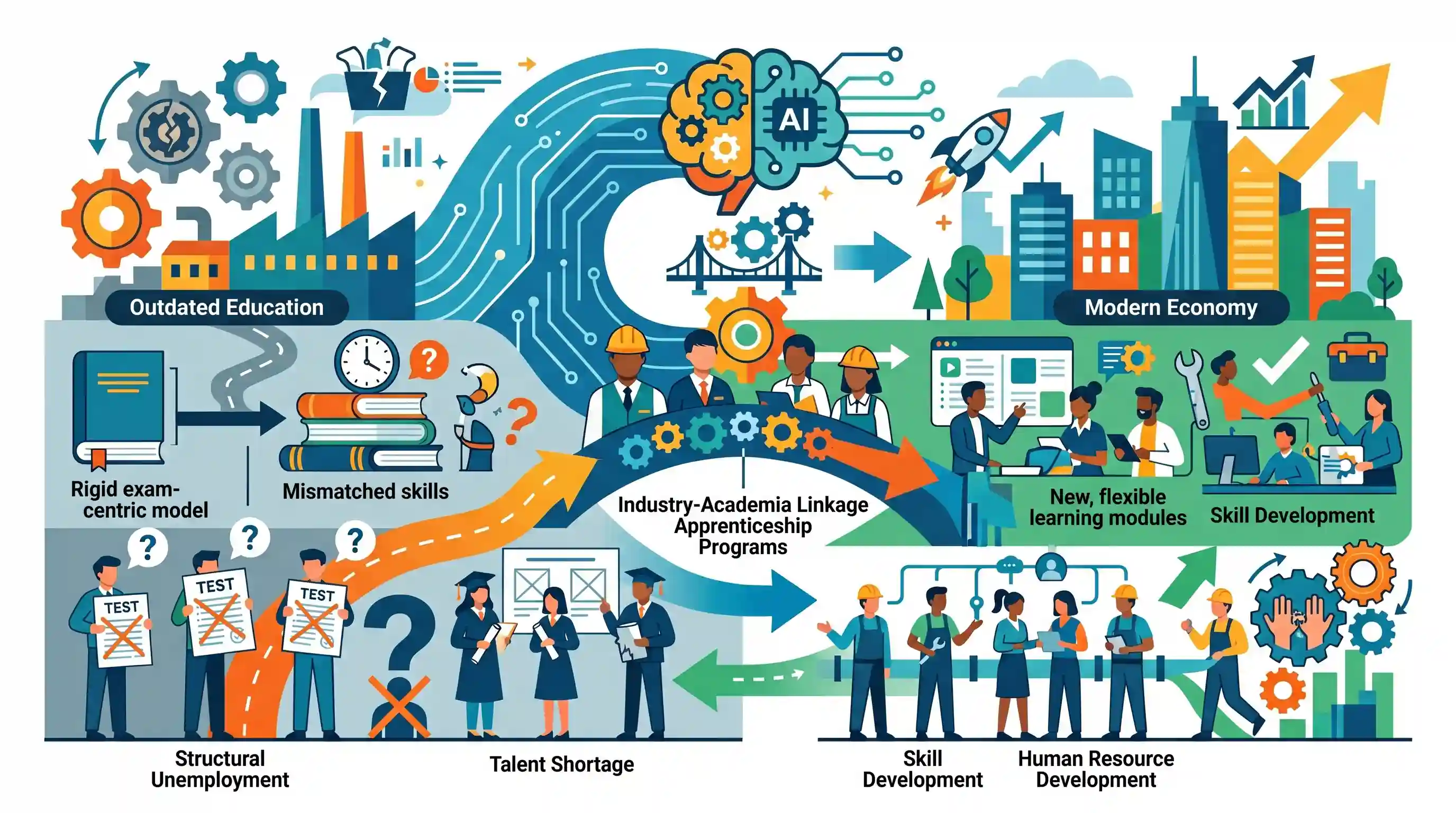
Experts at the Development Dialogue 2026 in Hubballi emphasized the urgent need to transition India's education system from rigid, exam-centric models to flexible, competency-based frameworks. They highlighted that rapid technological advancements, including AI, necessitate a focus on real-world readiness, adaptability, and skills. Key interventions discussed included expanding apprenticeship programs and bridging the gap between industry requirements and academic curricula to address the irony of talent shortage amidst student unemployment.
Key Points
- Education systems must shift from rigid, degree-centric models to flexible, competency-based frameworks to prepare students for an AI-driven future.
- There is a significant skill gap, particularly in rural areas, leading to a structural paradox where industries cannot find talent while graduates cannot find jobs.
- Expanding apprenticeship programmes and forging strong industry-academia linkages are essential to align workforce supply with market demand.
- Personalised and adaptive learning tools can democratise education and allow students to learn at their own pace.
- Teachers and universities must proactively nurture curiosity, critical thinking, and confidence to drive societal change.
Important Terms
Karnataka Skill Development Authority (KSDA)

The primary state-level agency in Karnataka tasked with implementing skill development policies and aligning the workforce with global industry standards through competency-based training.
UPSC context
GS II/III: Government policies for employment, skilling, and human capital development at the state level.
The Convergence Foundation
An influential philanthropic incubator that scales high-impact organizations to address systemic challenges in India's education, economic growth, and governance sectors.
UPSC context
GS II: Role of non-governmental organizations and philanthropy in socio-economic development.
Deshpande Foundation
A social entrepreneurship non-profit based in Hubballi that utilizes the "Sandbox" model to pilot and scale innovations in rural skilling, agriculture, and entrepreneurship.
UPSC context
GS II: Civil society initiatives and their impact on inclusive growth and education.
IIM Bangalore (IIMB)
An Institute of National Importance that provides management education and conducts policy-oriented research to improve India's business ecosystem and public governance.
UPSC context
GS II: Issues relating to development and management of the social sector/Education.
Prelims Trap
The paradox of graduates remaining unemployed while industries face talent shortages is an example of frictional unemployment.
This is structural unemployment. It arises from a fundamental mismatch between the skills workers possess and the skills industries require, not the time spent transitioning between jobs.
Static Concepts Connected
How does Structural Unemployment differ from other forms prevalent in India?
- Structural:: Arises from a mismatch between academic skills (supply) and changing industry requirements (demand).
- Frictional:: Temporary unemployment that occurs when workers are transitioning between jobs or entering the workforce.
- Disguised:: Prevalent in agriculture, where more people are employed than necessary for optimal production (marginal productivity is zero).
What are the key provisions for vocational education under NEP 2020?
- Integration:: Aims to seamlessly integrate vocational training into school and higher education curricula starting from Grade 6 (with internships).
- Target:: Set a concrete target for at least 50% of learners through the school and higher education system to have vocational exposure by 2025.
- Credit Framework:: Establishes a National Credit Framework to allow smooth credit transfers between academic and vocational streams.
Cross-Topic Patterns
Demographic Dividend vs. Disaster
The transition from degree-centric to competency-based education is the critical variable in determining whether India's youth bulge translates into a productive demographic dividend or a socio-economic demographic burden.
AI's Dual Impact on Labor & Education
While AI displaces routine cognitive jobs, its deployment in personalized, adaptive learning platforms offers a simultaneous solution to bridge India's rural-urban skill divide.

A GS3 mains question linking India's structural unemployment paradox with NEP 2020’s competency-based reforms is highly probable.
Linked PYQs · 3
Linked PYQs · 3
- 2023MainsGS2
Skill development programmes have succeeded in increasing human resources supply to various sectors. In the context of the statement analyse the linkages between education, skill and employment.
- 2021MainsGS2
“Earn while you learn' scheme needs to be strengthened to make vocational education and skill training meaningful.” Comment.
- 2023MainsGS3
Most of the unemployment in India is structural in nature. Examine the methodology adopted to compute unemployment in the country and suggest improvements.
