Union Education Ministry lauds Himachal Swad Sangam cuisine initiative
Source:crazynewsindia ↗
Why It Matters
The 'Ek Bharat Shreshtha Bharat' initiative frequently surfaces in exams in the context of state pairings and cultural exchange programs. Understanding state-specific cultural elements like regional cuisines (Dham, Siddu, Sadya) is also important for art and culture mapping questions in Prelims.
Summary
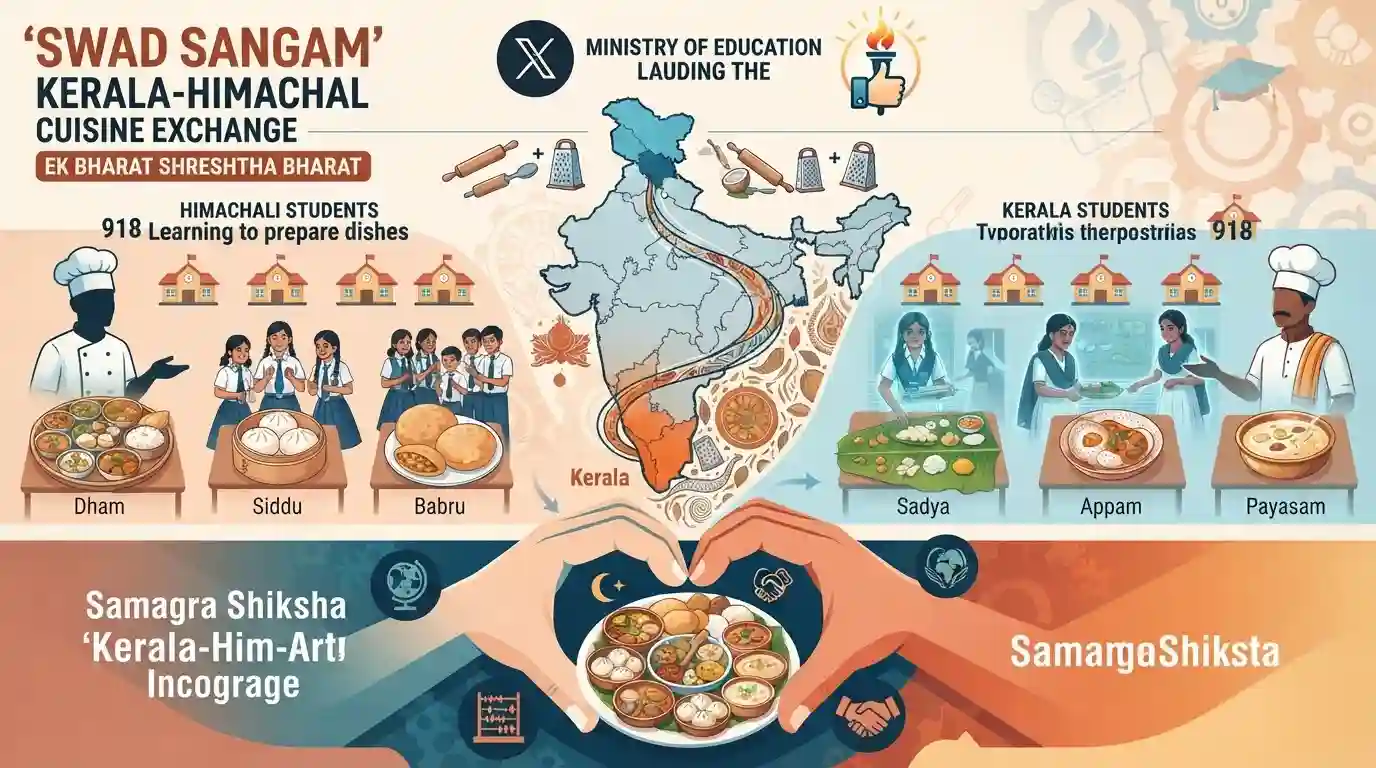
The Union Ministry of Education has lauded Himachal Pradesh's 'Swad Sangam' initiative, showcasing it on its official X handle. Organized under the 'Ek Bharat Shreshtha Bharat' scheme, the initiative featured a month-long Kerala-Himachal Cuisine Exchange program in 918 government schools across Himachal Pradesh. The program engaged approximately two lakh students who learned to prepare traditional regional dishes, such as Himachali Dham, Siddu, and Babru, as well as Kerala's Sadya, Appam, and Payasam. Organized by the Samagra Shiksha department, the initiative aims to promote cross-cultural awareness and national integration by pairing Himachal Pradesh with Kerala.
Key Points
- The Ministry of Education highlighted Himachal Pradesh's 'Swad Sangam' initiative on its official social media handle.
- 'Swad Sangam' was a month-long Kerala-Himachal Cuisine Exchange program conducted under the 'Ek Bharat Shreshtha Bharat' (EBSB) scheme.
- The program saw participation from around two lakh students across 918 government schools in Himachal Pradesh.
- Students prepared traditional delicacies from both states, including Himachali Dham, Siddu, and Babru, alongside Kerala's Sadya, Appam, and Payasam.
- The initiative aims to promote national integration and cultural understanding by pairing Himachal Pradesh with Kerala.
Important Terms
Ek Bharat Shreshtha Bharat

A flagship Union government initiative launched in 2015 to promote national integration and mutual understanding by pairing different Indian States and Union Territories for cultural, linguistic, educational, and culinary exchanges.
UPSC context
GS Paper II: Governance & Government Policies; tests flagship schemes promoting national unity and cultural diversity.
Samagra Shiksha
An integrated Centrally Sponsored Scheme launched in 2018 for school education extending from pre-school to Class 12, subsuming Sarva Shiksha Abhiyan, Rashtriya Madhyamik Shiksha Abhiyan, and Teacher Education.
UPSC context
GS Paper II: Social Justice & Education; tests knowledge of school education reforms and human resource development.
Ministry of Education
The nodal central ministry of India responsible for formulating and implementing national education policies, administering school literacy, and improving higher education standards.
UPSC context
GS Paper II: Executive & Ministries; tests governance structures, policy formulation, and major educational programs.
National Integration
The socio-political process of building a unified national identity, harmony, and mutual respect among diverse linguistic, cultural, regional, and religious communities.
UPSC context
GS Paper I: Indian Society; tests concepts of unity in diversity, communal harmony, and national cohesion.
Swad Sangam Initiative
A culinary exchange program in Himachal Pradesh government schools pairing local cuisine with Kerala's traditional dishes to promote cultural learning under the Ek Bharat Shreshtha Bharat scheme.
UPSC context
GS Paper I: Indian Culture & GS Paper II: Governance; tests innovative state-level practices for cross-cultural education.
Prelims Trap
"Ek Bharat Shreshtha Bharat is a flagship initiative of the Ministry of Culture."
Although EBSB focuses heavily on cultural exchange and heritage preservation, its designated Nodal Ministry is the Ministry of Education, not Culture.
Static Concepts Connected
What are the core components of the 'Ek Bharat Shreshtha Bharat' (EBSB) initiative?
- Launch Context: Announced in 2015 to mark Sardar Vallabhbhai Patel's 140th birth anniversary (Rashtriya Ekta Diwas).
- State Pairing: Pairs States/UTs annually to foster mutual understanding (e.g., Himachal Pradesh and Kerala).
- Sub-initiatives: Includes 'Bhasha Sangam' for 8th Schedule languages and 'Yuva Sangam' youth exchange based on 5 pillars (Paryatan, Parampara, Pragati, Prodyogik, Paraspar Sampark).
- Nodal Ministry: The Ministry of Education acts as the nodal coordinating ministry.
What does the Samagra Shiksha Scheme encompass?
- Umbrella Approach: A Centrally Sponsored Scheme launched in 2018 treating school education holistically, from pre-school up to Class 12.
- Subsumed Schemes: Subsumed three erstwhile schemes: Sarva Shiksha Abhiyan (SSA), Rashtriya Madhyamik Shiksha Abhiyan (RMSA), and Teacher Education (TE).
- SDG Alignment: Directly aligns with SDG-4, ensuring inclusive and equitable quality education and promoting lifelong learning opportunities.
Cross-Topic Patterns
Culinary Heritage and Pair-Matching
UPSC often tests regional crafts and cuisines. Specifics of HP's 'Dham' (sattvic, cooked in copper by hereditary 'Botis') could appear as a pair-matching question alongside intangible cultural heritage.
Education Infrastructure for Cultural Mandates
National integration initiatives are increasingly piggybacking on education infrastructure. Samagra Shiksha delivering EBSB mandates highlights a shift from pure academic literacy to holistic cultural soft-skills in schools.

Expect a Prelims question on EBSB sub-initiatives (Yuva Sangam, Bhasha Sangam) confusing its nodal Ministry of Education with Culture.
Linked PYQs · 1
Linked PYQs · 1
- 2023HPAS_PRELIMSGS1
Arrange the following schemes in chronological order from the year of launch : (1) Make in India (2) National Skill Development Mission (3) Startup India (4) Prime Minister's Employment Generation Programme Choose the correct answer from the options given below :
