Union Budget introduces education townships and digital content labs
Source:Indian Express ↗
Why It Matters
The budget's emphasis on Education Townships, digital content creation, and mental health directly targets the structural gaps in India's human capital development. It provides vital contemporary examples for Mains answers on the implementation of NEP 2020, skill-employment linkages, and the expansion of public healthcare systems beyond traditional physical health to include mental wellness.
Summary
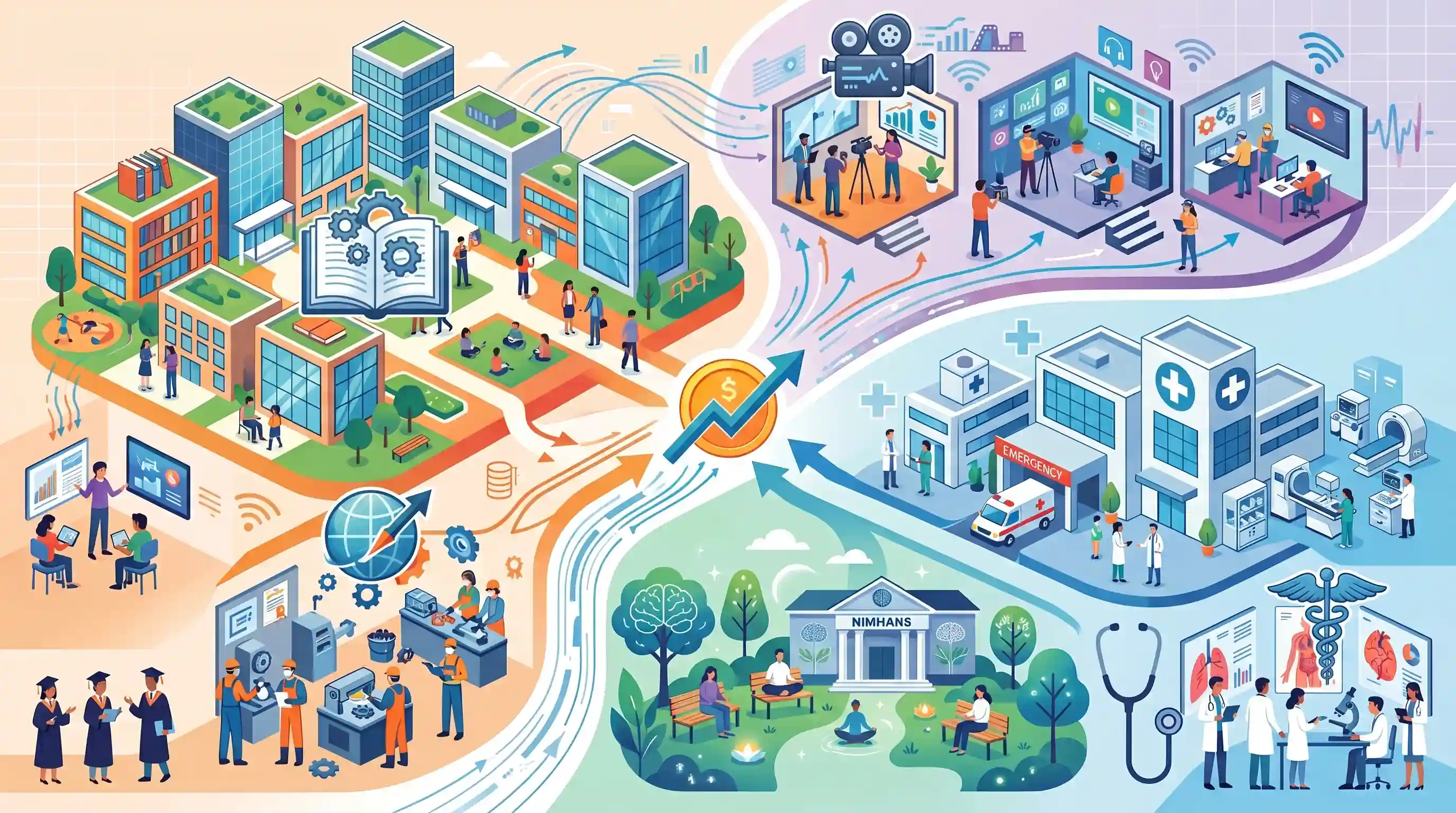
The Union Budget 2026-27 introduces strategic initiatives aimed at revamping India's education and public health sectors. Key highlights include the conceptualization of 'Education Townships' to create localized learning and skilling hubs, and the establishment of 'Content Creation Labs' to bolster digital education. In the healthcare domain, the budget places a significant emphasis on mental wellness and medical education, with enhanced support for institutions such as NIMHANS. These measures collectively align with broader goals of improving digital literacy, expanding vocational training, and strengthening primary and specialized healthcare infrastructure.
Key Points
- The Union Budget 2026-27 proposes the creation of 'Education Townships' to integrate academic institutions, skill centers, and industry.
- 'Content Creation Labs' are to be established to boost digital education, e-learning modules, and self-paced learning platforms.
- The budget features an enhanced focus on mental health infrastructure and medical education, involving key institutes like NIMHANS.
- Dedicated 'Skills Centres' aim to provide vocational training and bridge the gap between formal education and youth employment.
Important Terms
Education Townships

A planned integrated hub near industrial corridors combining universities, research centers, and skill institutes to bridge the academia-industry gap and enhance local employability.
UPSC context
GS Paper 2: Issues relating to Education and Human Resources; tests understanding of innovative urban-educational infrastructure.
National Education Policy (NEP) 2020
A 2020 framework aiming to revolutionize India's education system through multidisciplinarity, vocational integration, and a focus on 21st-century skills like digital literacy and critical thinking.
UPSC context
GS Paper 2: Government policies and interventions; fundamental for questions on educational reform and demographic dividend.
NIMHANS
India's premier multidisciplinary medical institution for mental health and neurosciences. Budget 2026-27 proposes a "NIMHANS-2" in North India to decentralize specialized psychiatric care.
UPSC context
GS Paper 2: Issues relating to Health; relevant for specialized healthcare infrastructure and mental health policy.
Content Creation Labs
Digital hubs planned for 15,000 schools and 500 colleges to provide vocational training in Animation, Visual Effects, Gaming, and Comics (AVGC) and social media content.
UPSC context
GS Paper 3: Employment and Human Resources; tests knowledge of skilling for the 'Orange Economy'.
AVGC Sector
A high-growth creative segment comprising Animation, Visual Effects, Gaming, and Comics; targeted by the government for large-scale youth employment and digital exports.
UPSC context
GS Paper 3: Indian Economy and mobilization of resources; relevant for sunrise industries and digital growth.
Union Budget 2026-27
The annual financial statement of the Government of India, outlining estimated receipts and expenditure; for 2026-27, it prioritizes social infrastructure and digital creativity.
UPSC context
GS Paper 3: Government Budgeting; core topic for fiscal policy and sectoral allocations.
Prelims Trap
"The 'Orange Economy' initiative in the Budget is designed to boost citrus fruit exports."
The 'Orange Economy' refers strictly to the creative and cultural industries, including AVGC (Animation, Visual Effects, Gaming, and Comics), not agriculture.
Static Concepts Connected
What are the core provisions of the Mental Healthcare Act, 2017?
- Decriminalizes suicide: Presumes severe stress for suicide attempt survivors, effectively restricting the application of IPC Section 309.
- Advance Directives: Grants individuals the legal right to specify in advance how they wish to be treated for mental illness.
- Rights-based approach: Ensures the right to access mental healthcare services from government funding without discrimination.
What is the 'Multiple Entry and Exit' system under NEP 2020?
- Academic Bank of Credits: Digitally stores academic credits earned from recognized HEIs, enabling seamless transitions between institutions.
- Flexible certification: Offers a certificate after 1 year, a diploma after 2 years, and a bachelor's degree after 3-4 years.
Cross-Topic Patterns
Tele-MANAS to physical infrastructure
The push for NIMHANS-2 and regional apex institutes physicalizes the mental health expansion that started digitally with Tele-MANAS in the 2022-23 Budget.
Orange Economy & AVGC Task Force
The focus on Content Creation Labs directly executes the I&B Ministry's AVGC Task Force recommendations, aiming to capture global market share in the creative sector.

Expect a multi-statement Prelims question linking 'Orange Economy' to AVGC skilling, or a matching pair on regional mental health centers.
Linked PYQs · 5
Linked PYQs · 5
- 2023MainsGS2
Skill development programmes have succeeded in increasing human resources supply to various sectors. In the context of the statement analyse the linkages between education, skill and employment.
- 2021MainsGS2
“Earn while you learn' scheme needs to be strengthened to make vocational education and skill training meaningful.” Comment.
- 2021MainsGS2
Has digital illiteracy, particularly in rural areas, coupled with lack of Information and Communication Technology (ICT) accessibility hindered socio-economic development? Examine with justification.
- 2021MainsGS2
“Besides being a moral imperative of a Welfare State, primary health structure is a necessary precondition for sustainable development.” Analyze.
- 2024MainsGS2
In a crucial domain like the public healthcare system the Indian State should play a vital role to contain the adverse impact of marketisation of the system. Suggest some measures through which the State can enhance the reach of public healthcare at the grassroots level.
