Budget 2026 Education and Skilling Reforms for Human Capital Growth
Source:The Hindu ↗
Why It Matters
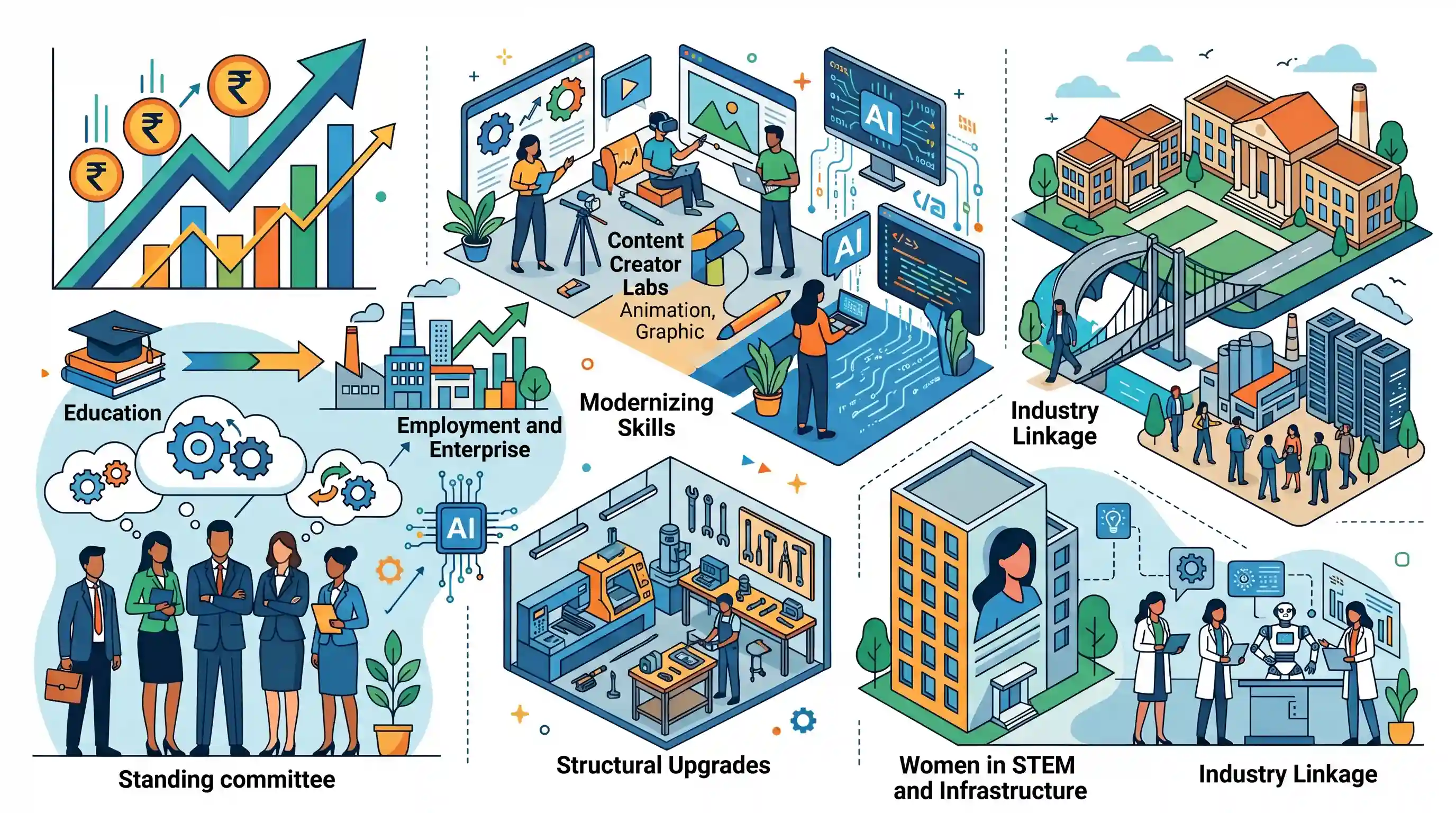
Bridging the education-to-employment gap is vital for India to capitalize on its demographic dividend. The Budget's focus on aligning curricula with emerging sectors like AI and AVGC, paired with massive investments in ITI upgrades and STEM infrastructure, outlines the government's strategy for modernizing human capital for the 21st-century economy.
Summary
The Union Budget 2026-27 provides a significant boost to education and skilling, increasing the Education Ministry's allocation by 14.21% to ₹1.39 lakh crore. A central theme is bridging the gap between education and employment, evidenced by the formation of a high-power standing committee mandated to evaluate 'Education to Employment and Enterprise' pathways and assess AI's impact on jobs. The budget emphasizes modernizing the workforce for a services-led economy by integrating AI into curricula and establishing Content Creator Labs for the AVGC sector. Furthermore, structural initiatives like the PM SETU scheme for upgrading ITIs, girls' hostels for STEM promotion, and university townships near industrial corridors aim to cultivate a diverse, industry-ready talent pool.
Key Points
- The Ministry of Education's budget allocation saw a 14.21% increase, reaching ₹1.39 lakh crore for 2026-27.
- A high-powered 'Education to Employment and Enterprise' Standing Committee will be established to focus on aligning education with the services sector and assessing AI's impact on the workforce.
- The budget pushes for integrating AI into educational curricula and upskilling/reskilling engineers in AI.
- To promote women in STEM, the government plans to set up a girls' hostel in each district.
- The PM SETU scheme forms a major component of the Ministry of Skill Development's ₹9,885.80 crore budget, aimed at upgrading ITIs.
- Content Creator Labs will be established in 15,000 schools and 500 colleges to support the AVGC (Animation, Visual Effects, Gaming, and Comics) sector.
- Five university townships are proposed near major industrial and logistics corridors to enhance industry-academia linkages.
Important Terms
PM SETU (Skilling and Employability Transformation through Upgraded ITIs)

A centrally sponsored scheme aimed at modernizing 1,000 government ITIs into industry-aligned 'Centres of Excellence' using a hub-and-spoke model to enhance vocational training and employability.
UPSC context
GS Paper 2 & 3: Human Resource Development and Employment. Tests knowledge of vocational training reforms and industry-academia linkage.
Samagra Shiksha
An overarching, integrated school education program (Pre-school to Class XII) that subsumes earlier schemes like SSA and RMSA to ensure inclusive, equitable, and quality learning.
UPSC context
GS Paper 2: Education and Social Justice. Crucial for understanding implementation of RTE (Art 21A) and Sustainable Development Goal 4.
PM Poshan
Formerly the Mid-Day Meal Scheme, this centrally sponsored initiative provides hot cooked meals to students (Classes I-VIII) in government schools to improve nutrition and enrollment.
UPSC context
GS Paper 2: Health, Hunger, and Education. Tests understanding of welfare schemes addressing malnutrition and classroom hunger.
Atal Tinkering Labs
Innovation workspaces in schools established under the Atal Innovation Mission (NITI Aayog) to foster curiosity, creativity, and STEM skills through hands-on learning and prototyping.
UPSC context
GS Paper 3: Science & Technology and Innovation. Tests strategies for building a scientific temper and entrepreneurial mindset from childhood.
Ministry of Education
The central ministry responsible for formulating the National Policy on Education and overseeing school, literacy, and higher education across India.
UPSC context
GS Paper 2: Governance. Fundamental for analyzing the administrative framework and policy shifts in India's education sector.
Ministry of Skill Development and Entrepreneurship
The nodal ministry for coordinating all skill development efforts across the country, aiming to bridge the supply-demand gap in the labor market.
UPSC context
GS Paper 3: Employment and Economic Development. Key to discussing India's demographic dividend and workforce productivity.
National Institute of Design
Premier autonomous design institutions under the Ministry of Commerce and Industry, with new centers proposed to support the creative economy and industrial design.
UPSC context
GS Paper 3: Industrial Growth and Employment. Relevant to the "Orange Economy" and high-value manufacturing services.
Kendriya Vidyalaya Sangathan
An autonomous body under the Ministry of Education that manages a system of central schools providing quality education to children of transferable central government employees.
UPSC context
GS Paper 2: Education Policies. Exemplifies a standardized, pan-India model for quality school education and social integration.
Prelims Trap
PM SETU is a Ministry of Education scheme designed to provide bridging courses for school dropouts.
PM SETU (Skilling and Employability Transformation through Upgraded ITIs) is under the Ministry of Skill Development, focusing on modernizing ITI infrastructure, not bridging school dropouts.
Static Concepts Connected
What links education, skilling, and India's Demographic Dividend?
- Dependency Ratio: A falling dependent-to-working-age ratio offers immense economic growth potential only if the workforce is highly employable.
- Employability Gap: Without relevant market skills (like AI/AVGC), the youth bulge leads to unemployment, turning the dividend into a 'demographic disaster'.
- Structural Shift: Moving surplus agricultural labor to productive services or manufacturing requires robust vocational training infrastructure like ITIs.
What is the "Leaky Pipeline" phenomenon in STEM?
- The Concept: The progressive loss of women at every step of the STEM career ladder, from primary education to leadership roles.
- Root Causes: Driven by lack of safe infrastructure (addressed by district girls' hostels), societal biases, and the dual burden of domestic responsibilities.
- Policy Interventions: Schemes like KIRAN, Vigyan Jyoti, and targeted budget allocations for hostels aim to plug these systemic leaks.
Cross-Topic Patterns
Geography meets Human Capital
Linking university townships to industrial/logistics corridors integrates economic geography with human resource development, mirroring cluster-based development models seen in PM Gati Shakti.
AVGC + Cultural Soft Power
Content Creator Labs tie into India's push to leverage the Animation, Visual Effects, Gaming, and Comics (AVGC) sector as a modern tool for cultural soft power and service-export growth.

GS3 Mains 2026 will likely test the 'education-to-employment' gap, specifically linking AI disruption in services with ITI modernization.
Linked PYQs · 5
Linked PYQs · 5
- 2023MainsGS2
Skill development programmes have succeeded in increasing human resources supply to various sectors. In the context of the statement analyse the linkages between education, skill and employment.
- 2021MainsGS2
“Earn while you learn' scheme needs to be strengthened to make vocational education and skill training meaningful.” Comment.
- 2023MainsGS2
The crucial aspect of development process has been the inadequate attention paid to Human Resource Development in India. Suggest measures that can address this inadequacy.
- 2023MainsGS3
Introduce the concept of Artificial Intelligence (AI). How does Al help clinical diagnosis? Do you perceive any threat to privacy of the individual in the use of Al in healthcare?
- 2024MainsGS1
Distinguish between gender equality, gender equity and women's empowerment. Why is it important to take gender concerns into account in programme design and implementation?
