Government announces five university townships and hostels
Source:Indian Express ↗
Why It Matters
These policy announcements highlight the dual approach to educational reform: upgrading qualitative infrastructure (university townships for global competitiveness) and ensuring inclusive access (girls' hostels to ensure gender parity). This is crucial for GS Paper 2 (issues relating to education and women's empowerment).
Summary
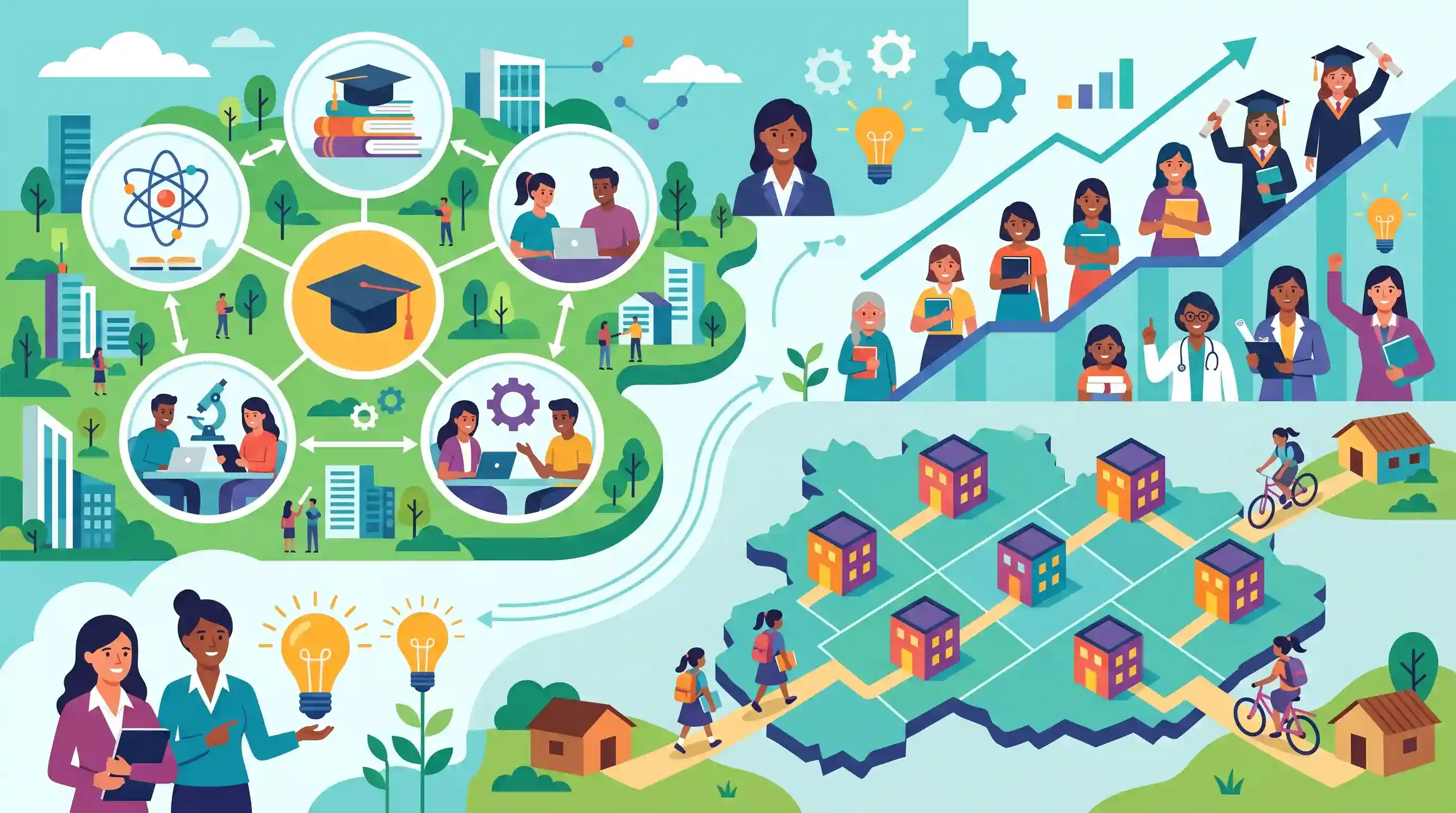
Major educational infrastructure announcements have been made, highlighted by the planned development of five new 'university townships' and the construction of girls' hostels in every district. The university townships are designed to act as integrated academic and research ecosystems, improving the quality and cluster-effect of higher education. Concurrently, the district-level girls' hostels initiative seeks to eliminate geographical and safety barriers, aiming to significantly reduce female dropout rates and improve women's Gross Enrolment Ratio (GER) across the country or state.
Key Points
- The announcement involves the establishment of 5 integrated university townships to create centralized hubs for higher education, research, and skill development.
- To address female dropout rates and safety concerns, the government announced the construction of at least one girls' hostel in every district.
- These initiatives are structurally aimed at boosting the Gross Enrolment Ratio (GER) and bridging the gender gap in secondary and higher education.
- The decentralization of residential infrastructure for girls directly tackles the geographical barriers that typically hinder women's educational mobility in rural and semi-urban areas.
Important Terms
University Townships

Integrated academic and research ecosystems located near industrial corridors, hosting multiple institutions, skill centers, and residential facilities to align higher education with economic hubs.
UPSC context
GS II (Education) & GS III (Industrial Growth); tests knowledge of industry-academia linkages and urban-academic infrastructure models.
Gross Enrolment Ratio (GER)
A statistical measure representing the percentage of students enrolled in a specific level of education relative to the official school-age population for that level.
UPSC context
GS II (Social Justice/Education); crucial for tracking NEP 2020 targets and gender parity in higher education.
Viability Gap Funding (VGF)
A one-time grant provided by the government to support infrastructure projects that are economically justified but lack financial viability for private or public entities.
UPSC context
GS III (Investment Models/Infrastructure); relevant for Public-Private Partnership (PPP) frameworks and financing social infrastructure.
STEM Education
An interdisciplinary curriculum focusing on Science, Technology, Engineering, and Mathematics, often targeted by policy interventions to improve female participation and research outcomes.
UPSC context
GS II (Women Empowerment) & GS III (S&T); tests strategies to bridge the gender gap in technical fields.
Challenge Route
A competitive selection mechanism where states compete for central government projects/funding by proposing best land-use policies and matching infrastructure.
UPSC context
GS II (Federalism/Governance); tests understanding of competitive federalism and efficient resource allocation between Centre and States.
Ministry of Education
The central nodal ministry responsible for formulating and implementing national policies on education, overseeing school, higher, and technical education.
UPSC context
GS II (Government Policies); primary authority for educational reforms and institutional framework in India.
Prelims Trap
"The 5 university townships will be established as fully funded Central Universities."
The Centre will assist states via a competitive "challenge route." They are state-led infrastructure projects with central support, not directly established Central Universities.
Static Concepts Connected
How is Gross Enrolment Ratio (GER) for higher education calculated?
- The Formula: Calculated as the total enrolment in higher education as a percentage of the eligible official population in the 18-23 years age group.
- NEP 2020 Target: The National Education Policy (NEP) 2020 aims to increase the GER in higher education, including vocational education, to 50% by 2035.
- Gender Trend: According to recent All India Survey on Higher Education (AISHE) data, female GER has been rising, narrowing the historical gender gap.
What is the 'Challenge Route' in cooperative federalism?
- Mechanism: A competitive funding model where states or local bodies compete for central grants by submitting innovative, metric-driven proposals rather than receiving flat allocations.
- Past Examples: Previously utilized effectively by the Union Government in the Smart Cities Mission and for establishing bulk drug and medical device parks.
Cross-Topic Patterns
Education + Industrial Corridors
Situating university townships near major industrial and logistics corridors attempts to solve India's structural employability crisis by clustering academia directly with applied industry needs.
Spatial barriers to female GER
District-level hostels directly address the geographical and safety constraints in rural areas that cause a sharp drop in female transition rates from secondary to tertiary education.

Expect a multi-statement question linking NEP 2020 GER targets with the competitive 'challenge route' funding for university townships.
Linked PYQs · 4
Linked PYQs · 4
- 2015MainsGS2
The quality of higher education in India requires major improvements to make it internationally competitive. Do you think that the entry of foreign educational institutions would help improve the quality of higher and technical education in the country? Discuss.
- 2021MainsGS2
“Though women in post-Independent India have excelled in various fields, the social attitude towards women and feminist movement has been patriarchal." Apart from women education and women empowerment schemes, what interventions can help change this milieu?
- 2023MainsGS2
Skill development programmes have succeeded in increasing human resources supply to various sectors. In the context of the statement analyse the linkages between education, skill and employment.
- 2017PrelimsGS1
Which of the following gives 'Global Gender Gap Index' ranking to the countries of the world?
