Uttarakhand Plans Hostels in Tribal Areas for Education Access
Why It Matters
Crucial for understanding state-level welfare initiatives targeted at marginalized and tribal populations in hill states like Uttarakhand.
Summary
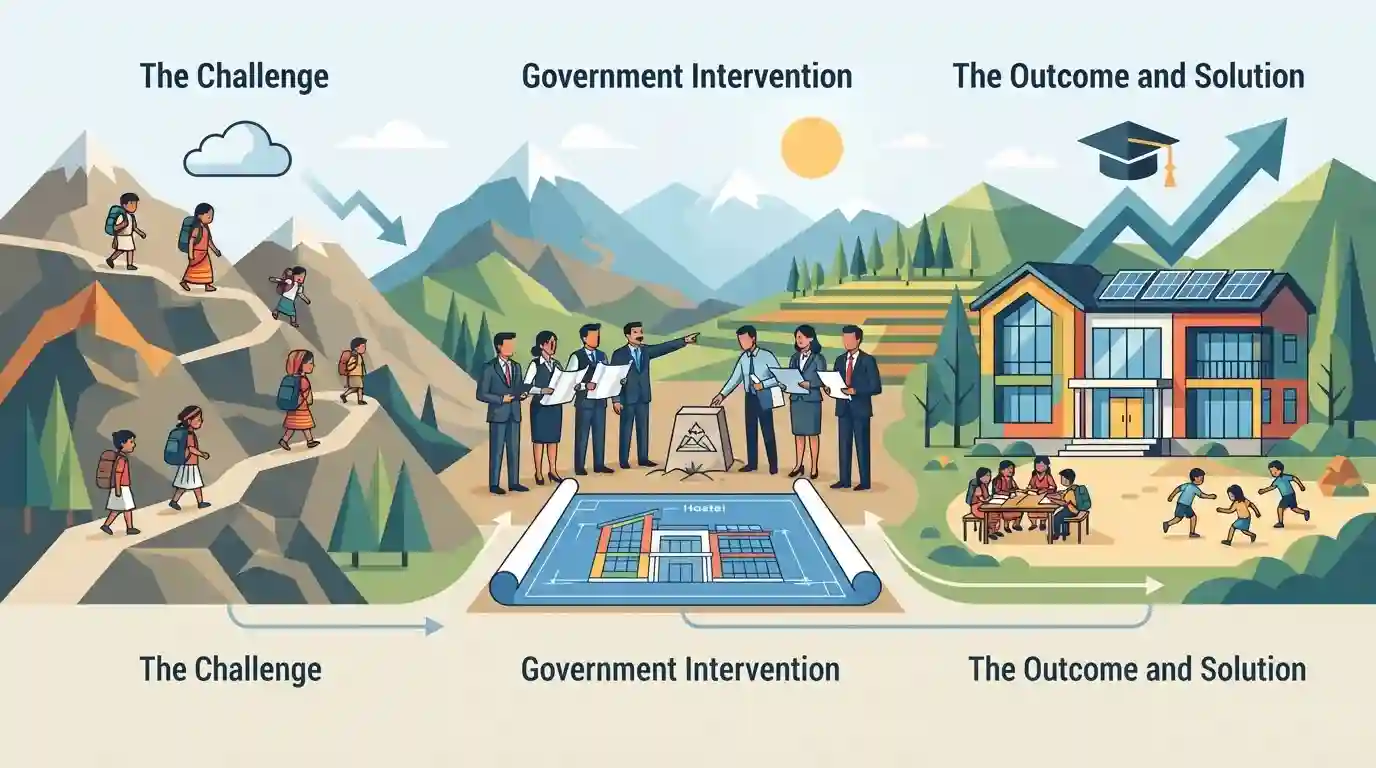
The Uttarakhand Education Department has announced plans to construct hostels in tribal-dominant areas of the state to enhance educational opportunities and reduce dropout rates among tribal youth living in remote terrains.
Key Points
- The Uttarakhand Education Department is planning to build dedicated hostels in tribal regions to improve educational access and retention among tribal students.
- The initiative aims to bridge educational disparities in remote and hilly tribal pockets of the state.
- Focus is given to marginalized communities to enhance literacy rates and support continuous schooling.
Important Terms
Dharti Aaba Tribal Village Excellence campaign

A central campaign aimed at inclusive development and saturation of basic infrastructure, including residential hostels, in over 63,000 tribal-majority villages across India.
UPSC context
UPSC/UKPSC Mains: Government Policies & Interventions, Vulnerable Sections (Scheduled Tribes welfare and rural development schemes).
Eklavya Model Residential Schools (EMRS)
Fully residential, co-educational schools established by the Ministry of Tribal Affairs to provide free quality education, boarding, and lodging to tribal students from Class VI to XII.
UPSC context
UKPSC/UPSC Prelims & Mains: Education Infrastructure and Welfare Schemes for Scheduled Tribes.
Ashram Paddhati Schools
State-managed residential educational institutions providing free tuition, boarding, and lodging facilities to economically disadvantaged children belonging to Scheduled Castes and Scheduled Tribes.
UPSC context
UKPSC Prelims/Mains: Uttarakhand Social Welfare schemes and educational infrastructure for vulnerable groups.
Prelims Trap
All residential facilities for tribal students in Uttarakhand are funded exclusively through the state budget under EMRS.
Aspirants often confuse Eklavya Model Residential Schools (EMRS), which are fully funded Central schemes, with state-specific hostels funded under campaigns like the Dharti Aaba Tribal Village Excellence campaign.
Static Concepts Connected
What are the key provisions and objectives of the Eklavya Model Residential Schools (EMRS) scheme in India?
- Primary Objective: Established to provide quality upper primary, secondary, and senior secondary education to ST students in remote areas.
- Skill Focus: Targeted at enabling students to access higher professional courses and get employment in various sectors.
- Demographic Criteria: Mandates setting up residential schools in blocks with more than 50% ST population and 20,000 tribal persons.
Which are the major Particularly Vulnerable Tribal Groups (PVTGs) and scheduled tribes found in Uttarakhand?
- Major Tribes: Includes Bhotia, Jaunsari, Tharu, Buxa, and Raji (the sole PVTG in the state).
- Raji Tribe Context: Raji community is primarily located in Pithoragarh and Champawat districts, practicing pastoralism and foraging traditionally.
- Bhotia Distribution: Bhotia community traditionally resides in high-altitude Himalayan border valleys like Chamoli, Pithoragarh, and Uttarkashi.
Cross-Topic Patterns
Tribal Welfare Schemes + Centre-State Fiscal Coordination
The convergence of PM-JUGAY and EMRS highlights how centrally sponsored schemes intersect with state-level tribal welfare mandates in Himalayan terrain.
Border Area Development + Tribal Education Infrastructure
Educational interventions in high-altitude border districts like Chamoli and Pithoragarh serve dual purposes of tribal empowerment and strategic border area development.

Expect a statement-based question linking PM-JUGAY, EMRS, and specific Uttarakhand tribal groups like Bhotia and Raji.
Linked PYQs · 2
Linked PYQs · 2
- 2024UKPSC_PRELIMSGS1
Who among the following was the Human Resource Development/Education Minister from Uttarakhand in Central Government in the year 2019 ?
- 2024UKPSC_PRELIMSGS1
On the basis of NFHS 2019-21 survey, the Multidimensional poverty in Uttarakhand in 2019-21 was
