Enforcement Directorate scrutiny of insolvency and bankruptcy code
Source:The Hindu ↗
આ શા માટે મહત્વનું છે
This topic is crucial for GS3 as it bridges corporate insolvency law (IBC) with financial crime enforcement (PMLA), shedding light on regulatory loopholes, asset recovery challenges, and the broader health of India's banking and credit ecosystem.
સારાંશ
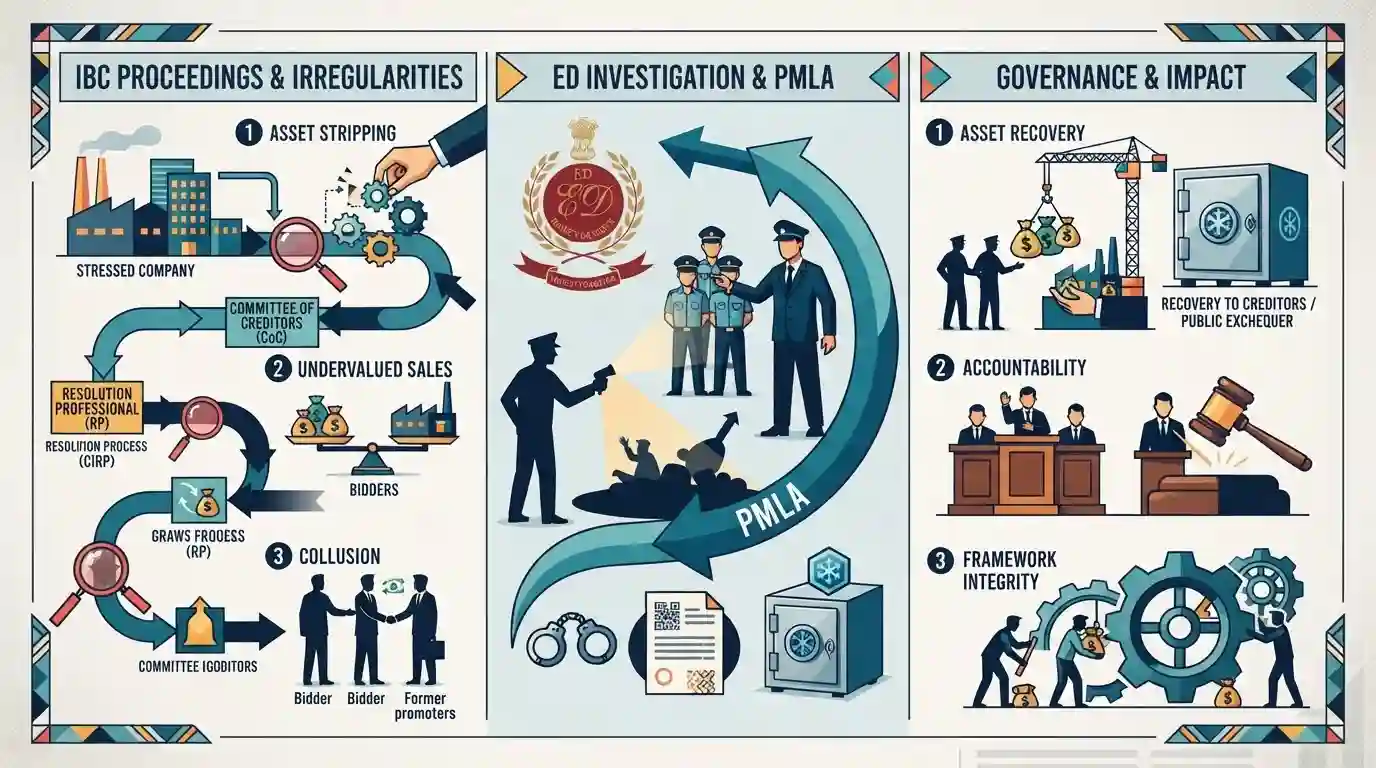
The article examines the Enforcement Directorate's (ED) widening investigation into potential fraudulent practices and financial irregularities within Insolvency and Bankruptcy Code (IBC) proceedings. It highlights how the PMLA is being invoked in cases involving distressed asset stripping, undervalued sales, and collusion during Corporate Insolvency Resolution Processes (CIRP), raising critical governance questions about accountability, asset recovery, and the integrity of India's insolvency framework.
મુખ્ય મુદ્દા
- The Enforcement Directorate (ED) has expanded its scrutiny into potential irregularities, fraud, and money laundering within Insolvency and Bankruptcy Code (IBC) proceedings.
- Investigations look into questionable asset valuations, collusion among resolution applicants, and undervalued sales of corporate debtor assets during Corporate Insolvency Resolution Processes (CIRP).
- The intersection of the IBC and the Prevention of Money Laundering Act (PMLA) highlights challenges in balancing swift corporate resolution with penal accountability for financial fraud.
- Regulatory bodies like the IBBI and adjudicating authorities like the NCLT are tightening oversight to prevent misuse of resolution mechanisms by defaulting promoters or malfeasant actors.
મહત્વપૂર્ણ શબ્દો
Insolvency and Bankruptcy Code (IBC)

A comprehensive legal framework enacted in 2016 to consolidate and amend laws relating to reorganisation and insolvency resolution of corporate persons, partnership firms, and individuals in a time-bound manner.
UPSC context
GS Paper III (Indian Economy - Growth, Development, and Mobilization of Resources). Tests understanding of credit discipline, bad loan resolution, and corporate governance.
Prevention of Money Laundering Act (PMLA)
A criminal statute enacted to prevent money laundering and to provide for the confiscation of property derived from, or involved in, money laundering and related matters.
UPSC context
GS Paper III (Internal Security, Money Laundering). Tests knowledge of legal mechanisms against financial crimes and asset attachment powers.
Enforcement Directorate (ED)
A specialized law enforcement agency under the Ministry of Finance, Government of India, responsible for enforcing economic laws and investigating financial crimes, including money laundering and foreign exchange violations.
UPSC context
GS Paper II/III (Polity - Statutory Bodies / Internal Security). Tests awareness of investigative agencies and regulatory jurisdictions.
National Company Law Tribunal (NCLT)
A quasi-judicial body adjudicating corporate disputes and insolvency proceedings in India, acting as the Adjudicating Authority for corporate insolvency under the IBC.
UPSC context
GS Paper II/III (Governance - Tribunals and Institutional Frameworks). Tests understanding of commercial dispute resolution mechanisms.
Insolvency and Bankruptcy Board of India (IBBI)
A statutory regulator established under the IBC to regulate professionals, agencies, and insolvency resolution processes, ensuring effective implementation of the Code.
UPSC context
GS Paper III (Indian Economy - Regulatory Frameworks). Tests knowledge of institutional regulators overseeing corporate insolvency and financial discipline.
પ્રિલિમ્સ ટ્રેપ
The IBC moratorium under Section 14 completely bars the Enforcement Directorate from attaching corporate debtor assets during a CIRP.
The IBC moratorium under Section 14 suspends civil proceedings and debt recovery actions, but judicial precedents clarify it does not shield proceeds of crime from PMLA attachment or criminal investigation.
સંલગ્ન સ્થિર ખ્યાલો
What are the key institutional pillars and adjudication levels under the Insolvency and Bankruptcy Code (IBC), 2016?
- IBBI Oversight:: Regulator setup under IBC to oversee insolvency professionals, agencies, and information utilities.
- NCLT Role:: Adjudicating authority for corporate persons (companies and LLPs) handling CIRP and liquidation.
- NCLAT Appeal:: Appellate tribunal for orders passed by the National Company Law Tribunal under the IBC.
What is the legal relationship between the Prevention of Money Laundering Act (PMLA) and the IBC regarding proceeds of crime?
- Supreme Court Precedent:: Supreme Court held that PMLA provisions regarding attachment of crime proceeds override civil or commercial recovery mechanisms when criminal elements exist.
- Clean Slate Limits:: Successful resolution applicants cannot use the 'clean slate' principle under Section 31 of IBC to evade pre-existing criminal liabilities investigated by the ED.
આંતર-વિષય પેટર્ન
PMLA vs. IBC: Jurisdictional Friction
The interplay between criminal asset attachment under PMLA and commercial resolution under IBC frequently creates jurisdictional friction, testing the primacy of economic legislation versus penal statutes.
CIRP Haircuts and Banking Sector Health
Distressed asset stripping and excessive haircuts during CIRP directly impair banking health, tying corporate insolvency outcomes directly to NPA resolution and fiscal stability.

IBC + PMLA intersection on asset attachment and clean slate doctrine will feature in Mains GS-3 or Prelims statutory body roles.
સંલગ્ન PYQ · 1
સંલગ્ન PYQ · 1
- 2021MainsGS3
Discuss how emerging technologies and globalisation contribute to money laundering. Elaborate measures to tackle the problem of money laundering both at national and international levels.
