Medical College Bribery Scandal and Regulatory Flaws
Source:Indian Express ↗
Why It Matters
The integrity of medical education regulation is critical for maintaining healthcare standards in India. This massive corruption scandal exposes vulnerabilities in bodies like the NMC and highlights the importance of institutional autonomy, transparency, and the effective functioning of investigative agencies like the CBI and ED.
Summary
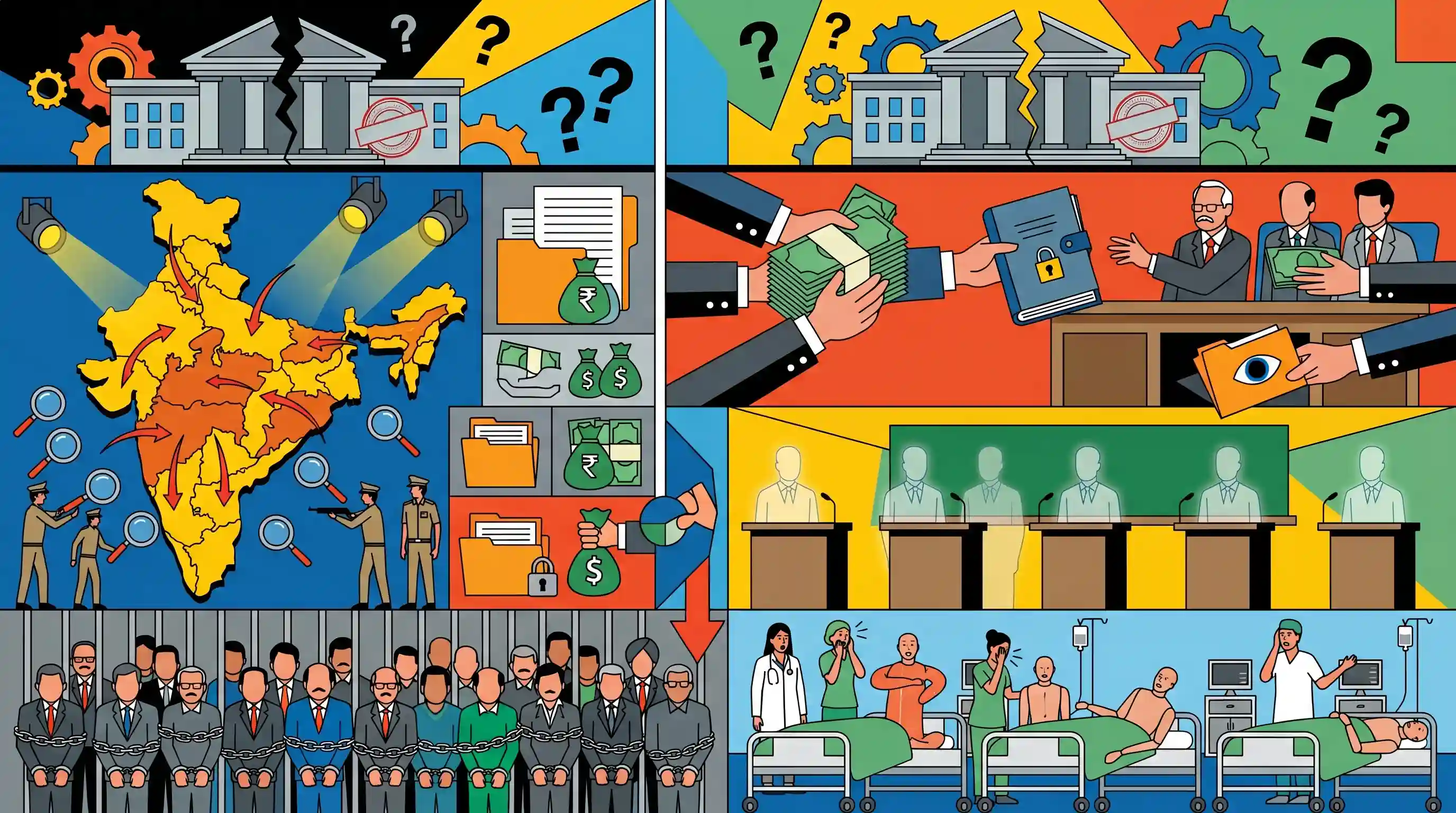
The Enforcement Directorate (ED) has conducted extensive raids across 10 states in connection with a major bribery and corruption scandal involving the regulatory framework for medical colleges. Based on a prior CBI FIR, the investigation targets 36 individuals, including the former UGC chairman, Union Health Ministry officials, and members of the National Medical Commission (NMC). The accused allegedly engaged in the unauthorized sharing of classified inspection information and accepted bribes to approve private medical colleges that employed fraudulent practices, such as ghost faculty and dummy patients. The ongoing probe underscores significant issues of regulatory capture and lack of accountability within India's medical education sector.
Key Points
- The ED launched coordinated raids across 10 states investigating a massive bribery scandal involving the regulatory approval of private medical colleges.
- The probe stems from a CBI FIR against 36 individuals, including former UGC Chairman D P Singh, Union Health Ministry officials, and National Medical Commission (NMC) members.
- Officials allegedly leaked confidential inspection files and accepted bribes via hawala channels to approve medical colleges with fraudulent infrastructure, such as ghost faculty and fictitious patients.
- The case highlights severe regulatory capture and corruption vulnerabilities within India's medical education governance framework.
Important Terms
National Medical Commission (NMC)

The apex regulatory body for medical education and professionals in India, established under the NMC Act 2019 to replace the corruption-tainted Medical Council of India (MCI).
UPSC context
GS Paper II: Health Governance and Statutory Bodies; crucial for understanding reforms in professional education and regulatory oversight.
Medical Assessment and Rating Board (MARB)
An autonomous board under the NMC responsible for inspecting, assessing, and rating medical colleges, and granting permissions for new institutions or seat increases.
UPSC context
GS Paper II: Transparency in governance; relevant to corruption and accountability within specialized regulatory frameworks.
Enforcement Directorate (ED)
A specialized financial investigation agency under the Ministry of Finance that enforces the Prevention of Money Laundering Act (PMLA) and Foreign Exchange Management Act (FEMA).
UPSC context
GS Paper II & III: Statutory bodies and Internal Security; essential for topics on money laundering and federal investigative powers.
Central Bureau of Investigation (CBI)
India's premier federal investigating agency, functioning under the DSPE Act, 1946. it probes high-profile corruption, economic crimes, and serious conventional offenses.
UPSC context
GS Paper II: Non-constitutional bodies and federalism; tests knowledge of anti-corruption mechanisms and state consent requirements.
University Grants Commission (UGC)
A statutory body under the Ministry of Education tasked with coordinating, determining, and maintaining standards of university education and disbursing grants to higher education institutions.
UPSC context
GS Paper II: Issues relating to Education; central to the governance and financing of India's higher education system.
Prelims Trap
"The Enforcement Directorate (ED) can take suo motu cognizance and initiate a money laundering probe into corruption allegations."
The ED cannot initiate a PMLA investigation on its own. It absolutely requires a 'predicate offence' (a scheduled offence) to be registered first by another agency like the CBI or state police.
Static Concepts Connected
What is the structural framework and mandate of the National Medical Commission (NMC)?
- Autonomous Boards: NMC consists of four autonomous boards, including the Medical Assessment and Rating Board (MARB) which conducts inspections and grants permission for new medical colleges.
- MCI Replacement: Established under the NMC Act 2019 to replace the Medical Council of India (MCI), specifically to address chronic regulatory failures and corruption.
- Regulatory Mandate: Enforces Minimum Standard Requirements (MSR) for medical colleges to curb infrastructure frauds like ghost faculty and dummy patients.
What are the foundational conditions for an Enforcement Directorate (ED) investigation under PMLA?
- Predicate Offence: ED requires a pre-existing FIR for a 'scheduled offence' (e.g., under the Prevention of Corruption Act) by another agency to invoke the Prevention of Money Laundering Act.
- Proceeds of Crime: PMLA focuses on the process of projecting tainted money or property as untainted, rather than investigating the core crime itself.
- Attachment Powers: The ED possesses the power to provisionally attach properties suspected to be derived from criminal activities during the investigation.
Cross-Topic Patterns
Regulatory capture in healthcare governance
The transition from MCI to NMC aimed to fix institutional rot, yet systemic corruption persists. This exemplifies 'regulatory capture', where watchdogs serve private interests—a recurring GS-2 Governance and GS-4 Ethics theme.
CBI's PCA FIR as ED's trigger
The ED's money laundering probe relies entirely on the CBI's initial FIR under the Prevention of Corruption Act, perfectly illustrating the 'predicate offence' inter-agency dependency required under PMLA.

Expect Prelims statements on the mandate of NMC's autonomous boards (like MARB) or ED's strict requirement for a 'predicate offence'.
Linked PYQs · 4
Linked PYQs · 4
- 2015MainsGS2
For achieving the desired objectives, it is necessary to ensure that the regulatory institutions remain independent and autonomous. Discuss in the light of the experiences in recent past.
- 2024MainsGS2
In a crucial domain like the public healthcare system the Indian State should play a vital role to contain the adverse impact of marketisation of the system. Suggest some measures through which the State can enhance the reach of public healthcare at the grassroots level.
- 2021MainsGS2
The jurisdiction of the Central Bureau of Investigation (CBI) regarding lodging an FIR and conducting probe within a particular State is being questioned by various States. However, the power of the States to withhold consent to the CBI is not absolute. Explain with special reference to the federal character of India.
- 2025MainsGS2
Discuss the 'corrupt practices' for the purpose of the Representation of the People Act, 1951. Analyze whether the increase in the assets of the legislators and/or their associates, disproportionate to their known sources of income, would constitute 'undue influence' and consequently a corrupt practice.
