Public sector bank loan fraud and PMLA investigation mechanisms
Source:The Hindu ↗
Why It Matters
Highlights the ongoing vulnerability of public sector banks to large-scale corporate fraud using trade finance instruments like Letters of Credit. It also underscores the critical role of agencies like the ED and the use of the PMLA to trace cross-border diversion of illicit funds, tying into broader GS-3 themes of economic security and money laundering.
Summary
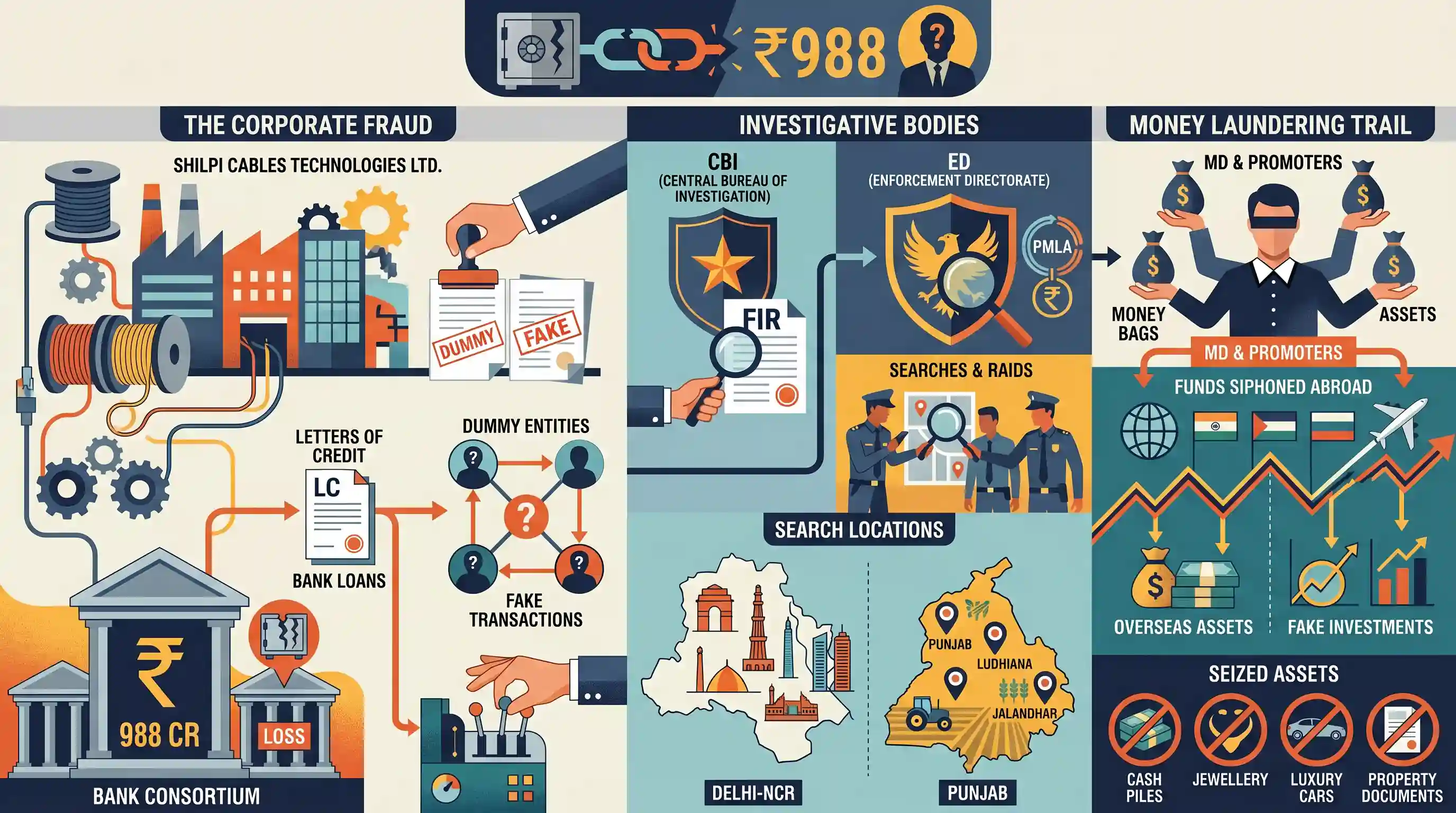
The Enforcement Directorate (ED) has carried out searches across multiple locations in Delhi-NCR and Punjab in connection with a ₹988 crore bank loan fraud case. Acting under the Prevention of Money Laundering Act (PMLA), the agency targeted the promoters of Shilpi Cables Technologies Ltd. (SCTL), including Managing Director Manish Goel. The investigation follows a CBI FIR alleging that the company cheated a consortium of banks led by IDBI Bank. Authorities suspect that a significant portion of the loan, secured using Letters of Credit (LCs), was siphoned abroad through fake transactions.
Key Points
- The Enforcement Directorate (ED) conducted searches in Delhi-NCR and Punjab over a ₹988 crore bank loan fraud investigation.
- The raids targeted Shilpi Cables Technologies Ltd. (SCTL) and its promoters under the Prevention of Money Laundering Act (PMLA).
- The ED action stems from a CBI FIR alleging the company defrauded a consortium of banks led by IDBI Bank.
- Investigators suspect loan funds acquired via Letters of Credit (LCs) were diverted abroad through fabricated transactions.
Important Terms
Prevention of Money Laundering Act (PMLA)

A 2002 Act designed to prevent money laundering and allow the confiscation of property derived from such activities. It forms the legal basis for investigating economic crimes in India.
UPSC context
GS Paper 3: Internal Security/Economy. Tests knowledge of legal frameworks against financial crimes and 'proceeds of crime' attachment.
Enforcement Directorate (ED)
A specialized financial investigation agency under the Ministry of Finance. It enforces the PMLA, FEMA, and Fugitive Economic Offenders Act to combat money laundering and foreign exchange violations.
UPSC context
GS Paper 2: Statutory and Investigative Bodies. Crucial for questions on agency powers, federalism, and economic security.
Central Bureau of Investigation (CBI)
India's premier investigating agency, governed by the Delhi Special Police Establishment Act, 1946. It probes complex corruption, economic offenses, and conventional crimes of national importance.
UPSC context
GS Paper 2: Governance/Constitutional Bodies. Tests jurisdictional issues, state consent (Section 6 DSPE Act), and investigative autonomy.
Letter of Credit (LC)
A bank-issued guarantee ensuring a seller receives payment from a buyer, provided specific documents are presented. In frauds, these are often forged to siphon funds without actual trade.
UPSC context
GS Paper 3: Economy. Relevant for understanding banking sector vulnerabilities, trade finance, and mechanisms of corporate loan fraud.
Money Laundering
The process of concealing the origins of illegally obtained money, typically by means of transfers involving foreign banks or legitimate businesses to make it appear 'untainted.'
UPSC context
GS Paper 3: Internal Security. Tests understanding of the three stages (Placement, Layering, Integration) and its threat to national security.
Proceeds of Crime
Any property derived or obtained, directly or indirectly, by any person as a result of criminal activity relating to a 'scheduled offense' under the PMLA.
UPSC context
GS Paper 3: Internal Security. Central to PMLA jurisprudence; tests understanding of asset attachment and confiscation powers.
Consortium of Banks
An arrangement where a group of banks collectively provides a loan to a single borrower to spread risk and meet high credit requirements.
UPSC context
GS Paper 3: Economy/Banking. Relevant to systemic risks, 'Twin Balance Sheet' problem, and large-scale bank loan fraud investigations.
Prelims Trap
The ED can independently register a PMLA case without a pre-existing FIR by other agencies.
The ED cannot suo motu register a PMLA case. It requires a 'scheduled offence' (predicate offence) to be registered first by agencies like CBI.
Static Concepts Connected
What is a Letter of Credit (LC) and how does it create banking risk?
- Definition: A guarantee from a bank ensuring a buyer's payment to a seller is received on time.
- Contingent Liability: It acts as an off-balance-sheet exposure; if the buyer defaults, the issuing bank is legally obligated to pay.
- Misuse for TBML: Funds can be siphoned using fake trade invoices (over/under-invoicing) without actual movement of goods.
How does the Prevention of Money Laundering Act (PMLA) alter standard criminal jurisprudence?
- Burden of Proof: Reverses the onus of proof, requiring the accused to prove that attached assets are not proceeds of crime.
- Stringent Bail: Courts must be satisfied prima facie that the accused is not guilty before granting bail (Section 45).
- Asset Attachment: The ED can provisionally attach properties suspected to be involved in money laundering even before the trial concludes.
Cross-Topic Patterns
Trade-Based Money Laundering (TBML)
UPSC frequently tests methods of illicit cross-border flows. Siphoning funds via LCs connects core banking instruments (Economy) with internal security threats (Trade-Based Money Laundering).
Corporate Fraud & the NPA cycle
Defrauding a consortium connects to the broader NPA crisis. It highlights the need for RBI's Central Repository of Information on Large Credits (CRILC) to track large loan exposures.

Multi-statement questions blending banking instruments (Letters of Credit) with PMLA's predicate offence rules are highly likely in 2026.
Linked PYQs · 2
Linked PYQs · 2
- 2021MainsGS3
Discuss how emerging technologies and globalisation contribute to money laundering. Elaborate measures to tackle the problem of money laundering both at national and international levels.
- 2021MainsGS2
The jurisdiction of the Central Bureau of Investigation (CBI) regarding lodging an FIR and conducting probe within a particular State is being questioned by various States. However, the power of the States to withhold consent to the CBI is not absolute. Explain with special reference to the federal character of India.
