Enforcement Directorate asset possession under PMLA
Source:Indian Express ↗
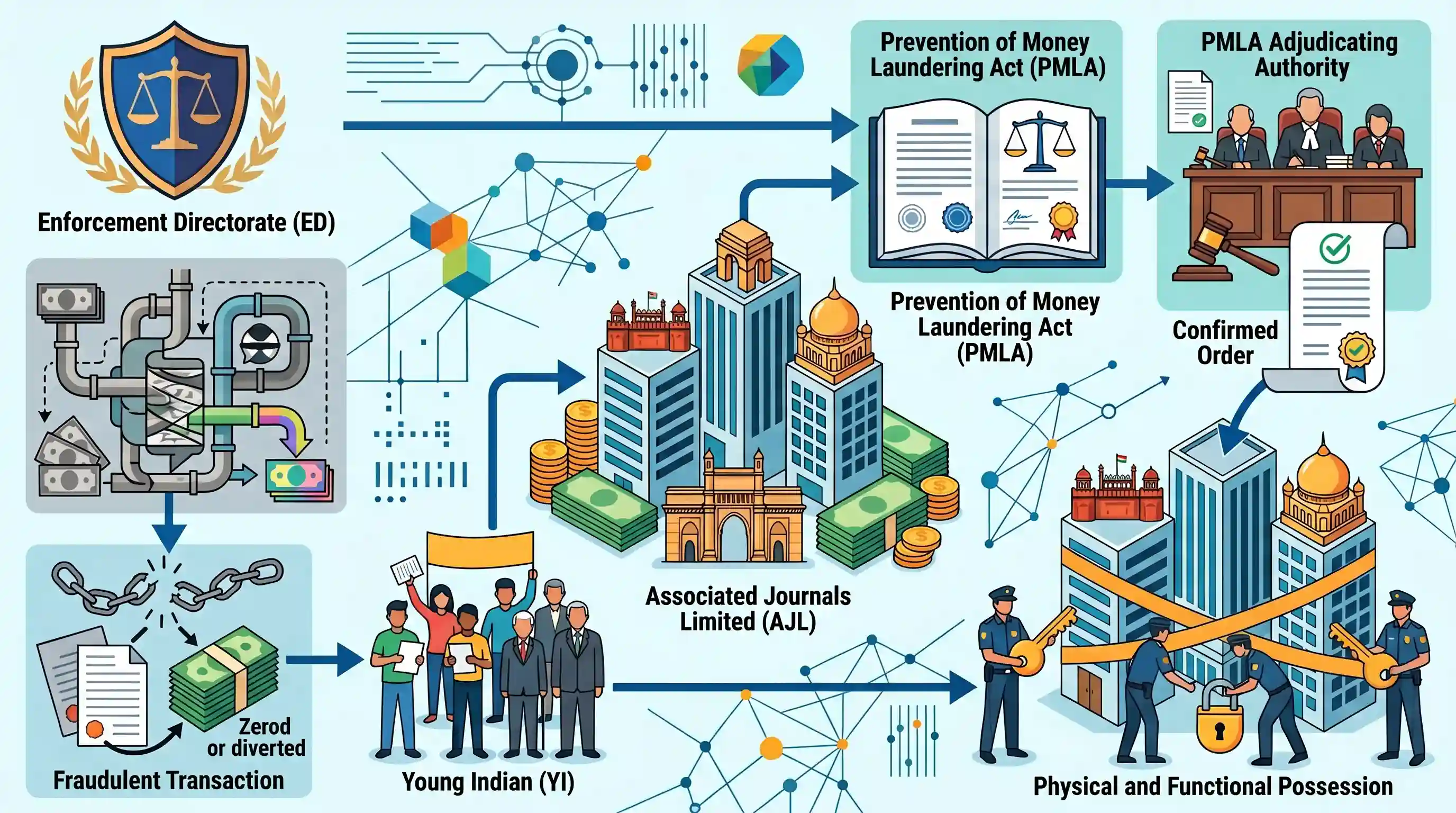
Why It Matters
Highlights the practical application and enforcement mechanisms of the Prevention of Money Laundering Act (PMLA), specifically regarding the provisional attachment and subsequent possession of assets by the Enforcement Directorate. It illustrates the role of investigative agencies and adjudicating authorities in combating complex financial crimes and economic offenses, crucial for GS-3 Internal Security and GS-2 Statutory Bodies.
Summary
The Enforcement Directorate (ED) has initiated procedures to take physical and functional possession of properties worth Rs 661 crore belonging to Associated Journals Limited (AJL) under the Prevention of Money Laundering Act (PMLA). This follows the confirmation of provisional attachment orders by the PMLA Adjudicating Authority. The assets, located in Delhi, Mumbai, and Lucknow, are at the center of the National Herald case. The ED alleges that Young Indian (YI), linked to senior Congress leaders, acquired these high-value assets through fraudulent financial transactions, including a loan waiver.
Key Points
- The Enforcement Directorate (ED) has issued notices to take possession of assets worth Rs 661 crore linked to Associated Journals Limited (AJL).
- The action is a result of the PMLA Adjudicating Authority confirming provisional attachment orders issued in November 2023.
- The case involves allegations of money laundering, claiming that Young Indian (YI) fraudulently acquired AJL's assets through a complex financial maneuver involving a Rs 90 crore loan waiver by the Congress party.
- Properties to be possessed include prominent real estate like the Herald House in New Delhi, and properties in Mumbai and Lucknow.
Important Terms
Prevention of Money Laundering Act (PMLA)

A 2002 Act designed to prevent money laundering and provide for the confiscation of property derived from, or involved in, money laundering and related crimes.
UPSC context
GS Paper III: Internal Security; tests understanding of legal frameworks for combating organized crime and black money.
Enforcement Directorate (ED)
A specialized financial investigation agency under the Ministry of Finance, mandated to enforce economic laws like PMLA, FEMA, and the Fugitive Economic Offenders Act.
UPSC context
GS Paper II: Statutory Bodies; tests knowledge of executive agencies and their powers in economic governance.
PMLA Adjudicating Authority
A quasi-judicial body that determines whether properties provisionally attached by the ED are involved in money laundering, providing a check on executive power.
UPSC context
GS Paper II: Quasi-judicial bodies; essential for understanding the procedural safeguards and checks in anti-money laundering law.
Young Indian (YI)
A Section 25 (non-profit) company central to the National Herald case; accused of acquiring high-value assets through fraudulent financial transactions and loan waivers.
UPSC context
GS Paper III: Internal Security/Money Laundering; useful for case studies on "shell" or non-profit entities in financial crimes.
Associated Journals Limited (AJL)
Established in 1937 by Jawaharlal Nehru, this company published the National Herald and owns significant real estate currently under investigation for fraudulent transfer.
UPSC context
GS Paper III: Money Laundering; represents the entity whose assets form the "proceeds of crime" in the National Herald case.
Prelims Trap
"The Enforcement Directorate independently possesses the final authority to permanently confiscate properties under the PMLA."
ED only issues 'provisional' attachment. It must be confirmed by the Adjudicating Authority within 180 days. Final confiscation occurs only after a Special Court conviction.
Static Concepts Connected
What are the three standard stages of money laundering?
- Placement: The initial entry of illicit funds into the formal financial system.
- Layering: Conducting a series of complex financial transactions to obscure the audit trail and distance the funds from their illegal source.
- Integration: Re-introducing the laundered funds back into the economy, allowing them to appear as legitimate wealth or assets.
What is the administrative control and mandate of the Enforcement Directorate (ED)?
- Administrative Control: The ED functions under the Department of Revenue, Ministry of Finance (not the Ministry of Home Affairs).
- Statutory Mandate: It is mandated to enforce the Prevention of Money Laundering Act (PMLA), the Foreign Exchange Management Act (FEMA), and the Fugitive Economic Offenders Act.
- Burden of Proof: Under PMLA, the burden of proof rests entirely on the accused to prove their assets are legitimate, unlike standard criminal law.
Cross-Topic Patterns
PMLA vs Benami Transactions Act
UPSC often tests comparative powers of agencies under different economic laws, specifically focusing on 'reversal of burden of proof' under PMLA versus the Benami Transactions Act.
Quasi-judicial oversight in economic laws
The role of the PMLA Adjudicating Authority links to a broader theme of executive seizures requiring quasi-judicial confirmation, similar to tribunals in tax and competition law.

Expect a multi-statement Prelims question testing the subtle differences between provisional attachment by ED and final confiscation.
Linked PYQs · 4
Linked PYQs · 4
- 2013MainsGS3
Money laundering poses a serious security threat to a country's economic sovereignty. What is its significance for India and what steps are required to be taken to control this menace?
- 2021MainsGS3
Discuss how emerging technologies and globalisation contribute to money laundering. Elaborate measures to tackle the problem of money laundering both at national and international levels.
- 2023MainsGS3
What are the internal security challenges being faced by India? Give out the role of Central Intelligence and Investigative Agencies tasked to counter such threats.
- 2025PrelimsGS1
With reference to the Government of India, consider the following information: Organization Some of its functions It works under I. Directorate of Enforcement Enforcement of the Fugitive Economic Offenders Act, 2018 Internal Security Division-I, Ministry of Home Affairs II. Directorate of Revenue Intelligence Enforces the Provisions of the Customs Act, 1962 Department of Revenue, Ministry of Finance III. Directorate General of Systems and Data Management Carrying out big data analytics to assist tax officers for better policy and nabbing tax evaders Department of Revenue, Ministry of Finance In how many of the above rows is the information correctly matched?
