Enforcement Directorate acts against RR Industries under FEMA
Source:The Hindu ↗
Why It Matters
This case exemplifies the methods used to siphon off funds via overseas subsidiaries and write-offs, highlighting the challenges of policing capital account convertibility and the pivotal role of the ED and FEMA in securing India's foreign exchange reserves and preventing money laundering.
Summary
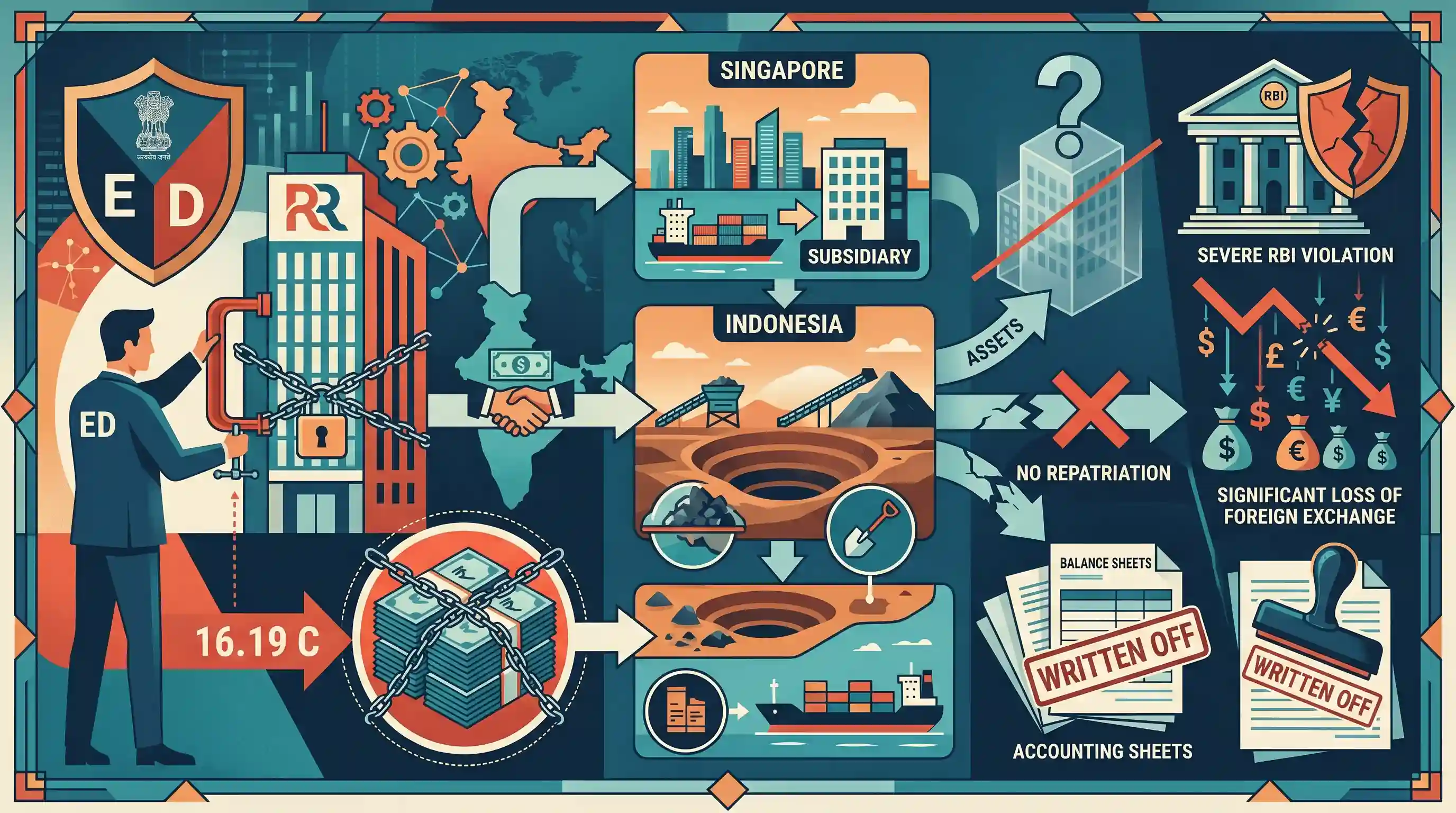
The Directorate of Enforcement (ED) has seized assets worth ₹16.19 crore from RR Industries under the Foreign Exchange Management Act (FEMA), 1999. The enforcement action targets a case of alleged corporate fraud where funds were remitted abroad as Overseas Direct Investment (ODI) to a Singapore subsidiary and subsequently parked in an Indonesian entity for mineral trading. The funds were neither used to acquire assets nor repatriated to India, and were later written off, constituting a severe violation of RBI guidelines and leading to a significant loss of foreign exchange.
Key Points
- The Directorate of Enforcement (ED) seized immovable property worth ₹16.19 crore belonging to RR Industries under the provisions of the Foreign Exchange Management Act (FEMA), 1999.
- The action stems from an outward remittance of ₹16.19 crore made by Chennai-based Hanudev Investment Private Limited (HIPL) as an Overseas Direct Investment (ODI) into its Singapore subsidiary, RR Industries Singapore Pte. Ltd.
- Funds were subsequently parked in an Indonesian entity, Novem Coal Resources (NCR), ostensibly to acquire coal rights. However, no such assets were acquired.
- The funds were never repatriated to India, and the entire investment was later written off in the books of the Singapore subsidiary, violating RBI guidelines and resulting in a total loss of foreign exchange.
Important Terms
Foreign Exchange Management Act (FEMA), 1999

A 1999 law regulating foreign exchange transactions in India, shifting the focus from 'regulation' (under FERA) to 'management' to facilitate external trade and payments.
UPSC context
GS Paper 3: Indian Economy. Key for understanding capital account vs. current account regulations and economic liberalization.
Directorate of Enforcement (ED)
India's premier economic intelligence and law enforcement agency under the Ministry of Finance, responsible for enforcing FEMA (1999) and PMLA (2002).
UPSC context
GS Paper 3: Internal Security and Economy. Important for topics on money laundering, financial crimes, and institutional frameworks.
Overseas Direct Investment (ODI)
Investments made by Indian residents or entities into foreign companies through unlisted equity, or holding a 10% or more stake with control in listed entities.
UPSC context
GS Paper 3: Economy. Tests knowledge of foreign capital flows and RBI's regulatory role in outbound investments.
Fund Diversion
The practice of siphoning money from its intended purpose to unauthorized entities or offshore accounts, often violating FEMA guidelines and causing foreign exchange loss.
UPSC context
GS Paper 3: Corporate Governance and Money Laundering. Relevant for understanding white-collar crimes and economic stability.
Section 37A of FEMA
A provision allowing the ED to seize domestic assets of equivalent value if it believes foreign exchange/assets are being held outside India in violation of FEMA.
UPSC context
GS Paper 2 & 3: Statutory powers of agencies. High relevance for Prelims regarding specific enforcement tools against offshore tax evasion.
Hanudev Investment Private Limited (HIPL)
The primary Indian entity in the RR Industries case that remitted ₹16.19 crore as ODI to Singapore, later diverted to Indonesia and written off.
UPSC context
Current Affairs. Case study of corporate fraud involving shell structures and violation of RBI repatriation guidelines.
Prelims Trap
"The ED can arrest individuals and initiate criminal prosecution for violations under the Foreign Exchange Management Act (FEMA)."
FEMA is a civil law meant for managing external trade and payments. The ED can penalize or seize equivalent domestic assets, but cannot arrest under FEMA (unlike PMLA).
Static Concepts Connected
What are the key differences between FEMA (1999) and PMLA (2002)?
- Civil vs Criminal: FEMA is a civil legislation regulating foreign exchange. PMLA is a criminal legislation aimed at combating money laundering and the generation of black money.
- Arrest Powers: Under PMLA, the Enforcement Directorate has the power to arrest individuals. Under FEMA, the ED can only adjudicate, impose penalties, and attach assets.
- Trigger mechanism: FEMA requires intent to violate forex rules, whereas PMLA triggers specifically when dealing with the "proceeds of crime" from a scheduled offense.
How is Overseas Direct Investment (ODI) defined under RBI rules?
- Unlisted equity: Acquiring any amount of unlisted equity capital in a foreign entity qualifies as an Overseas Direct Investment.
- Listed equity threshold: Acquiring 10% or more of the paid-up equity capital in a listed foreign entity is considered an ODI.
- Write-off regulations: Indian entities cannot arbitrarily write off ODIs. Disinvestment must follow arm's-length pricing, and legitimate dues must be repatriated to prevent forex depletion.
Cross-Topic Patterns
ODI write-offs & Round-Tripping
Parking outward remittances in overseas entities (e.g., in Singapore) and writing them off is a classic money-laundering typology often tested under Internal Security and black money themes.
Domestic seizures for foreign assets
Section 37A of FEMA allows ED to seize properties in India of equivalent value if illegal foreign exchange is held abroad, linking external sector management directly to domestic law enforcement.

Expect a multi-statement question contrasting ED's powers under FEMA (civil/asset seizure) vs PMLA (criminal/arrest) in Prelims.
Linked PYQs · 3
Linked PYQs · 3
- 2025PrelimsGS1
With reference to the Government of India, consider the following information: Organization Some of its functions It works under I. Directorate of Enforcement Enforcement of the Fugitive Economic Offenders Act, 2018 Internal Security Division-I, Ministry of Home Affairs II. Directorate of Revenue Intelligence Enforces the Provisions of the Customs Act, 1962 Department of Revenue, Ministry of Finance III. Directorate General of Systems and Data Management Carrying out big data analytics to assist tax officers for better policy and nabbing tax evaders Department of Revenue, Ministry of Finance In how many of the above rows is the information correctly matched?
- 2021MainsGS3
Discuss how emerging technologies and globalisation contribute to money laundering. Elaborate measures to tackle the problem of money laundering both at national and international levels.
- 2013MainsGS3
Money laundering poses a serious security threat to a country's economic sovereignty. What is its significance for India and what steps are required to be taken to control this menace?
