Enforcement Directorate Directives on Judicious Summons Use
Source:Indian Express ↗
Why It Matters
The expansive powers of the ED under the PMLA have been a major subject of debate. Directives to rationalize the use of summons and expedite investigations are important from a governance perspective, reflecting a necessary balance between state action against economic crimes and the protection of civil liberties.
Summary
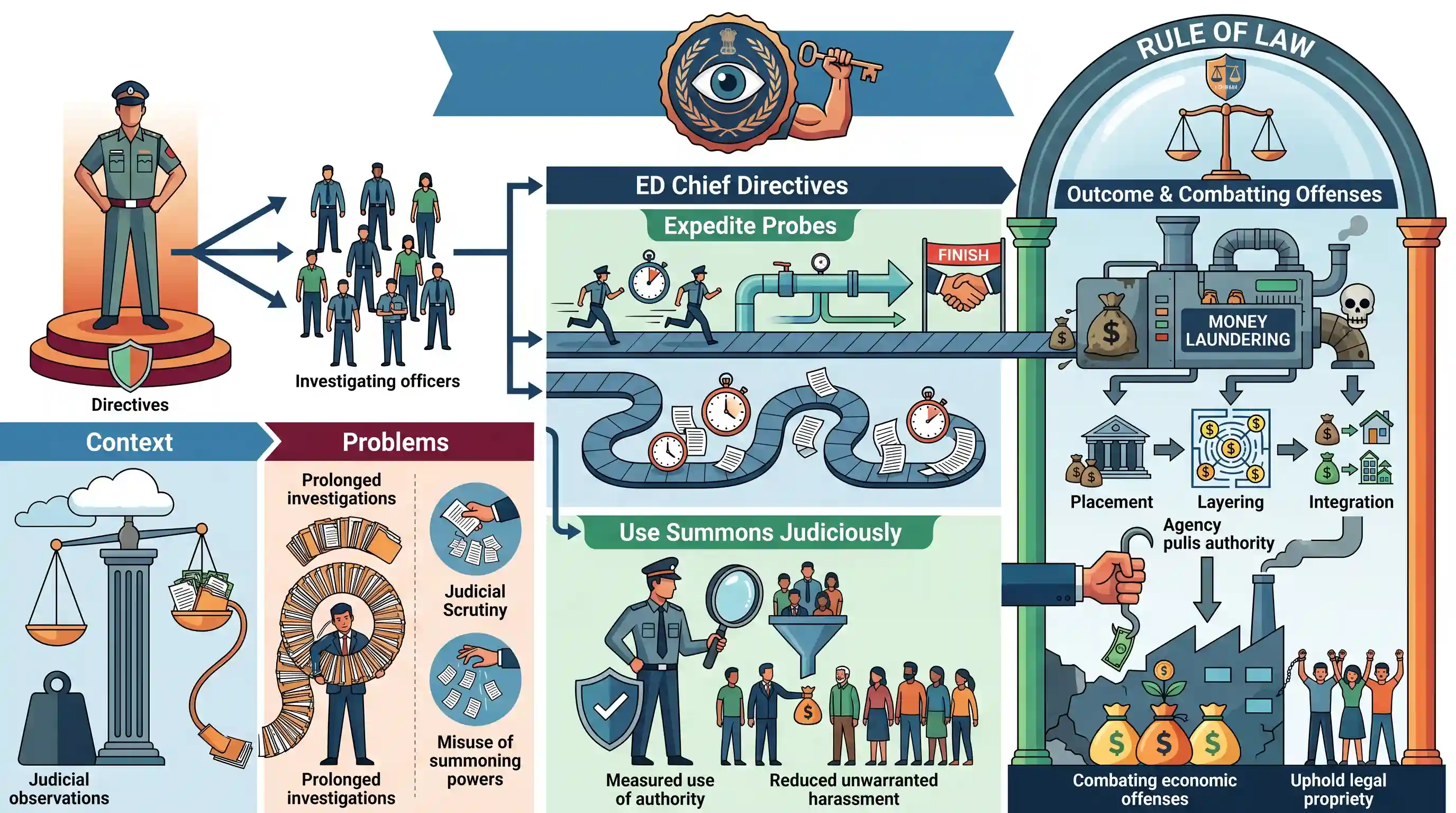
The Enforcement Directorate (ED) chief has issued directives to investigating officers to expedite ongoing money laundering probes and use their power to summon individuals judiciously. The instructions aim to address growing concerns and judicial observations regarding the prolonged nature of investigations and the potential misuse of summoning powers under the Prevention of Money Laundering Act (PMLA). By emphasizing faster case resolution and measured use of authority, the agency seeks to streamline its operations, reduce unwarranted harassment, and uphold legal propriety while continuing to combat economic offenses.
Key Points
- The head of the Enforcement Directorate has directed investigating officers to speed up ongoing probes to prevent cases from languishing indefinitely.
- Officers have been instructed to exercise their power to issue summons judiciously, aiming to reduce undue harassment of individuals during investigations.
- This directive follows increasing judicial scrutiny, including Supreme Court observations regarding the prolonged pre-trial incarceration of accused persons under the stringent provisions of the PMLA.
- The move reflects an effort to balance the agency's robust mandate to tackle money laundering and economic offenses with the protection of citizens' fundamental rights.
Important Terms
Enforcement Directorate (ED)

A specialized financial investigation agency under the Ministry of Finance's Department of Revenue. It enforces economic laws like PMLA and FEMA to combat money laundering and foreign exchange violations.
UPSC context
GS Paper II/III: Statutory bodies and internal security. Tests knowledge of investigative mandates and agency functioning.
Prevention of Money Laundering Act (PMLA)
A 2002 law providing the legal framework to prevent money laundering, attach 'proceeds of crime,' and prosecute offenders. It empowers the ED with stringent search and seizure authority.
UPSC context
GS Paper III: Internal Security. Crucial for topics on organized crime, terror financing, and legislative amendments.
Section 50 of PMLA
A specific provision of the PMLA that empowers ED officers to summon any person for evidence or document production. Statements recorded here are deemed judicial proceedings.
UPSC context
GS Paper II: Fundamental Rights. Concerns the balance between investigative powers and the right against self-incrimination.
Foreign Exchange Management Act (FEMA)
A 1999 act that replaced FERA to liberalize foreign exchange controls. It regulates capital and current account transactions to facilitate external trade and maintain the forex market.
UPSC context
GS Paper III: Economy. Tests understanding of India's external sector regulations and capital account convertibility.
Judicial Scrutiny
The power of the judiciary to review executive actions. In this context, it refers to court-mandated guidelines to prevent the arbitrary use of summons by agencies.
UPSC context
GS Paper II: Separation of Powers. Vital for discussions on the Rule of Law and executive accountability.
Prelims Trap
"Statements recorded by ED officers during summons are inadmissible as evidence in a court of law."
Under Section 50 of the PMLA, ED officers are not classified as "police officers," making statements recorded before them admissible in court, unlike standard police statements.
Static Concepts Connected
What are the "twin conditions" for bail under the PMLA?
- Reverse Burden: The court must be satisfied that there are reasonable grounds to believe the accused is not guilty of the offense.
- Future Conduct: The court must be satisfied that the accused is not likely to commit any offense while out on bail.
- Judicial Override: Recent SC rulings hold that prolonged pre-trial incarceration and delayed trials can override these strict statutory bars under Article 21.
How does the operational jurisdiction of the ED differ from the CBI?
- Governing Statutes: CBI derives investigative power from the DSPE Act, while the ED operates under FEMA, PMLA, and FEOA.
- Ministry Control: CBI operates under the DoPT (Ministry of Personnel), whereas the ED functions under the Department of Revenue (Ministry of Finance).
- State Consent: CBI requires prior state government consent (general or specific) to investigate locally, whereas ED exercises nationwide jurisdiction without state approval.
Cross-Topic Patterns
Article 21 vs. Statutory Bail Conditions
The Supreme Court increasingly invokes Article 21 (speedy trial) to bypass stringent statutory bail conditions in special laws like PMLA and UAPA, linking fundamental rights directly to criminal jurisprudence.
Federalism and Central Investigative Agencies
ED's power to bypass state consent connects money laundering enforcement to center-state federalism disputes, providing a direct contrast with CBI's Section 6 consent requirement.

Expect a comparative prelims question testing the statutory backing, ministry control, and state-consent requirements of ED vs CBI vs NIA.
Linked PYQs · 4
Linked PYQs · 4
- 2021MainsGS3
Discuss how emerging technologies and globalisation contribute to money laundering. Elaborate measures to tackle the problem of money laundering both at national and international levels.
- 2021MainsGS2
The jurisdiction of the Central Bureau of Investigation (CBI) regarding lodging an FIR and conducting probe within a particular State is being questioned by various States. However, the power of the States to withhold consent to the CBI is not absolute. Explain with special reference to the federal character of India.
- 2025PrelimsGS1
With reference to the Government of India, consider the following information: Organization Some of its functions It works under I. Directorate of Enforcement Enforcement of the Fugitive Economic Offenders Act, 2018 Internal Security Division-I, Ministry of Home Affairs II. Directorate of Revenue Intelligence Enforces the Provisions of the Customs Act, 1962 Department of Revenue, Ministry of Finance III. Directorate General of Systems and Data Management Carrying out big data analytics to assist tax officers for better policy and nabbing tax evaders Department of Revenue, Ministry of Finance In how many of the above rows is the information correctly matched?
- 2003PrelimsGS1
Which one of the following statements is correct with reference to FEMA in India?
