Money laundering investigations and federal jurisdiction friction
Source:The Hindu ↗
Why It Matters
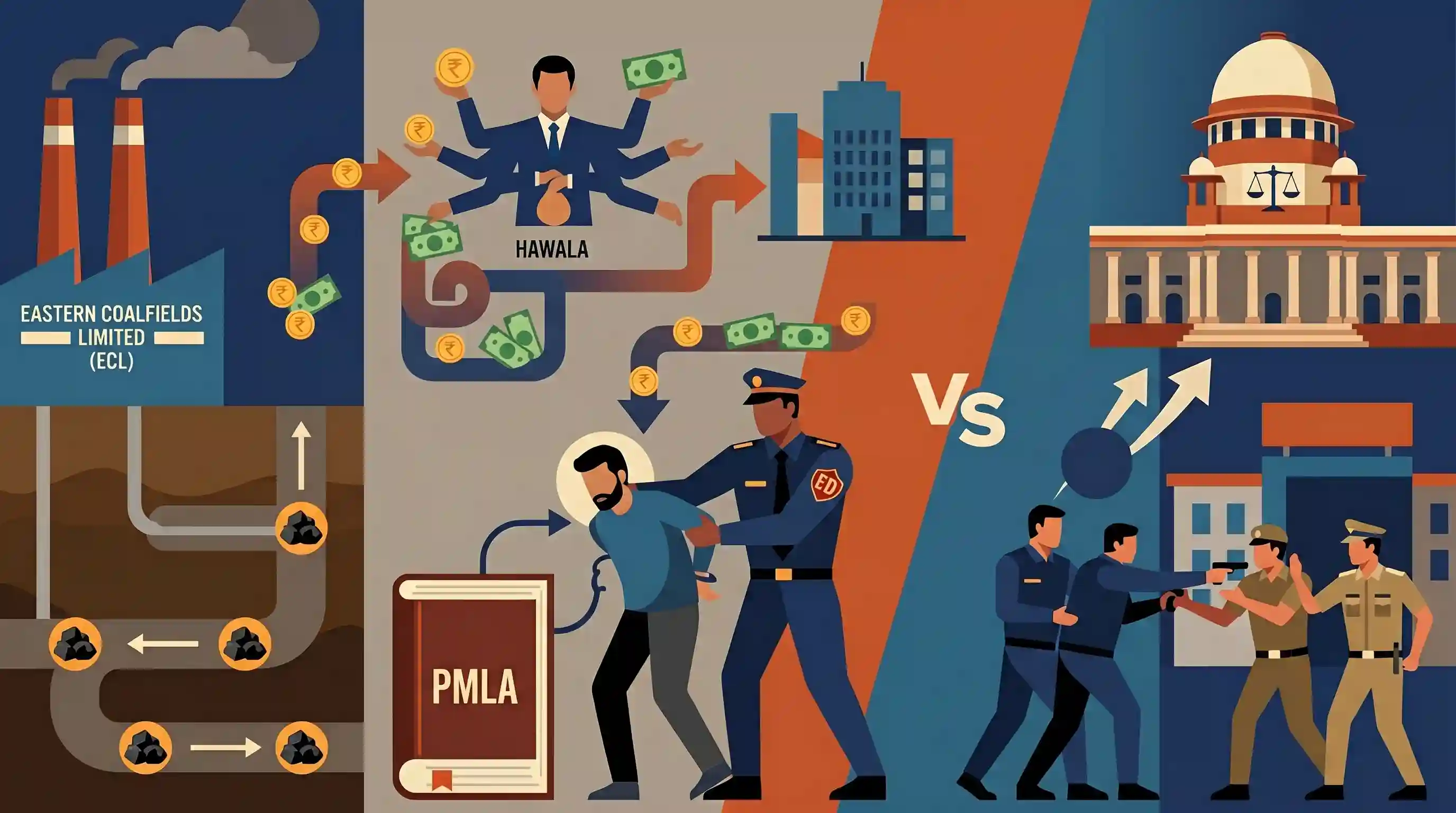
It provides a contemporary example of federal friction where state governments and central agencies (ED/CBI) conflict over jurisdiction, while also demonstrating the operational reach of the PMLA into cases involving resource pilferage and political consultancy.
Summary
The Enforcement Directorate (ED) arrested Vinesh Chandel, a director and co-founder of the Indian Political Action Committee (I-PAC), under the Prevention of Money Laundering Act (PMLA) in connection with a multi-crore coal pilferage scam in West Bengal. The scam involves illegal coal mining from Eastern Coalfields Limited (ECL) areas in Asansol. A hawala operator allegedly channeled proceeds of the crime to an I-PAC linked company. The issue also spotlights the friction between central investigative agencies and the West Bengal state government, with the ED approaching the Supreme Court over alleged state interference during a search operation.
Key Points
- The ED arrested I-PAC director Vinesh Chandel under the PMLA for allegedly receiving hawala funds linked to a multi-crore coal pilferage case.
- The probe originated from a CBI FIR concerning illegal coal extraction in Eastern Coalfields Limited (ECL) leasehold areas in West Bengal's Asansol region.
- Tensions between federal agencies and the state escalated when West Bengal Chief Minister Mamata Banerjee allegedly intervened at an ED search location, prompting the ED to petition the Supreme Court.
- The case underscores challenges to federalism, as state governments and central agencies (CBI, ED) repeatedly clash over jurisdiction and 'abuse of power' allegations.
- It highlights the nexus between natural resource pilferage, money laundering via hawala channels, and political consultancy funding.
Important Terms
Enforcement Directorate (ED)

A specialized financial investigation agency under the Ministry of Finance. It enforces economic laws like PMLA and FEMA, with powers to conduct searches, seize assets, and arrest individuals involved in money laundering.
UPSC context
GS Paper II: Statutory/Regulatory Bodies. Tests understanding of the agency's jurisdiction, powers, and impact on the federal balance.
Prevention of Money Laundering Act (PMLA)
A 2002 Act enacted to prevent money laundering and confiscate property derived from 'proceeds of crime.' It gives agencies wide-ranging powers and often shifts the burden of proof to the accused.
UPSC context
GS Paper III: Money Laundering. Tests knowledge of the legal framework used to combat internal security threats and financial crimes.
Central Bureau of Investigation (CBI)
India's premier investigating police agency under the DSPE Act, 1946. It probes high-profile corruption and conventional crimes, often filing the 'predicate offense' required for the ED to initiate money-laundering probes.
UPSC context
GS Paper II: Statutory Bodies. Tests knowledge of agency jurisdiction and the friction regarding 'general consent' from state governments.
Centre-State Relations
The constitutional framework (Part XI) governing power-sharing. This case highlights 'federal friction' where central agency investigations into state-linked entities lead to legal battles over alleged state interference and sovereignty.
UPSC context
GS Paper II: Federal Structure. Tests ability to analyze institutional conflicts between central mandates and state executive powers.
Eastern Coalfields Limited (ECL)
A public sector undertaking and subsidiary of Coal India Limited. It operates coal mines in West Bengal and Jharkhand and is the victim entity in the multi-crore coal pilferage scam.
UPSC context
GS Paper III: Infrastructure/Economy. Tests knowledge of major energy PSUs and the management of natural resources against illicit excavation.
Hawala
An informal, trust-based money transfer system that operates outside traditional banking channels. It is frequently used to launder 'proceeds of crime' and move illicit funds across jurisdictions to evade detection.
UPSC context
GS Paper III: Money Laundering/Security. Tests understanding of illegal financial flows and the challenges they pose to national security and financial integrity.
Prelims Trap
The Enforcement Directorate requires the general consent of the State Government to conduct PMLA investigations.
Unlike the CBI under the DSPE Act, the ED derives its powers from the PMLA/FEMA and can conduct nationwide searches without state government consent.
Static Concepts Connected
How do jurisdictional mandates differ among India's central investigative agencies?
- CBI (DSPE Act): Requires state consent (general or specific) under Section 6 of the DSPE Act to investigate within a state's territory.
- NIA (NIA Act): Possesses pan-India statutory jurisdiction for scheduled offenses like terrorism; no state consent is required.
- ED (PMLA/FEMA): A non-statutory body under the Dept of Revenue probing economic crimes (PMLA/FEMA) nationwide without needing state consent.
What is the administrative structure of India's nationalized coal sector?
- Nationalization: Coal mining was nationalized in the 1970s to ensure planned development, resource security, and improve worker safety.
- Coal India Limited: Operates as a Maharatna CPSE holding company, managing regional production through subsidiaries like Eastern Coalfields Limited (ECL).
- Centre-State control: While coal-bearing lands are located within states, coal is heavily regulated by the Centre under the MMDR Act.
Cross-Topic Patterns
PMLA and Electoral Financing scrutiny
The application of PMLA to a political consultancy highlights the evolving scrutiny of election-related financing and informal hawala networks intersecting with state politics.
Resource Theft & Federal Friction
Illegal mining in central CPSE leaseholds triggers federal probes that collide with state law-and-order machinery, a recurring theme for Article 131 Supreme Court disputes.

Expect a comparative Prelims question in 2026 testing statutory backing, parent ministries, and state-consent rules for CBI vs ED vs NIA.
Linked PYQs · 5
Linked PYQs · 5
- 2021MainsGS3
Discuss how emerging technologies and globalisation contribute to money laundering. Elaborate measures to tackle the problem of money laundering both at national and international levels.
- 2013MainsGS3
Money laundering poses a serious security threat to a country's economic sovereignty. What is its significance for India and what steps are required to be taken to control this menace?
- 2021MainsGS2
The jurisdiction of the Central Bureau of Investigation (CBI) regarding lodging an FIR and conducting probe within a particular State is being questioned by various States. However, the power of the States to withhold consent to the CBI is not absolute. Explain with special reference to the federal character of India.
- 2022PrelimsGS1
In India, what is the role of the Coal Controller's Organization (CCO)? 1. CCO is the major source of Coal Statistics in Government of India. 2. It monitors progress of development of Captive Coal/Lignite blocks. 3. It hears any objection to the Government's notification relating to acquisition of coal-bearing areas. 4. It ensures that coal mining companies deliver the coal to end users in the prescribed time. Select the correct answer using the code given below:
- 2019PrelimsGS1
Consider the following statements: 1. Coal sector was nationalized by the Government of India under Indira Gandhi. 2. Now, coal blocks are allocated on lottery basis. 3. Till recently, India imported coal to meet the shortages of domestic supply, but now India is self-sufficient in coal production. Which of the statements given above is/are correct?
