State Public Service Commission Recruitment Scams and Money Laundering
Source:The Hindu ↗
ఇది ఎందుకు ముఖ్యం
The case exposes systemic vulnerabilities and corruption within State Public Service Commissions, fundamentally compromising the integrity of public service recruitment. It also illustrates how illegal gratifications can be sophisticatedly laundered using legal facades like CSR donations, emphasizing the crucial role of central agencies like the ED and CBI in enforcing institutional accountability.
సారాంశం
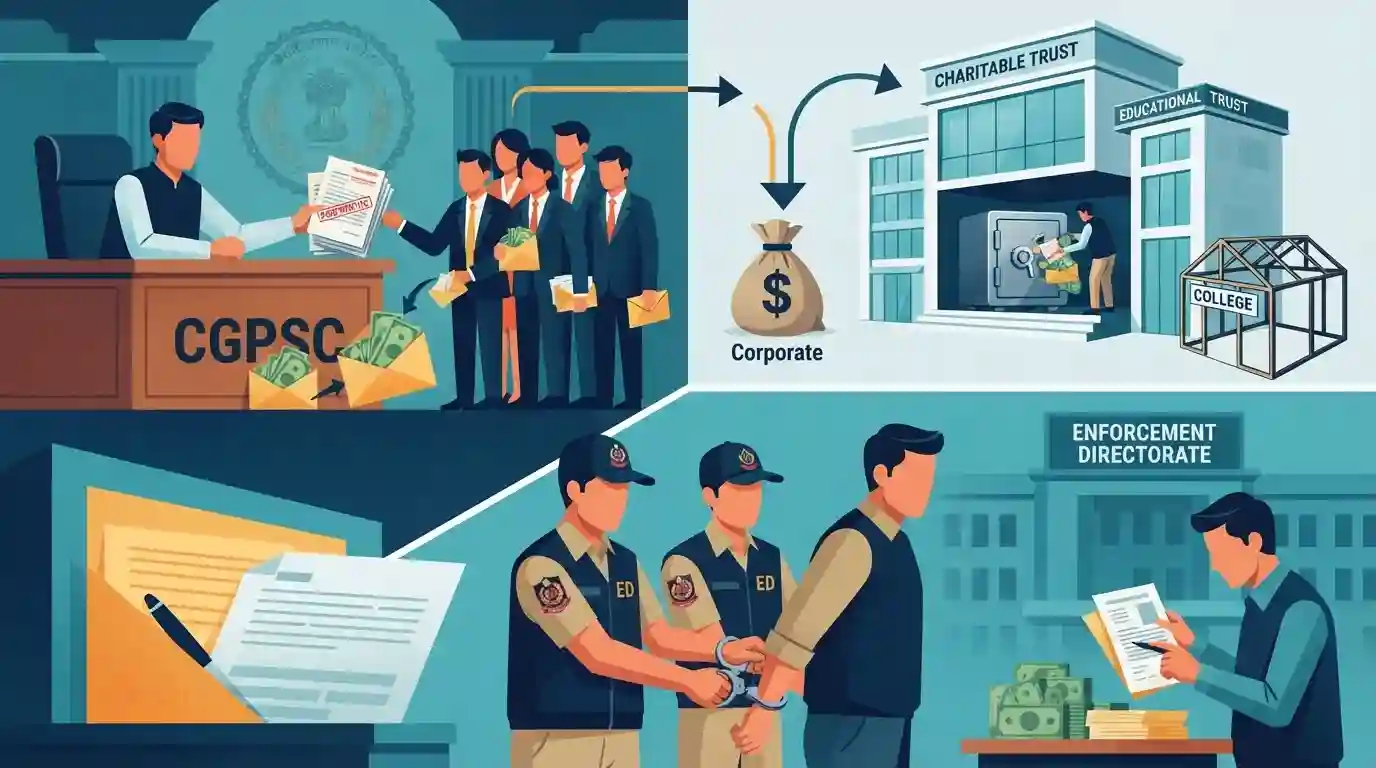
The Enforcement Directorate has arrested former Chhattisgarh Public Service Commission (CGPSC) chairman Taman Singh Sonwani under the Prevention of Money Laundering Act (PMLA) in connection with a major examination paper leak scam. Sonwani is accused of leaking question papers and manipulating the selection process during the 2020 and 2021 CGPSC exams to favor his relatives and candidates who paid bribes. The ED alleges that illegal gratification was collected both in cash and laundered under the guise of Corporate Social Responsibility (CSR) donations to a family-controlled trust for a non-existent college. The case, which originated from a CBI FIR, highlights severe institutional corruption within public recruitment bodies and the misuse of charitable trusts for money laundering.
ముఖ్య అంశాలు
- The ED arrested former CGPSC chairman Taman Singh Sonwani and an industrialist in a money laundering case linked to an exam paper leak and recruitment scam.
- Sonwani is accused of manipulating CGPSC exams (2020 and 2021) to favor his relatives and bribe-paying candidates, including altering recruitment rules to exempt 'nephews' from the definition of relatives.
- Bribes were allegedly collected as cash and disguised as Corporate Social Responsibility (CSR) donations to a family-controlled trust for a non-existent college.
- The arrests were executed under the Prevention of Money Laundering Act (PMLA), stemming from a prior 2024 CBI FIR regarding the scam.
ముఖ్యమైన పదాలు
Prevention of Money Laundering Act (PMLA)

A key Indian legislation enacted in 2002 to prevent money laundering, combat the channelizing of illegal proceeds, and enable the attachment and confiscation of property derived from scheduled offences.
UPSC context
GS Paper III (Internal Security/Money Laundering); tests knowledge of legal frameworks combating financial crime.
Enforcement Directorate (ED)
A specialized multi-disciplinary law enforcement and economic intelligence agency under the Ministry of Finance, responsible for enforcing the PMLA, FEMA, and Fugitive Economic Offenders Act.
UPSC context
GS Paper II (Regulatory Bodies) and GS III; tests understanding of economic law enforcement agencies.
Chhattisgarh Public Service Commission (CGPSC)
A constitutional body established under Article 315 of the Constitution of India, responsible for conducting civil service examinations and recruiting Group A and B officers in Chhattisgarh.
UPSC context
GS Paper II (Constitutional Bodies/SPSC); tests SPSC functions and integrity under Article 315-323.
Central Bureau of Investigation (CBI)
The premier investigating agency of India, operating under the Ministry of Personnel, Public Grievances and Pensions, which investigates complex economic crimes, corruption, and inter-state offenses.
UPSC context
GS Paper II (Regulatory Bodies); tests understanding of premier investigation agencies and federal crime control.
Gramin Vikas Samiti
A registered non-governmental organization (NGO) used as a front by accused officials in the CGPSC scam to receive and launder bribery funds.
UPSC context
GS Paper II & IV (NGOs/Civil Society, Ethics); tests challenges of institutional corruption and transparency.
ప్రిలిమ్స్ ఉచ్చు
The Governor of a State has the power to remove or dismiss the Chairman of a State Public Service Commission on grounds of misbehaviour.
Although the Governor appoints SPSC members, they can only be removed by the President of India after a Supreme Court inquiry under Article 317.
అనుసంధానమైన స్థిర భావనలు
What is the constitutional procedure for the removal of an SPSC Chairman?
- Presidential Authority: Under Article 317, SPSC members/chairpersons are removed only by the President of India, not the Governor, following a Supreme Court reference and inquiry.
- Governor's Suspension Power: The Governor possesses the power to suspend the Chairman or members from office until the President receives the Supreme Court's report.
- Other Grounds: The President can remove them directly without SC inquiry if they are adjudged insolvent, engage in paid outside employment, or are declared infirm.
How does the PMLA interact with a 'predicate offence'?
- Dependency Rule: The Enforcement Directorate (ED) cannot register an ECIR independently without a prior "scheduled/predicate offence" filed by another primary agency.
- Supreme Court Clarification: As per the Vijay Madanlal case (2022), if the accused is acquitted or the predicate offence is quashed, the PMLA charges cannot proceed.
అంతర-అంశ నమూనాలు
Corporate Governance + Money Laundering
The misuse of Corporate Social Responsibility (CSR) funds via family trusts highlights how corporate governance laws intersect with money laundering and PMLA enforcement.
Constitutional Integrity + Public Ethics
Recruitment corruption in constitutional bodies like SPSCs violates Article 16 (equality of opportunity), directly linking GS-2 (institutions) to GS-4 (public service ethics).

SPSC constitutional safeguards (Presidential removal) combined with PMLA predicate offence rules will likely feature in a 2026 Prelims question.
అనుసంధాన PYQలు · 5
అనుసంధాన PYQలు · 5
- 2021MainsGS3
Discuss how emerging technologies and globalisation contribute to money laundering. Elaborate measures to tackle the problem of money laundering both at national and international levels.
- 2013MainsGS3
Money laundering poses a serious security threat to a country's economic sovereignty. What is its significance for India and what steps are required to be taken to control this menace?
- 2025MainsGS2
Discuss the 'corrupt practices' for the purpose of the Representation of the People Act, 1951. Analyze whether the increase in the assets of the legislators and/or their associates, disproportionate to their known sources of income, would constitute 'undue influence' and consequently a corrupt practice.
- 2017MainsGS4
Examine the relevance of the following in the context of civil service: Transparency, Accountability, Fairness and justice, Courage of conviction, Spirit of service.
- 2020MainsGS2
Institutional quality is a crucial driver of economic performance". In this context suggest reforms in Civil Service for strengthening democracy.
