Macroeconomic Growth Projections Amid Global Uncertainties
Source:The Hindu ↗
Why It Matters
This article provides an authoritative forward-looking assessment of India's macroeconomy. It touches upon essential GS3 concepts like the capital expenditure multiplier, outward vs. inward FDI, external commercial borrowings (ECBs), and the role of monetary policy (RBI) in managing inflation and growth amid global headwinds.
Summary
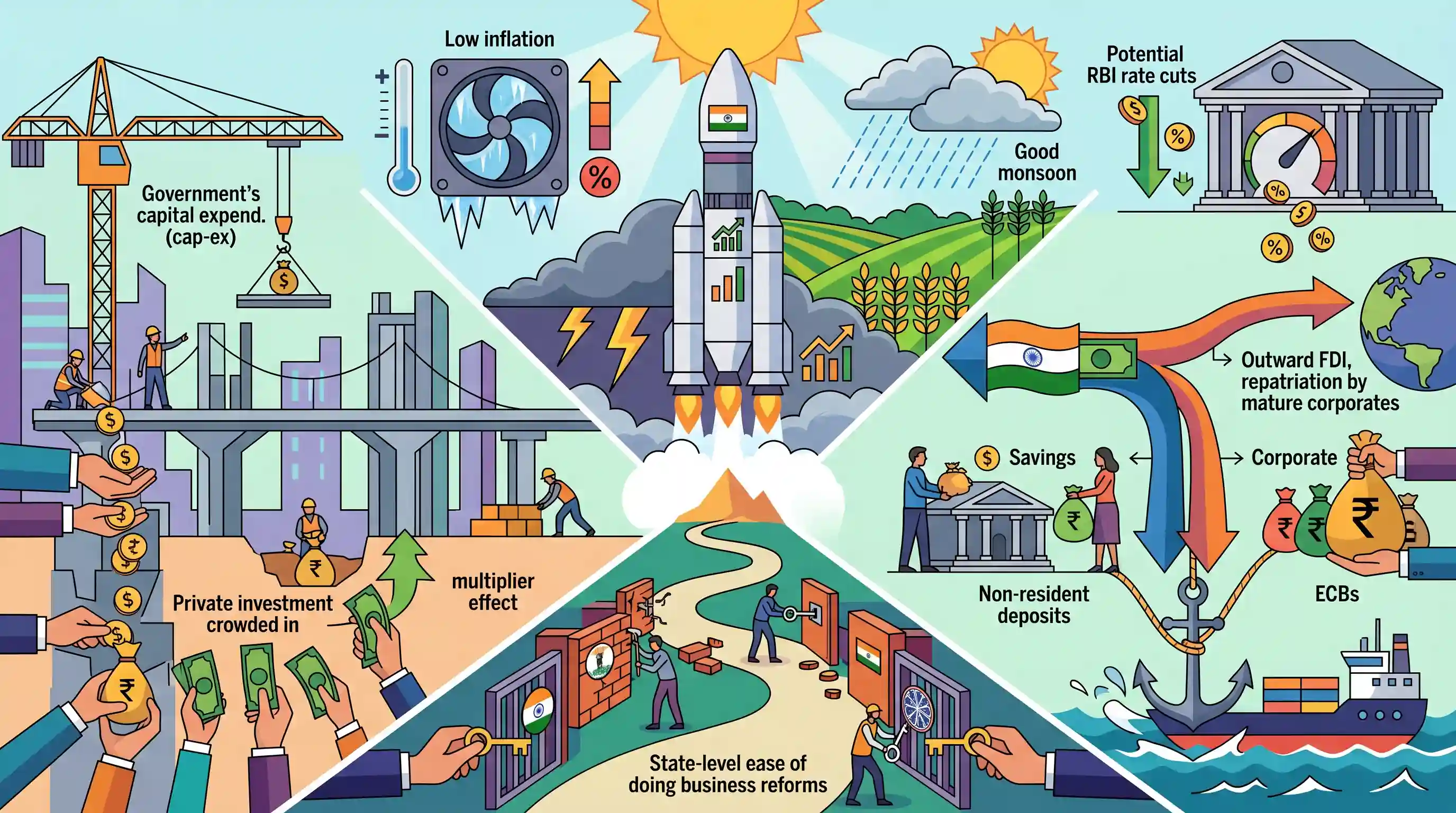
EAC-PM Chairman S. Mahendra Dev projects the Indian economy to grow at a resilient 6.5% in FY26 despite global geopolitical tensions. This optimism is underpinned by domestic tailwinds including anticipated low inflation, a good monsoon, and prospective RBI interest rate cuts. A critical growth driver remains the government's sustained capital expenditure, which continues to crowd-in private investment through a robust multiplier effect. On the external front, while total FDI inflows increased, net FDI moderated due to a surge in outward FDI and repatriation, reflecting a maturing corporate sector. Strong inflows via non-resident deposits and External Commercial Borrowings (ECBs) further anchor external stability. Achieving long-term potential now heavily depends on state-level ease of doing business reforms.
Key Points
- India's economy is projected to grow at 6.5% in FY26, defying global geopolitical and trade uncertainties and surpassing IMF and World Bank estimates.
- Growth is primarily driven by rising government capital expenditure, which is creating a significant multiplier effect on private investment.
- Positive tailwinds for FY26 include anticipated low inflation, a favorable monsoon, and a benign interest rate environment aided by expected RBI rate cuts.
- India saw a 14% increase in foreign direct investment (FDI) inflows, though net FDI was moderated by a surge in outward FDI—a sign of a maturing economy.
- External resilience is bolstered by higher net inflows from non-resident deposits and External Commercial Borrowings (ECBs).
- Sustaining growth will require state-level deregulation and easing of compliance burdens to encourage a largely debt-free corporate sector to resume heavy investments.
Important Terms
Economic Advisory Council to the Prime Minister (EAC-PM)

An independent, non-constitutional body constituted to provide economic advice, particularly on macroeconomic issues and policy trends, directly to the Prime Minister of India.
UPSC context
GS Paper III (Indian Economy); tests knowledge of institutional frameworks for economic policy-making and advisory bodies.
Capital Expenditure (Capex)
Government or private spending on the acquisition, creation, or improvement of long-term physical assets like infrastructure, which generates future income and improves productivity.
UPSC context
GS Paper III (Budgeting/Growth); crucial for understanding fiscal policy, capital vs. revenue expenditure, and growth drivers.
Crowding-in
A phenomenon where increased government investment in public goods and infrastructure boosts business confidence and profitability, leading to a subsequent rise in private sector investment.
UPSC context
GS Paper III (Investment Models/Fiscal Policy); tests understanding of the relationship between public spending and private capital.
External Commercial Borrowings (ECBs)
Loans availed by Indian entities from non-resident lenders in foreign currency, including commercial bank loans and securitized instruments, regulated by the RBI.
UPSC context
GS Paper III (Mobilization of Resources/External Sector); tests knowledge of foreign capital inflows and external debt management.
Foreign Direct Investment (FDI)
A cross-border investment where an entity from one country establishes a lasting interest and significant influence (typically 10%+ stake) over a business in another country.
UPSC context
GS Paper III (Effects of Liberalization); key for understanding non-debt capital flows and technology transfer.
Multiplier Effect
The proportionality between an initial change in spending (such as government Capex) and the larger final increase in the total national income or GDP.
UPSC context
GS Paper III (Growth and Development); tests understanding of how fiscal stimulus impact cascades through the economy.
Prelims Trap
"An increase in gross FDI inflows always guarantees a corresponding increase in Net FDI."
Net FDI can decline despite higher gross inflows if Outward FDI (domestic companies investing abroad) and capital repatriation by foreign investors outpace the incoming investments.
Static Concepts Connected
What is the 'Crowding-in' effect of government capital expenditure?
- Definition: The phenomenon where increased government spending induces a subsequent rise in private sector investment.
- Mechanism: Public infrastructure spending lowers business operational costs (e.g., better roads, logistics), which boosts expected private returns and stimulates private capex.
- Contrast: It is the opposite of 'crowding-out', where heavy government borrowing raises interest rates, stifling credit access for the private sector.
What are the core features of External Commercial Borrowings (ECBs)?
- Nature: Commercial loans raised by eligible resident Indian entities from recognized non-resident entities to access cheaper global capital.
- Currency: They can be denominated in a foreign currency (FCY) or in Indian Rupees (INR).
- Regulation: They are closely regulated by the Reserve Bank of India (RBI) under the Foreign Exchange Management Act (FEMA).
Cross-Topic Patterns
Outward FDI as strategic diplomacy
India's rising Outward FDI reflects a maturing corporate sector securing global value chain integration and strategic assets abroad, shifting the narrative from merely attracting foreign capital to projecting economic power globally.
Federalism's role in private investment
Achieving the 6.5% growth potential heavily depends on State-level deregulation (land, labor, local compliances). This shifts the private-investment bottleneck directly into the domain of competitive-cooperative federalism.

Expect a 2026 Prelims multi-statement question differentiating Gross vs Net FDI, coupled with the mechanics and impacts of Outward FDI.
Linked PYQs · 5
Linked PYQs · 5
- 2020MainsGS3
Explain the meaning of investment in an economy in terms of capital formation. Discuss the factors to be considered while designing a concession agreement between a public entity and a private entity.
- 2021PrelimsGS1
Consider the following : 1. Foreign currency convertible bonds 2. Foreign institutional investment with certain conditions 3. Global depository receipts 4. Non-resident external deposits Which of the above can be included in Foreign Direct Investments?
- 2022PrelimsGS1
With reference to the Indian economy, consider the following statements: 1. If the inflation is too high, Reserve Bank of India (RBI) is likely to buy government securities. 2. If the rupee is rapidly depreciating, RBI is likely to sell dollars in the market. 3. If interest rates in the USA or European Union were to fall, that is likely to induce RBI to buy dollars. Which of the statements given above are correct?
- 2022PrelimsGS1
Consider the following statements: 1. Tight monetary policy of US Federal Reserve could lead to capital flight. 2. Capital flight may increase the interest cost of firms with existing External Commercial Borrowings (ECBs). 3. Devaluation of domestic currency decreases the currency risk associated with ECBs. Which of the statements given above are correct?
- 2015PrelimsGS1
With reference to inflation in India, which of the following statements is correct?
