Festive demand and rural recovery boost third quarter economic growth
Source:Indian Express ↗
Why It Matters
Understanding the drivers of economic recovery, particularly the interplay between urban festive consumption and rural demand, is vital for analyzing India's GDP growth dynamics. It highlights structural dependencies within the economy, relevant for GS Paper 3 topics on growth, development, and resource mobilization.
Summary
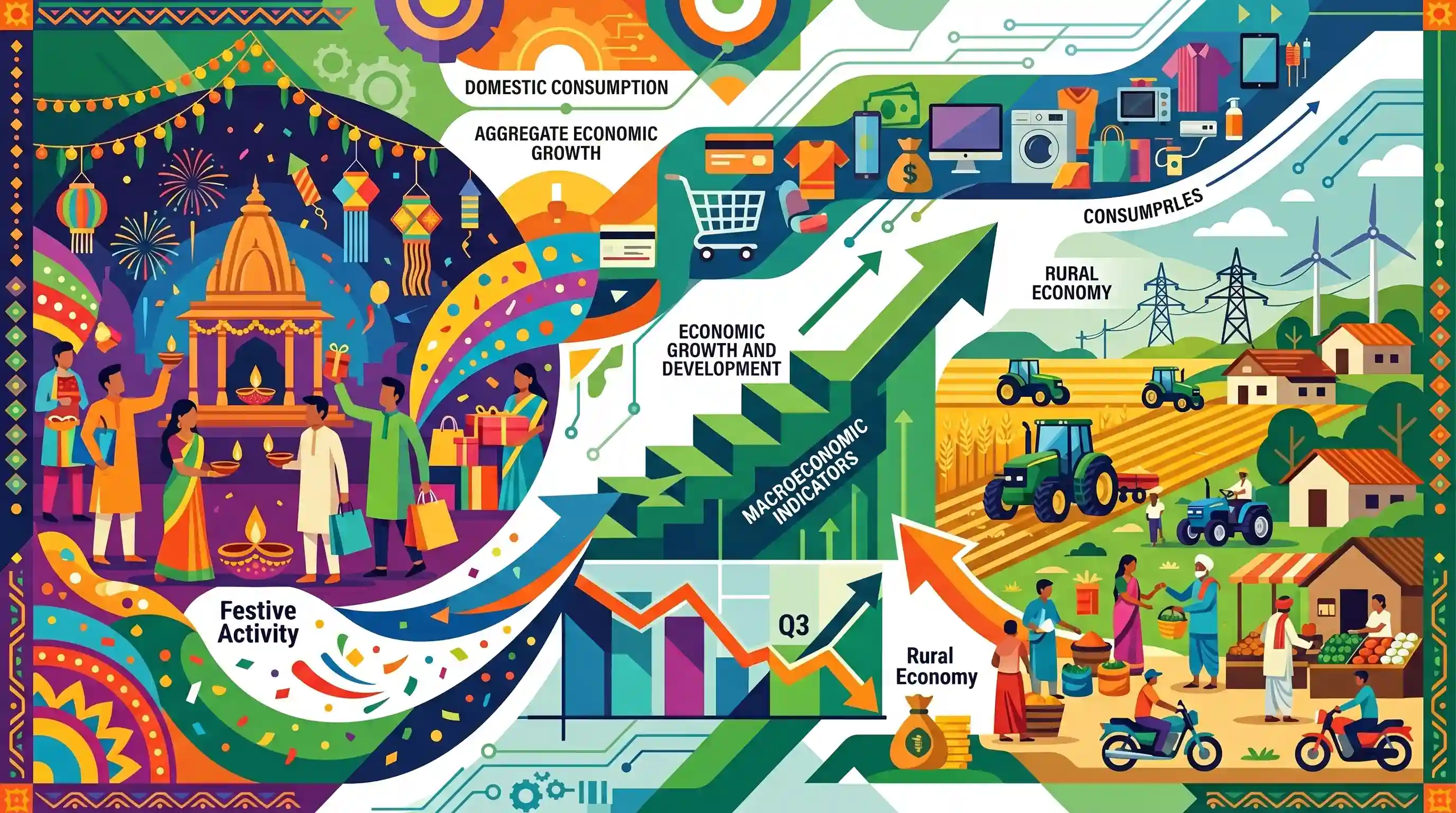
The Indian economy is on a recovery path in the third quarter (Q3), driven by robust festive activity and a resurgence in rural demand. This rebound in consumption, particularly in rural areas, has provided much-needed support to aggregate economic growth, easing earlier concerns of a slowdown and highlighting the critical role of domestic demand dynamics in sustaining economic momentum.
Key Points
- The Indian economy has demonstrated a recovery trajectory in the third quarter (Q3) of the fiscal year.
- This growth momentum has been significantly fueled by a surge in consumption linked to strong festive season activities.
- A revival in rural demand has emerged as a crucial factor, acting as a cushion and driver for overall aggregate demand.
- Positive trends in these high-frequency indicators ease immediate concerns about an economic slowdown and underscore the importance of rural wage growth and agricultural performance in sustaining broader economic vitality.
Prelims Trap
"An increase in nominal rural wages always leads to a proportional expansion in Private Final Consumption Expenditure."
Real wages matter, not just nominal wages. If consumer inflation outpaces nominal wage growth, real purchasing power falls, which can restrict—rather than expand—overall domestic consumption.
Static Concepts Connected
What are the primary components of India's GDP calculated by the expenditure method?
- PFCE: Private Final Consumption Expenditure constitutes the largest share (~58-60%), reflecting domestic household consumption.
- GFCF: Gross Fixed Capital Formation tracks investment in durable assets and infrastructure by both private and public sectors.
- GFCE: Government Final Consumption Expenditure covers government spending on day-to-day operations and public services.
- Net Exports: Total exports minus total imports, traditionally a negative figure (net drag) for the Indian economy.
How do High-Frequency Indicators (HFIs) assist in macroeconomic policymaking?
- Real-time tracking: They provide real-time, high-speed insights into economic momentum, bridging the gap between delayed quarterly GDP data releases.
- Key indicators: Commonly tracked metrics include GST collections, e-way bill generation, Purchasing Managers' Index (PMI), electricity demand, and tractor/auto sales.
- Policy agility: They allow the RBI and Ministry of Finance to swiftly detect slowdowns or recoveries and course-correct monetary and fiscal policies.
Cross-Topic Patterns
Monsoons, Agriculture, and FMCG demand
Rural consumption is fundamentally tied to monsoon performance. Erratic weather patterns (like El Niño) directly dictate rural FMCG and auto sales by altering agricultural output and real incomes.
Rural food inflation vs Monetary Policy
Food price volatility disproportionately hits rural consumers. High food inflation erodes rural purchasing power, restricting PFCE and complicating RBI's growth-inflation tradeoff even when core inflation remains stable.

Expect a multi-statement Prelims question linking components of India's aggregate demand (PFCE) with real vs. nominal rural wage trends.
Linked PYQs · 3
Linked PYQs · 3
- 2020MainsGS3
Define potential GDP and explain its determinants. What are the factors that have been inhibiting India from realizing its potential GDP?
- 2022MainsGS3
Economic growth in the recent past has been led by increase in labour productivity." Explain this statement. Suggest the growth pattern that will lead to creation of more jobs without compromising labour productivity.
- 2018PrelimsGS1
Increase in absolute and per capita real GNP do not connote a higher level of economic development, if
