Welfare scheme transitions and electoral roll revision concerns
Source:The Hindu ↗
Why It Matters
Highlights critical issues related to the shift from rights-based welfare (MGNREGS) to mission-based schemes, potential disenfranchisement of marginalized voters, and the ongoing demand for women's political representation—all core areas of GS2 governance and social justice.
Summary
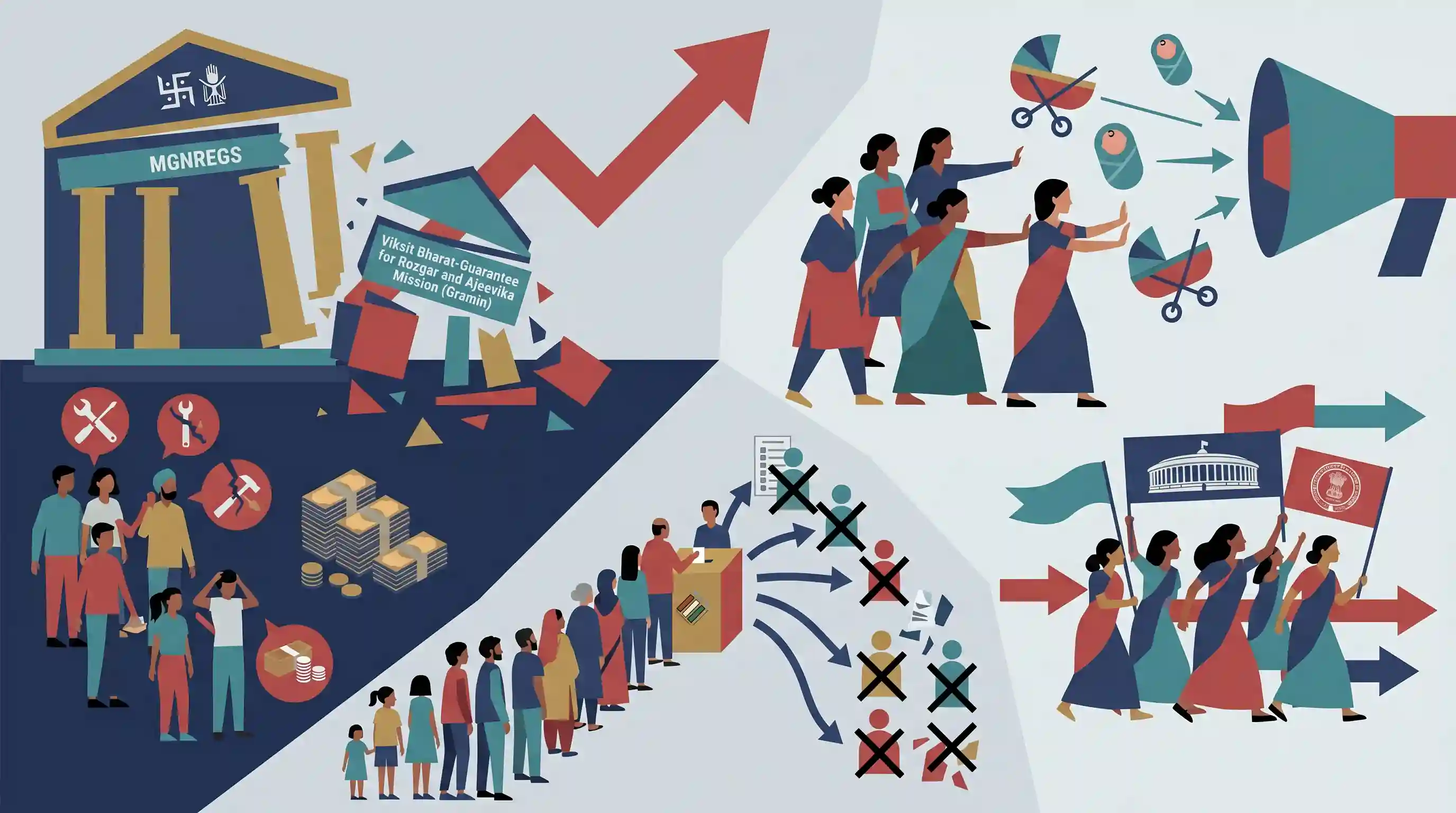
CPI national secretary Annie Raja has criticized the NDA government’s policies for exacerbating economic distress and unemployment. She raised concerns over the replacement of the rights-based MGNREGS with the new Viksit Bharat-Guarantee for Rozgar and Ajeevika Mission (Gramin), which she claims lacks adequate wage and worker safeguards. Raja also highlighted alleged voter disenfranchisement among marginalized communities due to flawed voter list revisions. Additionally, she criticized remarks encouraging higher fertility rates and announced a nationwide campaign for the immediate implementation of women's legislative reservation.
Key Points
- The CPI leadership claims the shift from the rights-based MGNREGS to the new Viksit Bharat-Guarantee for Rozgar and Ajeevika Mission (Gramin) removes critical wage safeguards for rural workers.
- Concerns were raised regarding the mass deletion of voters from marginalized communities, migrants, and minorities from electoral rolls due to alleged technical discrepancies.
- The CPI and the National Federation of Indian Women plan to launch a nationwide campaign demanding the immediate implementation of women's reservation in legislative bodies.
- CPI national secretary Annie Raja criticized Andhra Pradesh Chief Minister N. Chandrababu Naidu's comments encouraging people to have more children.
Important Terms
Mahatma Gandhi National Rural Employment Guarantee Scheme (MGNREGS)

A 2005 rights-based law guaranteeing 100 days of unskilled wage employment annually to rural households. It was a demand-driven entitlement where the Centre bore 100% of unskilled wage costs.
UPSC context
GS Papers 2 & 3: Welfare schemes for vulnerable sections; tests rights-based vs mission-mode social security.
Viksit Bharat-Guarantee for Rozgar and Ajeevika Mission (Gramin) (VB-G RAM G)
A 2025 legislation replacing MGNREGA. It increases guaranteed work to 125 days but shifts to a supply-driven 'normative allocation' and a 60:40 Centre-State funding ratio for most states.
UPSC context
GS Paper 3: Employment and Rural Development; tests policy shifts in flagship social safety nets.
Nari Shakti Vandan Adhiniyam (Women's Reservation Bill)
The Constitution (106th Amendment) Act, 2023, reserving 33% of seats in Lok Sabha and State Assemblies for women. Implementation is linked to the first census and delimitation exercise after 2024.
UPSC context
GS Paper 2: Governance and Parliament; tests constitutional amendments and political empowerment of women.
Delimitation
The act of redrawing boundaries of Lok Sabha and State Assembly constituencies based on census data. It is the prerequisite for implementing the Women's Reservation Act.
UPSC context
GS Paper 2: Elections and Representation of People Act; tests electoral reforms and demographic representation.
National Federation of Indian Women (NFIW)
Established in 1954, it is the women's wing of the Communist Party of India. It focuses on women’s rights, political representation, and legal reforms against gender-based violence.
UPSC context
GS Paper 1: Role of women and women's organizations; tests the influence of civil society and political wings.
Prelims Trap
Viksit Bharat-Guarantee for Rozgar provides a universal statutory right to employment across all rural areas like MGNREGA.
The new scheme shifts from MGNREGA's universal framework to a conditional model limited to notified rural areas. Despite increasing days to 125, it is no longer universally guaranteed across all regions.
Static Concepts Connected
How is the delimitation of constituencies currently frozen, and what are its implications?
- Constitutional Freeze: The 84th Amendment Act froze the number of Lok Sabha seats per state until after the first Census published post-2026.
- Demographic Penalty: Southern states fear losing political representation due to successful population control measures compared to Northern states.
- Women's Reservation Link: The 106th CAA's (Women's Reservation) implementation is explicitly contingent on the delimitation exercise following the post-2026 Census.
Which statute governs the preparation, revision, and deletion of electoral rolls in India?
- RPA 1950: This Act governs the allocation of seats, delimitation, and the preparation/revision of electoral rolls for Parliament and State Legislatures.
- Voter Registration: Section 19 provides the statutory conditions for registration, namely being ordinarily resident in the constituency and at least 18 years of age.
- Statutory Deletions: Section 22 empowers Electoral Registration Officers to amend or delete entries, provided the person is given a reasonable opportunity to be heard.
Cross-Topic Patterns
106th CAA + Demographic Penalty
The operationalization of the Nari Shakti Vandan Adhiniyam is legally bound to post-2026 delimitation, intertwining women's rights with the brewing North-South political representation clash over fertility rates.
Evolution of Rural Employment Safety Nets
The shift from the universally statutory MGNREGA to the conditionally targeted Viksit Bharat-GRAM reflects a macroeconomic policy transition from rights-based welfare to targeted fiscal rationalization.

Expect a multi-statement Polity question linking the 106th CAA, post-2026 delimitation freeze, and the 'demographic penalty' on states.
Linked PYQs · 4
Linked PYQs · 4
- 2017MainsGS2
Poverty alleviation programmes in India remain mere showpieces until and unless they are backed up by political will." Discuss with reference to the performance of the major poverty alleviation programmes in India.
- 2024MainsGS2
Examine the need for electoral reforms as suggested by various committees with particular reference to "one nation one election" principle.
- 2019MainsGS2
“The reservation of seats for women in the institutions of local self-government has had a limited impact on the patriarchal character of the Indian Political Process.” Comment.
- 2023MainsGS2
Discuss the contribution of civil society groups for women's effective and meaningful participation and representation in state legislatures in India.
