Macroeconomic Growth and Sluggish Private Investment
Source:Indian Express ↗
Why It Matters
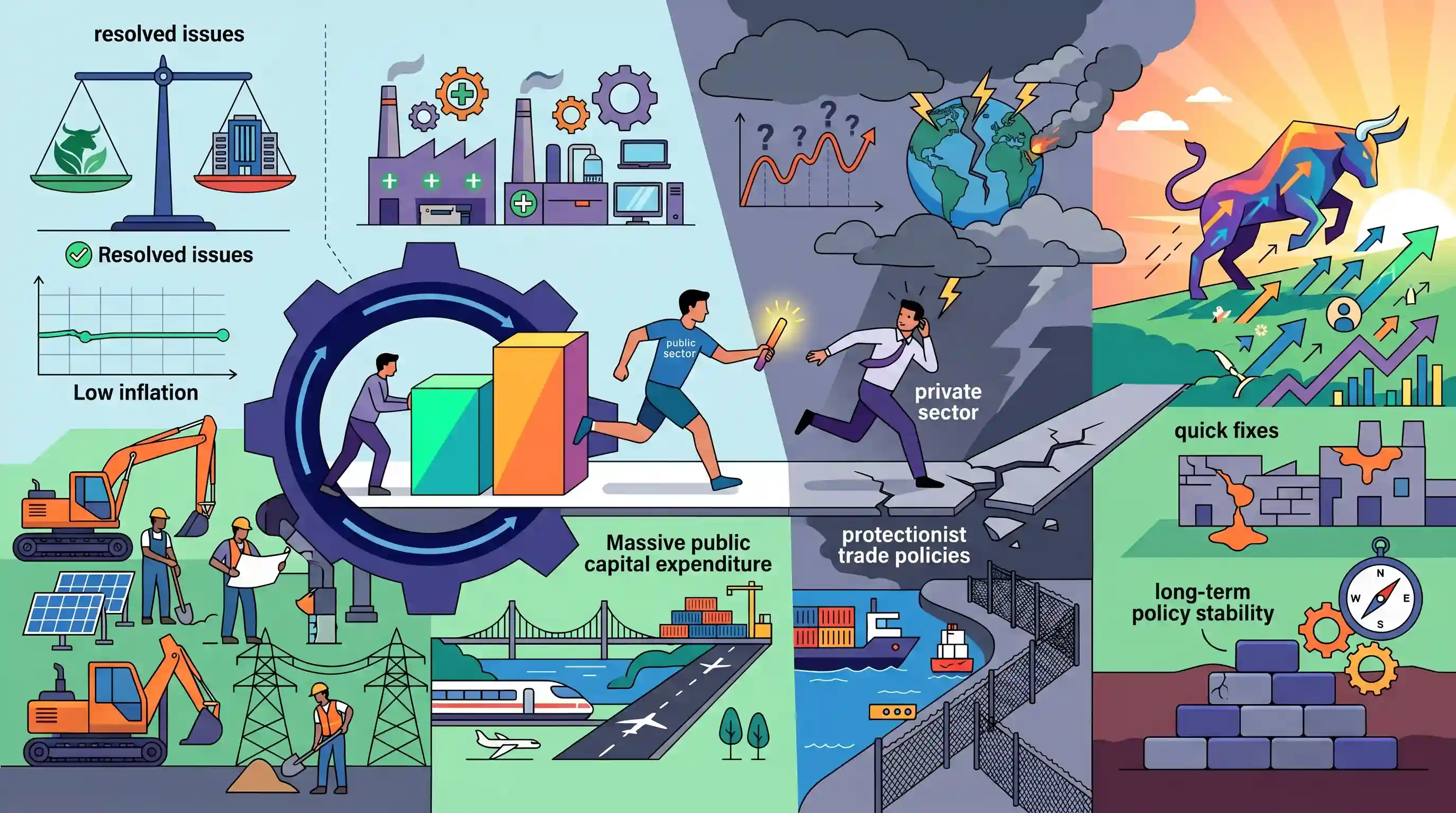
This article highlights a critical paradox in the current Indian economy: the contrast between a robust macroeconomic environment (buoyed by high public capex and banking sector recovery) and persistently sluggish private investment. Understanding this gap is crucial for aspirants answering questions on investment models, the effectiveness of the PLI scheme, and strategies for sustainable GDP growth.
Summary
The Indian economy is currently positioned in a macroeconomic 'sweet spot' with low inflation, healthy corporate balance sheets, and a resolved 'twin balance sheet' problem. The government has heavily leaned into public capital expenditure and supply-side incentives like the PLI scheme to spur growth. However, the private sector has not picked up the baton. A broad-based private investment cycle remains elusive as companies face demand uncertainty, global geopolitical risks, and potential protectionist trade policies. The editorial concludes that rather than relying on quick fixes, long-term policy stability is necessary to revive the private sector's 'animal spirits' and stimulate genuine economic momentum.
Key Points
- India's macroeconomic indicators are highly favorable, characterized by multi-decadal low bank NPAs, resolved corporate debt (twin balance sheet problem solved), and low inflation.
- The government has aggressively stepped up public capital expenditure, which has more than tripled since 2019-20 to Rs 11.21 lakh crore, intending to crowd in private investment.
- Supply-side measures like the PLI scheme and India Semiconductor Mission have attracted specific investments (e.g., Apple, Samsung), but have failed to kickstart a broad-based private capex cycle.
- Private sector investment and household consumption remain subdued due to fundamental uncertainties around domestic demand, geopolitical disruptions, and the threat of protectionist trade policies (e.g., potential tariffs by the US).
- The article argues that 'animal spirits' cannot be revived through quick fixes; what the private sector requires is sustained policy stability and organic demand visibility.
Important Terms
Production Linked Incentive (PLI) Scheme

A government scheme offering financial incentives to domestic manufacturers based on incremental sales in 14 key sectors (e.g., electronics, pharma) to boost local production.
UPSC context
GS Paper 3: Industrial policy and its effects on growth; tests knowledge of 'Atmanirbhar Bharat' and supply-side incentives.
Twin Balance Sheet Problem
A situation where both banks (burdened by NPAs) and corporates (over-leveraged with debt) face financial distress simultaneously, hindering investment and credit growth.
UPSC context
GS Paper 3: Indian Economy; critical for understanding banking health, NPA cycles, and barriers to private sector investment.
Animal Spirits
A term coined by J.M. Keynes describing the human emotions, instincts, and confidence (optimism or pessimism) that drive financial decisions and private investment cycles.
UPSC context
GS Paper 3: Resource mobilization and growth; frequently cited in Economic Surveys to explain private sector investment behavior.
Public Capital Expenditure (Capex)
Government spending on long-term physical assets like infrastructure (roads, railways) to create a 'multiplier effect' that stimulates demand and potentially 'crowds in' private investment.
UPSC context
GS Paper 3: Government Budgeting; tests the efficacy of state-led growth models versus private sector-led momentum.
India Semiconductor Mission (ISM)
An independent division under Digital India Corporation aimed at building a sustainable semiconductor and display ecosystem in India with a ₹76,000 crore outlay.
UPSC context
GS Paper 3: Science & Technology and Industrial Policy; tests understanding of strategic manufacturing and global supply chain integration.
Reserve Bank of India (RBI)
India’s central bank responsible for formulating monetary policy, managing inflation (targeting 4% +/- 2%), and ensuring the stability of the financial system.
UPSC context
GS Paper 3: Indian Economy; core institution for monetary management and macroeconomic stability.
Prelims Trap
High public capital expenditure inevitably crowds out private sector investment.
In developing economies with infrastructure deficits, targeted public capex often "crowds in" private investment by reducing logistics costs, rather than crowding it out.
Static Concepts Connected
What is the Twin Balance Sheet (TBS) advantage?
- TBS Problem: A historical macroeconomic bottleneck where overleveraged, highly indebted corporates coincided with severely stressed banks holding high Non-Performing Assets (NPAs).
- TBS Advantage: The current resolved scenario characterized by deleveraged, profitable corporate balance sheets alongside well-capitalized banks with multi-decadal low NPAs, ready to lend.
How do Keynesian 'Animal Spirits' impact economic growth?
- Key Concept: A term coined by John Maynard Keynes describing the psychological, emotional, and intuitive factors that drive business leaders' investment decisions.
- Economic Impact: Even with low interest rates and supply-side incentives, poor animal spirits (pessimism about future demand or policy stability) will keep private capital expenditure subdued.
Cross-Topic Patterns
PLI Scheme vs. Global Protectionism
India's PLI schemes aim to build major export capacities, but rising geopolitical risks and Western protectionist policies threaten the external demand needed to sustain these mega-factories.
K-Shaped Recovery & Subdued Demand
The private sector's reluctance to invest points directly to stagnant household consumption, linking macroeconomic capex stagnation to rural wage distress and the broader K-shaped economic recovery.

Expect a GS3 question evaluating why record public capex and PLI schemes have failed to revive private 'animal spirits' and investment.
Linked PYQs · 4
Linked PYQs · 4
- 2025MainsGS3
Discuss the rationale of the Production Linked Incentive (PLI) scheme. What are its achievements? In what way can the functioning and outcomes of the scheme be improved?
- 2023MainsGS3
Faster economic growth requires increased share of the manufacturing sector in GDP, particularly of MSMEs. Comment on the present policies of the Government in this regard.
- 2019MainsGS3
The public expenditure management is a challenge to the Government of India in the context of budget making during the post-liberalization period. Clarify it.
- 2023PrelimsGS1
Consider the following statements: Statement-I: In the post-pandemic recent past, many Central Banks worldwide had carried out interest rate hikes. Statement-II: Central Banks generally assume that they have the ability to counteract the rising consumer prices via monetary policy means. Which one of the following is correct in respect of the above statements?
