Macroeconomic Indicators and GDP Growth Estimates for 2025-26
Source:Indian Express ↗
Why It Matters
Advance GDP estimates directly inform the Union Budget's fiscal arithmetic. Understanding the implications of the real vs. nominal GDP growth gap, the impact of global protectionism on domestic growth, and base year revisions is highly relevant for GS3 questions on economic planning, resource mobilization, and macroeconomic stability.
Summary
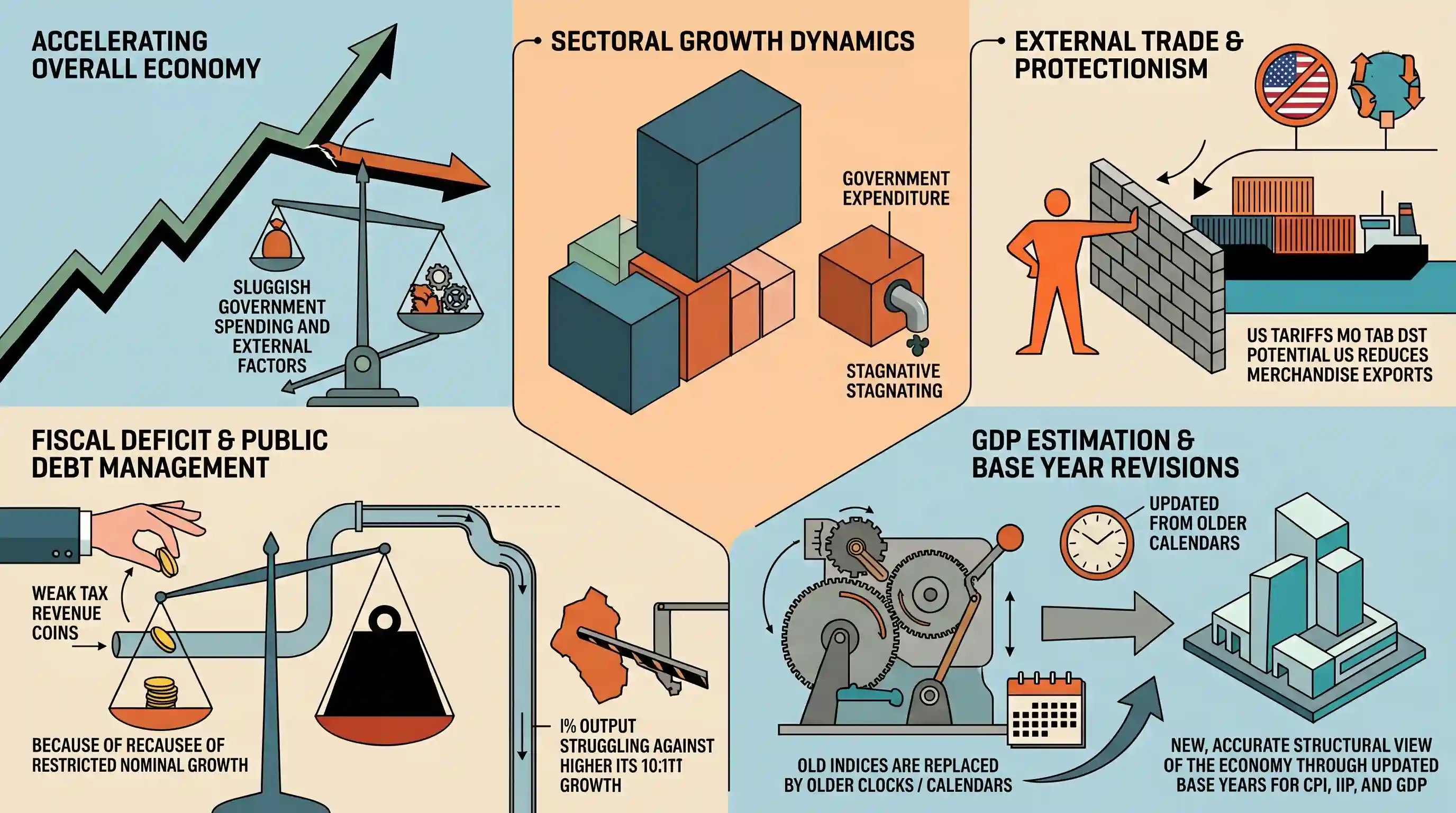
The National Statistical Office's first advance estimates project the Indian economy to grow at a faster-than-expected 7.4% in 2025-26. However, growth is expected to moderate in the second half of the year due to sluggish government expenditure and external headwinds, notably potential US tariffs under Donald Trump affecting merchandise exports. While real GDP growth driven by the services sector remains robust, a major concern is the sluggish nominal GDP growth, estimated at just 8% against a budget assumption of 10.1%. Slower nominal growth restricts tax revenue expansion and complicates the management of fiscal deficit and public debt. The upcoming revision of base years for CPI, IIP, and GDP will provide a more updated structural view of the economy.
Key Points
- India's economy is projected to grow at 7.4% in 2025-26 according to the NSO's first advance estimates, surpassing the expectations of the RBI and market analysts.
- Growth is expected to decelerate from 8% in the first half of the year to 6.8% in the second half, partly due to muted government spending and the looming impact of US tariffs on Indian exports.
- The services sector remains the primary growth engine (9.1% growth), significantly outpacing industry (5.8%) and agriculture (3.6%).
- Nominal GDP is estimated to grow at only 8%, falling short of the 10.1% budgeted assumption; this marks the second consecutive year of sub-10% nominal growth, which complicates fiscal deficit and debt management.
- Major statistical revisions are imminent, including a new Consumer Price Index (CPI) series with a 2024 base year, alongside updated Index of Industrial Production (IIP) and GDP series using 2022-23 as the new base year.
Important Terms
National Statistical Office (NSO)

The central statistical agency under MoSPI responsible for national accounts, including GDP and CPI. It ensures data consistency through uniform methodologies across states.
UPSC context
GS-III (Economy): Tests institutional frameworks and the 'National Accounting' methodology under the System of National Accounts (SNA).
Nominal GDP
The total value of goods and services produced at current market prices. It serves as the denominator for key ratios like fiscal deficit and public debt.
UPSC context
GS-III (Growth & Budget): Crucial for understanding 'tax buoyancy' and fiscal consolidation targets in the Union Budget.
Real GDP
Economic output adjusted for inflation using constant prices from a base year. It reflects the actual volume of production rather than price-driven increases.
UPSC context
GS-III (Macroeconomics): The primary metric used by the RBI and government to measure 'true' economic expansion.
First Advance Estimates (FAE)
The first official GDP projections for a fiscal year, released by the NSO in early January to provide the base for Union Budget calculations.
UPSC context
GS-III (Budgeting): Important for the 'Budget-making process' and understanding how early data influences fiscal allocations.
Base Year Revision
Updating the reference year for indices (GDP, CPI, IIP) to reflect modern consumption patterns, industrial structures, and emerging sectors like the digital economy.
UPSC context
GS-III (Economic Development): Tests concepts of 'statistical rebasing' and maintaining data accuracy against structural shifts.
Fiscal Deficit
The gap between a government’s total expenditure and its total non-borrowed receipts, representing the total amount of money the government needs to borrow.
UPSC context
GS-III (Fiscal Policy): Central to the 'FRBM Act' and assessing the sustainability of public debt.
Prelims Trap
Sluggish nominal GDP growth improves the Fiscal Deficit-to-GDP ratio by limiting inflation.
Lower nominal GDP acts as a smaller denominator, mechanically inflating (worsening) the Fiscal Deficit-to-GDP ratio, even if absolute government borrowing remains completely constant.
Static Concepts Connected
Why are base years for GDP, IIP, and CPI periodically revised?
- Structural reflection: Captures changes in consumption patterns (e.g., the rise of digital services) and new industrial activity that emerged since the previous base year.
- Real vs Nominal: Establishes a more accurate GDP deflator, which is essential for stripping out price-induced inflation to measure genuine economic output.
How does nominal GDP growth impact fiscal consolidation?
- Denominator effect: Nominal GDP serves as the mathematical denominator; slower nominal growth inflates deficit-to-GDP and debt-to-GDP ratios automatically.
- Tax buoyancy: Lower nominal economic growth suppresses nominal tax collections, directly impairing the government's ability to meet budgeted revenue targets.
- Debt sustainability: When the effective interest rate on public debt exceeds nominal GDP growth, debt dynamics worsen, creating a snowball effect.
Cross-Topic Patterns
Tariffs + Current Account vulnerabilities
Rising US protectionism directly threatens Indian merchandise exports, creating external headwinds that could widen the Current Account Deficit and exert pressure on the Rupee.
CPI base year + Food weighting
Updating the CPI base to 2024 will likely reduce the weight of food (previously ~46% under 2012 base), significantly altering how the RBI calculates inflation and sets monetary policy.

The mathematical interplay between nominal GDP growth, the GDP deflator, and fiscal deficit ratios is a prime Prelims 2026 target.
Linked PYQs · 4
Linked PYQs · 4
- 2001PrelimsGS1
The most appropriate measure of a country’s economic growth is its
- 2019MainsGS3
Do you agree with the view that steady GDP growth and low inflation have left the Indian economy in good shape? Give reasons in support of your arguments.
- 2025MainsGS3
What are the challenges before the Indian economy when the world is moving away from free trade and multilateralism to protectionism and bilateralism? How can these challenges be met?
- 2018MainsGS3
How would the recent phenomena of protectionism and currency manipulations in world trade affect macroeconomic stability of India?
