Tamil Nadu Agriculture Sector Structural Challenges and Trends
Source:The Hindu ↗
Why It Matters
This survey provides a comprehensive micro-level case study applicable to GS-3 topics like crop yield stagnation, the shift towards allied sectors (livestock/poultry), and the failure of agricultural extension services (MSP awareness, Soil Health Cards). It highlights real-world agricultural constraints and structural transitions occurring in Indian states.
Summary
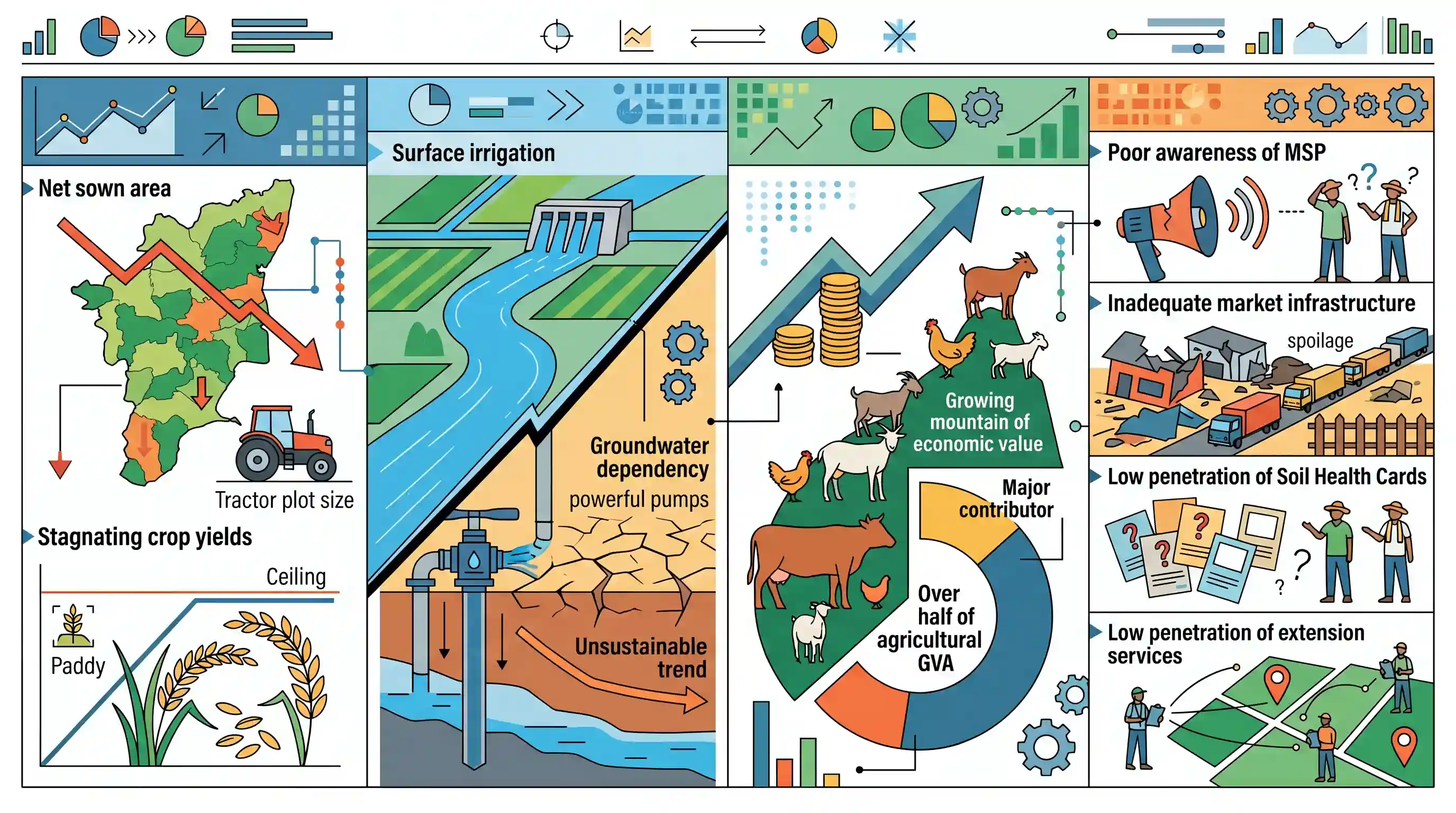
The Tamil Nadu Economic Survey 2025-26, released by the State Planning Commission, reveals structural challenges in the state's agriculture sector. Key concerns include a continuous decline in net sown area, stagnating yields of major crops like paddy, and an unsustainable shift from surface irrigation to groundwater dependency. Conversely, the livestock sector has emerged as a major growth driver, contributing 53% of the agricultural GVA. The survey also underscores severe institutional gaps, notably poor awareness of the Minimum Support Price (MSP), inadequate agricultural market infrastructure, and low penetration of Soil Health Cards and agricultural extension services.
Key Points
- Tamil Nadu's net sown area has shrunk by approximately 2 lakh hectares since 2001-02, alongside a significant rise in fallow lands.
- Surface irrigation (canals and tanks) has declined, pushing farmers towards heavy reliance on groundwater extracted via electrified well pumpsets, necessitating better groundwater management policies.
- The livestock sector has shown robust growth, contributing 53% to the agriculture GVA in 2024-25 (up from 30% in 2011-12), which has concurrently driven a 7.5% CAGR increase in maize cultivation for poultry feed.
- Awareness regarding the Minimum Support Price (MSP) remains critically low, with 68% of paddy farmers and 90% of maize farmers unaware of the scheme.
- Extension services are weak, reflected in low adoption rates for bio-inputs and Soil Health Cards, and an over-reliance on local markets due to poor storage and transport infrastructure.
Important Terms
Minimum Support Price (MSP)

A government-guaranteed floor price at which the state purchases crops from farmers to ensure remunerative returns and prevent distress sales during market price fluctuations.
UPSC context
GS Paper 3: Agricultural pricing and food security; tests understanding of farmer safety nets and procurement mechanisms.
Soil Health Card (SHC) Scheme
A scheme launched in 2015 providing farmers with reports on 12 soil parameters (macro/micronutrients, physical properties) to ensure balanced fertilizer use and sustainable soil health.
UPSC context
GS Paper 3: Sustainable agriculture and land degradation; tests knowledge of soil-test-based nutrient management.
Agricultural Extension Services
The transfer of technical advice, scientific research, and modern farming techniques to farmers to increase productivity, improve livelihoods, and manage risks sustainably.
UPSC context
GS Paper 3: Technology in agriculture; tests understanding of the 'lab-to-land' bridge and institutional support systems.
State Planning Commission
An advisory body at the state level responsible for policy coordination, sectoral research, and preparing the State Economic Survey to guide development planning.
UPSC context
GS Paper 2/3: Governance and federalism; tests knowledge of state-level planning vs. NITI Aayog's national framework.
Gross Value Added (GVA)
A measure of the total value of goods and services produced in an economy (or sector) after deducting the cost of all intermediate inputs used in production.
UPSC context
GS Paper 3: National income accounting; tests ability to analyze sectoral contributions to the economy.
Net Sown Area
The total area on which crops are actually sown and harvested at least once during the agricultural year; a key indicator of land utilization.
UPSC context
GS Paper 1/3: Geography and Agriculture; tests understanding of land-use patterns and food production capacity.
Prelims Trap
The crop sector accounts for the absolute majority of Agricultural GVA in all major agrarian states in India.
False. Allied sectors are rapidly overtaking crop production. In states like Tamil Nadu, the livestock sector now contributes over 50% of the total agriculture GVA, bypassing traditional crops.
Static Concepts Connected
What factors drive cropping pattern shifts towards coarse cereals like maize?
- Feed Demand: Rapid growth in the poultry and livestock sectors creates massive demand for maize as animal feed.
- Climate Resilience: Maize requires significantly less water compared to water-guzzling crops like paddy and sugarcane, offering better climate resilience.
- Bio-fuel Policies: Government pushes to utilize damaged or surplus maize for ethanol production incentivize farmers to expand cultivation.
Why has groundwater extraction dominated over surface irrigation in India?
- Power Subsidies: Free or heavily subsidized electricity policies for agriculture incentivize the continuous pumping of groundwater.
- Surface Infrastructure Neglect: Poor maintenance, siltation, and encroachment have degraded traditional surface water structures like canals and tanks.
- Fragmented Landholdings: Small landholdings make individual tube wells more practically viable for farmers than relying on collective canal distribution networks.
Cross-Topic Patterns
Livestock feed vs. Ethanol blending mandate
The shift toward maize cultivation to support the booming poultry sector directly competes with national bio-fuel policies that increasingly rely on maize for achieving E20 (20% ethanol blending) targets.
Power subsidies and groundwater depletion
The structural shift away from traditional tank irrigation toward electrified pumpsets is directly fueled by state-level free electricity policies, demonstrating the ecological cost of untargeted agricultural subsidies.

Expect a multi-statement prelims question linking the shift in Agri-GVA (livestock > crops) to rising maize demand and water table stress.
Linked PYQs · 5
Linked PYQs · 5
- 2023MainsGS3
Explain the changes in cropping pattern in India in the context of changes in consumption pattern and marketing conditions.
- 2017MainsGS3
What are the major reasons for declining rice and wheat yield in the cropping system? How crop diversification is helpful to stabilise the yield of the crops in the system?
- 2024MainsGS3
What are the major challenges faced by Indian irrigation system in recent times? State the measures taken by the government for efficient irrigation management.
- 2016MainsGS3
What is water-use efficiency? Describe the role of micro-irrigation in increasing the water-use efficiency.
- 2015MainsGS3
Livestock rearing has a big potential for providing non-farm employment and income in rural areas. Discuss suggesting suitable measures to promote this sector in India.
