Economic Survey 2026 tax reforms and decriminalisation
Source:Indian Express ↗
Why It Matters
The Economic Survey is a primary source for UPSC GS3 preparation, offering the official macroeconomic perspective and identifying key structural bottlenecks. Its focus on tax simplification and decriminalisation of economic offences directly links to syllabus topics on investment models, government budgeting, and economic reforms.
Summary
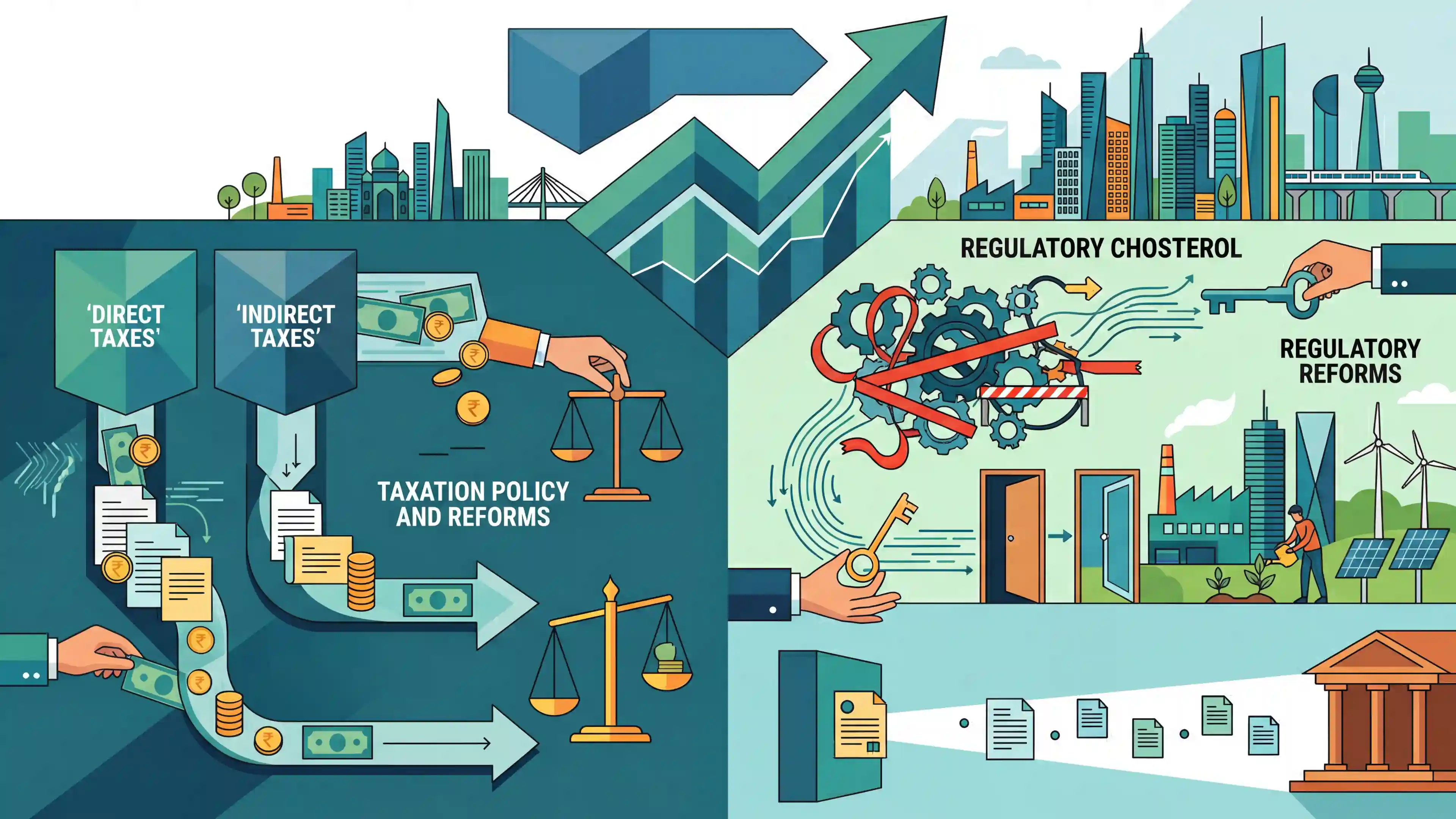
The Economic Survey projects a 7% economic growth target for India, underscoring the need for continued structural reforms to sustain macroeconomic momentum. A major focus of the Survey is the call to simplify both direct and indirect tax systems, which is intended to ease the compliance burden on taxpayers and curb extensive tax litigation. Additionally, it advocates for the decriminalisation of technical and minor economic offences. By addressing this 'regulatory cholesterol,' the government aims to significantly improve the ease of doing business, thereby fostering a more favorable environment for private investments and corporate growth.
Key Points
- The Economic Survey outlines a 7% economic growth target for the upcoming fiscal year, highlighting macroeconomic stability.
- It strongly recommends the simplification of India's tax systems (both direct and indirect) to boost compliance and reduce prolonged litigation.
- The document advocates for the decriminalisation of minor and technical economic offences to remove regulatory bottlenecks.
- Reducing 'regulatory cholesterol' is emphasized as a critical step to improve the ease of doing business and attract robust private sector investment.
Important Terms
Economic Survey

Annual document by the Ministry of Finance reviewing the economy's performance over the past year. Prepared by the Chief Economic Adviser, it provides growth projections and policy recommendations before the Union Budget.
UPSC context
GS-III (Indian Economy); tests ability to analyze macroeconomic trends, policy shifts, and the government's economic outlook.
Goods and Services Tax (GST)
A destination-based, multi-stage indirect tax introduced in 2017 to unify India’s internal market. It subsumed various central and state taxes like excise duty and VAT under a "One Nation, One Tax" framework.
UPSC context
GS-III (Taxation/Budgeting); essential for understanding fiscal federalism, indirect tax reforms, and the GST Council's role.
Ministry of Finance
The nodal agency responsible for managing India's public finances, including the preparation of the Union Budget, tax administration, and overseeing financial institutions and capital markets.
UPSC context
GS-II/III (Governance/Economy); tests knowledge of budget-making, fiscal policy, and institutional financial frameworks.
Regulatory Cholesterol
A concept highlighting the burdensome, complex, and often archaic web of regulations and compliance requirements. It acts as a friction point that stifles entrepreneurship, productivity, and growth.
UPSC context
GS-III (Economy); tests understanding of structural bottlenecks and the need for regulatory simplification.
Decriminalisation of Economic Offences
Shifting minor or technical regulatory defaults from criminal law (imprisonment) to civil law (monetary penalties). This reduces the fear of litigation for businesses and unclogs the judicial system.
UPSC context
GS-III (Ease of Doing Business); relevant for corporate governance and trust-based investment climate.
Ease of Doing Business
The simplicity of regulations for businesses throughout their lifecycle. India's reforms focus on "trust-based compliance," digitizing processes, and reducing the time and cost of operating a company.
UPSC context
GS-III (Economic Development); critical for assessing investment attractiveness and industrial growth reforms.
Prelims Trap
The Economic Survey mandates the government to decriminalise minor economic offences.
The Economic Survey, authored by the CEA, is purely an advisory review of the economy. It recommends policy directions but cannot mandate or legislate them.
Static Concepts Connected
What are India's key tax dispute resolution schemes?
- Vivad se Vishwas: A direct tax dispute resolution scheme aimed at clearing pending litigation, offering waivers on interest and penalties to free up locked government revenues.
- Sabka Vishwas: A legacy dispute resolution scheme targeting indirect taxes (like Excise and Service Tax) that originated before the implementation of the GST regime.
What is 'Regulatory Cholesterol' and how is it addressed?
- Regulatory Cholesterol: Refers to the excessive, overlapping, and archaic compliance burdens that hinder private enterprise and complicate the ease of doing business in India.
- Jan Vishwas Act: Recent legislation like the Jan Vishwas Act addresses this by decriminalising minor, technical offences across various laws, replacing imprisonment with civil monetary penalties.
Cross-Topic Patterns
Tax simplification + Judicial pendency
Government is the largest litigator in India; simplifying tax laws directly aids the National Litigation Policy by reducing court clogging and unlocking stuck revenues.
Trust-based Governance + MSME growth
Decriminalising technical offences specifically shields MSMEs from disproportionate harassment, acting as a non-fiscal stimulus to boost private sector investment.

Expect a GS-3 mains question linking 'regulatory cholesterol' and tax simplification to private investment stagnation and economic growth.
Linked PYQs · 4
Linked PYQs · 4
- 2019MainsGS3
Enumerate the indirect taxes which have been subsumed in the Goods and Services Tax (GST) in India. Also, comment on the revenue implications of the GST introduced in India since July 2017.
- 2019PrelimsGS1
Which one of the following is not a sub-index of the World Bank's 'Ease of Doing Business Index'?
- 2022MainsGS3
Economic growth in the recent past has been led by increase in labour productivity." Explain this statement. Suggest the growth pattern that will lead to creation of more jobs without compromising labour productivity.
- 2023MainsGS3
Faster economic growth requires increased share of the manufacturing sector in GDP, particularly of MSMEs. Comment on the present policies of the Government in this regard.
