Economic Survey 2025-26 artificial intelligence roadmap
Source:Indian Express ↗
Why It Matters
The article outlines the Government of India's official strategic approach to AI as presented in the Economic Survey. It provides crucial insights into how India plans to balance AI innovation with regulation, data privacy, and global leadership, which is highly relevant for GS-2 (Governance) and GS-3 (Science and Technology / Economy).
Summary
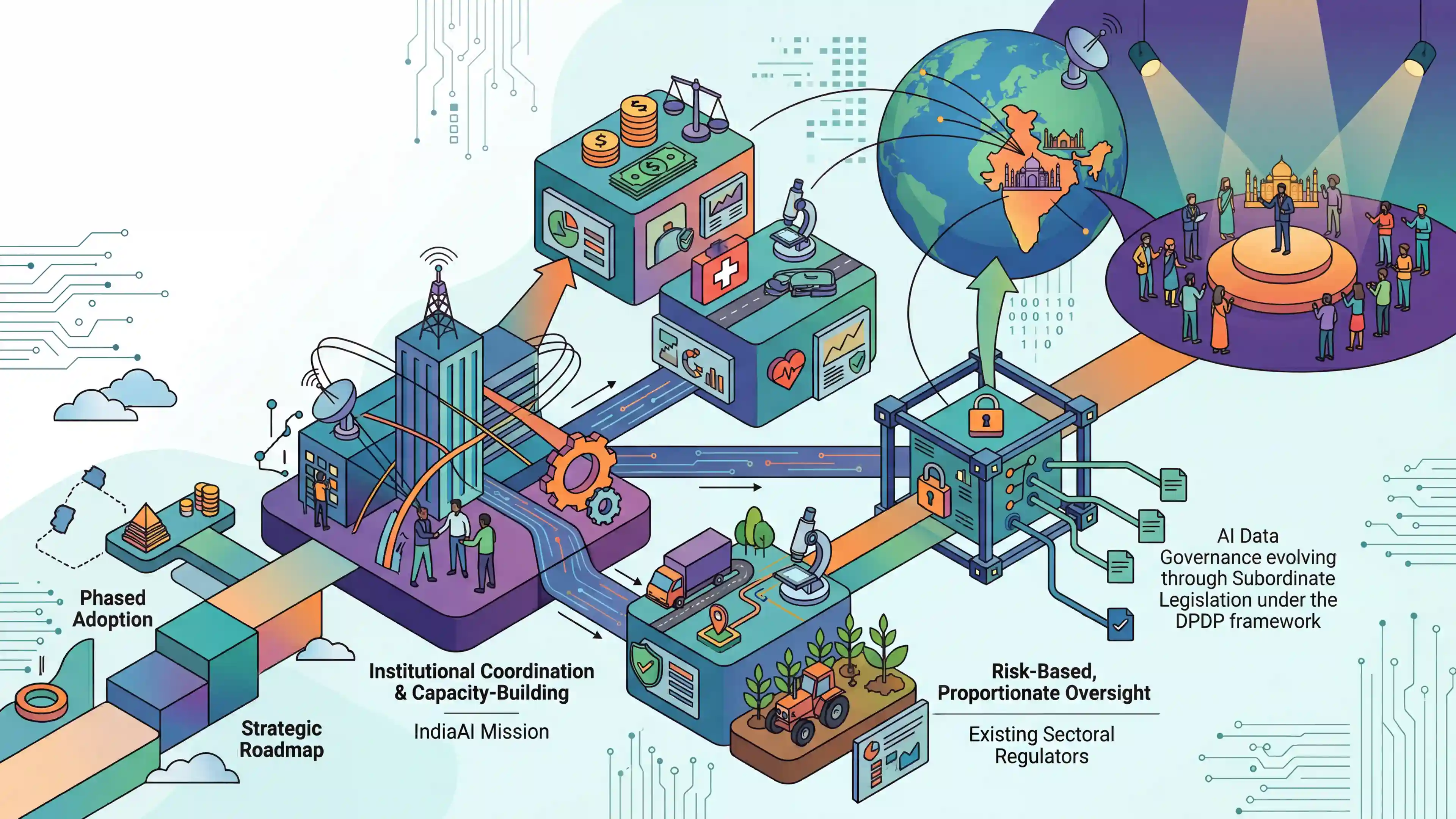
The Economic Survey 2025-26 outlines a strategic roadmap for Artificial Intelligence (AI) in India, recommending a phased adoption strategy to navigate uncertainties and resource constraints. It advocates for prioritizing institutional coordination and capacity-building via the IndiaAI Mission before implementing binding regulations. Rejecting a single omnibus AI law, the Survey favors risk-based, proportionate oversight managed by existing sectoral regulators. It also suggests that AI data governance should evolve through subordinate legislation under the DPDP framework. Additionally, the Survey highlights India's expanding role in global technology governance, noting that New Delhi will host the AI Impact Summit 2026, the first such summit in the Global South.
Key Points
- The Economic Survey 2025-26 recommends a phased strategy for AI adoption: first building coordination and capacity, then establishing binding policy leverage to avoid premature regulatory lock-ins.
- It advises against a single omnibus AI law, instead favoring risk-based, proportionate regulation embedded within existing sectoral regulators.
- Data governance for AI should evolve organically through subordinate legislation under the Digital Personal Data Protection (DPDP) framework.
- The survey supports the IndiaAI Mission's efforts to promote small, open-weight models, shared computing resources, and pooled access to public datasets.
- India will host the AI Impact Summit 2026 in New Delhi, marking the first such global AI safety and governance summit held in the Global South.
Important Terms
IndiaAI Mission

A ₹10,372 crore national initiative to build sovereign AI capacity through GPU procurement, indigenous foundational models (BharatGen), and sector-specific applications in healthcare and agriculture.
UPSC context
GS-III/S&T; critical for questions on digital sovereignty, indigenization of technology, and India's role in the global AI race.
Economic Survey 2025-26
The annual flagship report by the Ministry of Finance; the 2025-26 edition advocates a 'phased AI adoption' strategy, prioritizing institutional capacity over binding omnibus regulations.
UPSC context
GS-III/Economy; tests ability to analyze strategic shifts in government policy and resource prioritization for emerging technologies.
IndiaAI Safety Institute
A technical advisory body under the IndiaAI Mission that develops safety standards, risk-assessment tools, and benchmarks for ethical AI development using a hub-and-spoke model.
UPSC context
GS-II/Governance; important for discussing non-regulatory institutional mechanisms and ethical guardrails for disruptive technologies.
AI Impact Summit 2026
The first major global AI summit hosted in the Global South (February 2026), focusing on 'AI for All' and the developmental impact of AI on society.
UPSC context
GS-II/International Relations; highlights India’s leadership in global tech governance and its advocacy for the Global South's interests.
Digital Personal Data Protection (DPDP) framework
India’s primary legal structure for personal data; the 2025-26 Survey recommends using its subordinate rules to manage AI data governance and automated decision-making.
UPSC context
GS-II/Governance & GS-III/Cybersecurity; essential for understanding the intersection of privacy rights and AI innovation.
Prelims Trap
The Economic Survey recommends a single comprehensive omnibus AI law to centrally govern AI.
The Survey explicitly rejects an omnibus AI law, instead favoring a phased, risk-based regulatory framework managed by existing sectoral regulators to prevent stifling innovation.
Static Concepts Connected
What are the core components of the IndiaAI Mission?
- Compute Capacity: Creating an AI computing infrastructure of 10,000+ GPUs through public-private partnerships to support domestic startups.
- Datasets Platform: Establishing a unified platform to provide researchers and innovators seamless access to non-personal public datasets.
- Application Development: Promoting indigenous open-weight foundational models and AI applications targeting healthcare, agriculture, and governance.
Key provisions of the Digital Personal Data Protection (DPDP) Act
- Data Fiduciaries: Entities determining the purpose and means of data processing are accountable for protecting personal data and handling user grievances.
- Subordinate Legislation: The Act provides a skeletal framework, relying heavily on executive-drafted rules to govern specific operational details and future tech compliance.
- State Exemptions: Grants the central government power to exempt certain state instrumentalities in the interest of national sovereignty and security.
Cross-Topic Patterns
Sectoral vs Omnibus Tech Regulation
India's AI approach parallels its fintech strategy: relying on existing sectoral regulators (RBI, SEBI) to manage specific use-case risks rather than creating a massive central technology super-regulator.
Global South Tech Diplomacy
Hosting the AI Impact Summit 2026 builds on India's G20 legacy of shaping Digital Public Infrastructure (DPI), shifting global dialogue from Western 'AI existential safety' to 'AI for Development'.

Expect a Prelims question contrasting India's sectoral, risk-based AI regulatory approach with the EU's centralized omnibus AI Act.
Linked PYQs · 5
Linked PYQs · 5
- 2020PrelimsGS1
With the present state of development, Artificial Intelligence can effectively do which of the following? 1. Bring down electricity consumption in industrial units 2. Create meaningful short stories and songs 3. Disease diagnosis 4. Text-to-Speech Conversion 5. Wireless transmission of electrical energy Select the correct answer using the code given below:
- 2025PrelimsGS1
Consider the following statements: I. It is expected that Majorana 1 chip will enable quantum computing. II. Majorana 1 chip has been introduced by Amazon Web Services (AWS). III. Deep learning is a subset of machine learning. Which of the statements given above are correct?
- 2024MainsGS2
Right to privacy is intrinsic to life and personal liberty and is inherently protected under Article 21 of the constitution. Explain. In this reference discuss the law relating to D.N.A. testing of child in the womb to establish its paternity.
- 2024PrelimsGS1
Under which of the following Articles of the Constitution of India, has the Supreme Court of India placed the Right to Privacy ?
- 2025MainsGS2
e-governance projects have a built-in bias towards technology and back-end integration than user-centric designs. Examine.
