Ecological disruptions as non-traditional national security threats
Source:The Hindu ↗
Why It Matters
This topic blurs the traditional boundary between environmental science and national security. It is crucial for UPSC aspirants as it demonstrates how climate change and ecological collapse act as structural risks to national stability, serving as excellent fodder for GS3 (Security and Environment) and Essay papers.
Summary
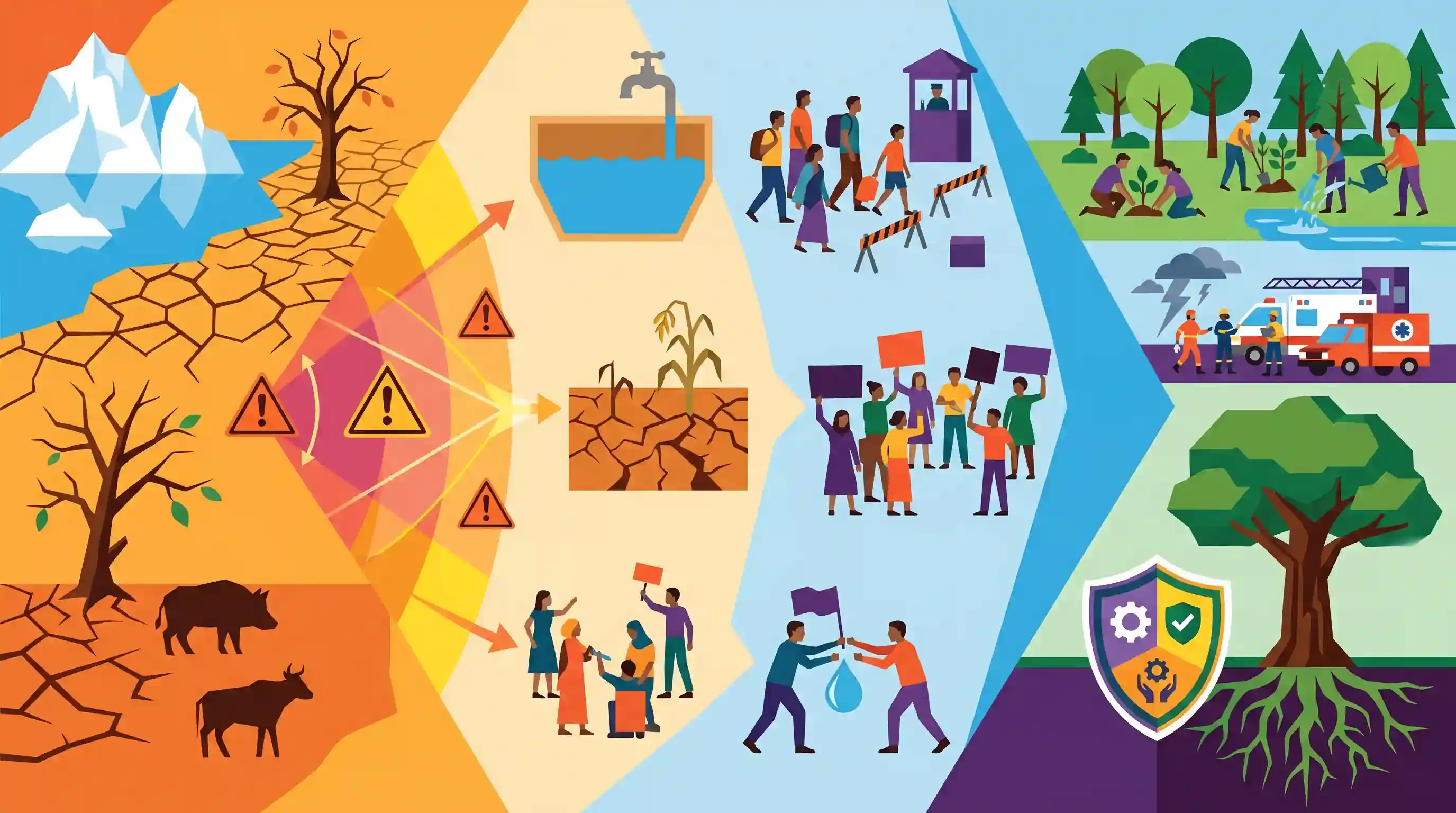
The article highlights how ecological disruptions—ranging from climate change and biodiversity loss to resource depletion—constitute severe non-traditional threats to national security. Environmental degradation acts as a 'threat multiplier,' worsening existing social, economic, and political fault lines. Issues such as water scarcity, food insecurity, and climate-induced mass migration can escalate into geopolitical conflicts, border insecurity, or internal unrest. The piece argues that integrating ecological resilience and environmental conservation into formal national security planning is critical for safeguarding a nation's long-term stability and mitigating future climate-linked crises.
Key Points
- Ecological disruptions act as 'threat multipliers' by aggravating existing vulnerabilities such as poverty, resource scarcity, and social inequality.
- Transboundary environmental issues, including shared river disputes and resource degradation, present major geopolitical and border management challenges.
- Climate-induced migration (climate refugees) from disaster-prone areas strains local resources, risking internal demographic tensions and cross-border friction.
- The increasing frequency of extreme weather events stretches defense and paramilitary forces via continuous Humanitarian Assistance and Disaster Relief (HADR) deployments, potentially impacting combat readiness.
- National security doctrines must evolve to formally include ecological security, treating sustainable resource management and climate resilience as core strategic imperatives.
Important Terms
Non-traditional Security (NTS) Threats

Transnational challenges arising from non-military sources—such as climate change, pandemics, and resource scarcity—that threaten both state survival and human well-being.
UPSC context
GS Paper III (Internal Security); tests understanding of modern security environments beyond conventional military warfare.
Threat Multiplier
A strategic concept describing how climate change interacts with and intensifies existing socio-economic and political vulnerabilities, amplifying risks of instability and conflict.
UPSC context
GS Paper III (Environment/Security); used to analyze how environmental stress triggers secondary crises like migration.
Sendai Framework for Disaster Risk Reduction
A 15-year (2015-2030) voluntary UN agreement aimed at substantially reducing disaster risk and losses through proactive governance, investment, and resilience.
UPSC context
GS Paper III (Disaster Management); provides the global roadmap for India’s National Disaster Management Plan.
Intergovernmental Panel on Climate Change (IPCC)
The UN body responsible for providing objective scientific assessments of climate change, its risks, and options for global adaptation and mitigation.
UPSC context
GS Paper III (Environment); its "Assessment Reports" are foundational for global climate policy and negotiations.
UN Security Council (UNSC)
The principal UN organ for maintaining international peace and security, currently debating the inclusion of climate change as a formal security threat.
UPSC context
GS Paper II (International Relations); tests India's stance on the "climatization" of security and UNSC reform.
Ecological Resilience
The capacity of an ecosystem to absorb disturbances and shocks, such as climate-linked disasters, while maintaining its essential structure and functions.
UPSC context
GS Paper III (Environment); critical for mitigation strategies against climate-induced national security risks.
Prelims Trap
Climate refugees are recognized as a protected class under the 1951 UN Refugee Convention.
The 1951 UN Refugee Convention only covers persecution based on race, religion, nationality, social group, or political opinion. It does NOT legally recognize climate migration.
Static Concepts Connected
What characterizes 'Non-Traditional Security' (NTS) threats?
- Human-centric focus: NTS shifts the focus from state sovereignty and military defense to the survival, livelihood, and well-being of individuals and communities.
- Transnational nature: Issues like climate change, pandemics, and cyber threats ignore national borders, requiring multilateral cooperation rather than unilateral military action.
- Threat multipliers: They exacerbate existing socio-economic fault lines (e.g., poverty, ethnic tensions), transforming local resource scarcity into hard security crises.
What is the Sendai Framework for Disaster Risk Reduction (2015-2030)?
- Successor agreement: It succeeded the Hyogo Framework, shifting the global focus from simply 'managing disasters' to proactively 'managing disaster risk' and addressing underlying vulnerabilities.
- Four priorities: 1) Understanding risk; 2) Strengthening governance; 3) Investing in resilience; 4) Enhancing preparedness for effective response (Build Back Better).
- Non-binding nature: It is a voluntary, non-binding agreement where the primary role rests with the State, but responsibility is shared with local governments and stakeholders.
Cross-Topic Patterns
Climate migration & Border Demographics
Ecological crises in neighboring states (e.g., sea-level rise in Bangladesh) drive unregulated migration into India, linking climate change directly to demographic tensions and border management challenges in GS-3.
Hydropolitics & Himalayan Ecology
Glacial retreat and transboundary river degradation in the Himalayas intertwine GS-1 geography with GS-2 IR, complicating the Indus Water Treaty and Brahmaputra basin relations with neighbors.

GS-3 Mains 2026 will likely feature a composite question linking climate change as a 'threat multiplier' to border security and HADR.
Linked PYQs · 4
Linked PYQs · 4
- 2021MainsGS3
Analyse the multidimensional challenges posed by external state and non-state actors, to the internal security of India. Also discuss measures required to be taken to combat these threats.
- 2024MainsGS3
Flooding in urban areas is an emerging climate-induced disaster. Discuss the causes of this disaster. Mention the features of two such major floods in the last two decades in India. Describe the policies and frameworks in India that aim at tackling such floods.
- 2024MainsEssay
Forests precede civilizations and deserts follow them.
- 2022MainsGS3
Discuss global warming and mention its effects on the global climate. Explain the control measures to bring down the level of greenhouse gases which cause global warming, in the light of the Kyoto Protocol, 1997.
