Ecocide definition under international criminal court rome statute
Source:Indian Express ↗
Why It Matters
Understanding ecocide and the Rome Statute is crucial for UPSC aspirants as it bridges International Relations (GS2) and Environmental Conservation (GS3). It highlights the evolution of international law from anthropocentric to ecocentric frameworks and underscores the jurisdictional limitations of global institutions like the ICC in addressing contemporary transnational challenges.
Summary
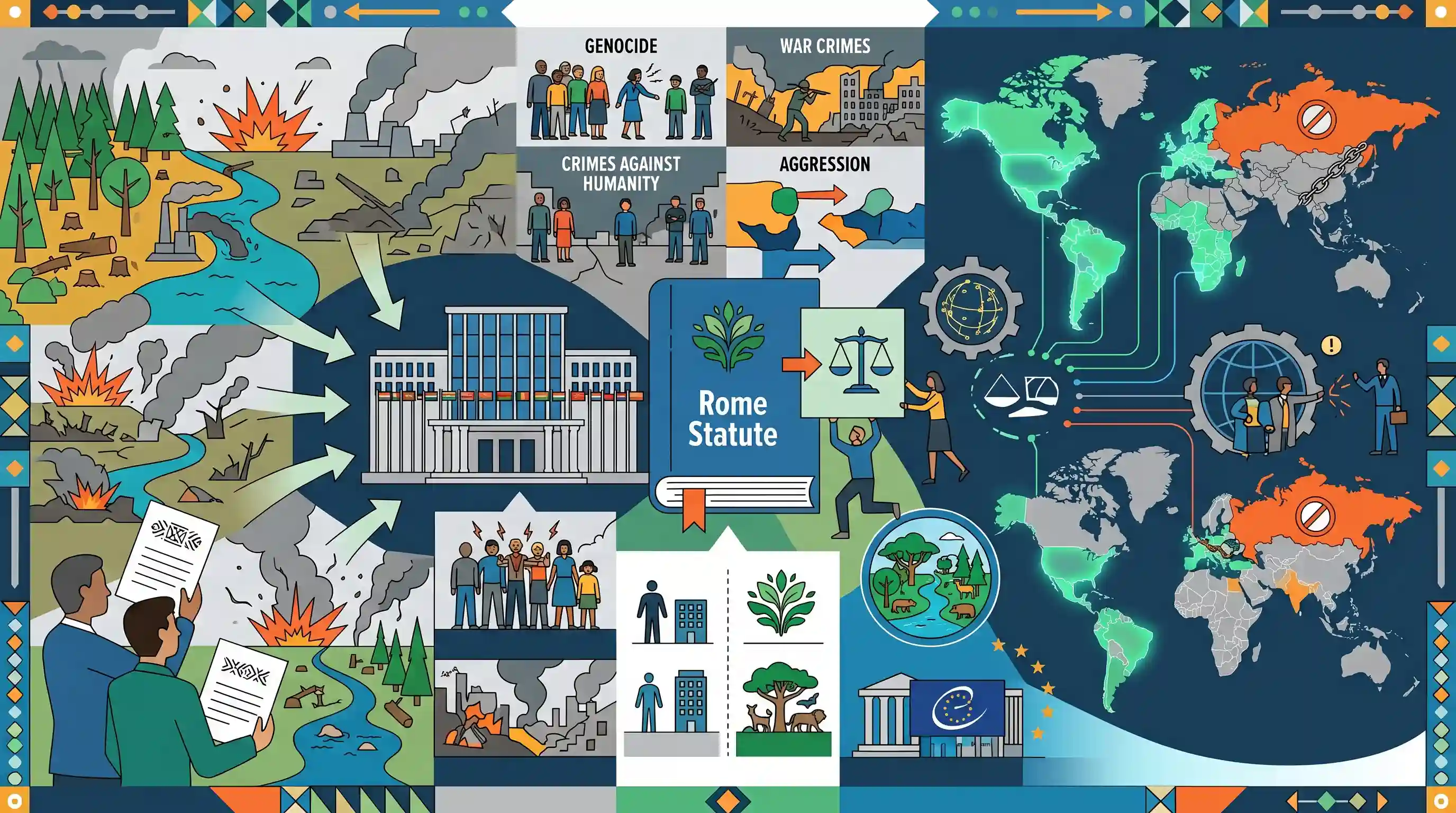
The article explains the concept of "ecocide," a term used to describe massive and long-term environmental destruction, which originated during the Vietnam War. Environmental advocates are pushing to amend the Rome Statute to recognize ecocide as the fifth international crime prosecutable by the International Criminal Court (ICC). While existing international frameworks like the Geneva Conventions and the ENMOD convention address environmental damage during wartime, they are fundamentally anthropocentric, requiring proof of direct harm to humans. An ecocide law would introduce an ecocentric approach, protecting ecosystems for their intrinsic value. However, significant enforcement challenges remain, primarily because many global powers are not signatories to the Rome Statute, limiting the ICC's jurisdictional reach. The Council of Europe's recent adoption of a convention acknowledging ecocide highlights growing international momentum.
Key Points
- Ecocide is defined as unlawful or wanton acts committed with the knowledge that there is a substantial likelihood of severe, widespread, or long-term environmental damage.
- The push to criminalize ecocide aims to make it the fifth international crime under the Rome Statute of the International Criminal Court (ICC), alongside genocide, crimes against humanity, war crimes, and crimes of aggression.
- Existing international laws, such as the Geneva Conventions and ENMOD, are largely anthropocentric, meaning they focus on environmental damage only when it directly harms human beings or is disproportionate to military advantage.
- In contrast, criminalizing ecocide represents an ecocentric approach, protecting the environment for its own intrinsic value, regardless of direct human impact.
- The Council of Europe has recently adopted the Convention on the Protection of the Environment through Criminal Law, becoming the first international instrument to acknowledge ecocide.
- A major challenge to prosecuting environmental destruction as an international crime is the ICC's limited jurisdiction, as several major nations and parties involved in current conflicts are not signatories to the Rome Statute.
Important Terms
Rome Statute

The 1998 foundational treaty that established the International Criminal Court (ICC), defining the four core international crimes: genocide, crimes against humanity, war crimes, and the crime of aggression.
UPSC context
GS II (International Relations). Crucial for understanding global justice frameworks and India's stance on non-signatory status.
International Criminal Court (ICC)
An intergovernmental organization and international tribunal in The Hague that prosecutes individuals for the world's most serious crimes. It is a 'court of last resort' complementing national systems.
UPSC context
GS II (International Relations). Tests knowledge of international bodies, jurisdiction, and legal sovereignty issues.
Environmental Modification Convention (ENMOD)
A 1977 international treaty prohibiting the military or hostile use of environmental modification techniques (like weather modification) that have widespread, long-lasting, or severe effects.
UPSC context
GS II & III (IR and Environment). Relevant for environmental security and legal prohibitions during warfare.
Geneva Conventions
Four 1949 treaties and three additional protocols forming the core of International Humanitarian Law. They establish standards for the humane treatment of non-combatants and prisoners during war.
UPSC context
GS II (International Relations). Fundamental to understanding global human rights standards and laws of armed conflict.
Council of Europe
Europe's oldest intergovernmental organization (founded 1949), distinct from the EU, focused on human rights, democracy, and the rule of law. It oversees the European Court of Human Rights.
UPSC context
GS II (International Institutions). Important for distinguishing between various European regional organizations.
Convention on the Protection of the Environment through Criminal Law
A 2025 legally binding treaty that establishes minimum criminal standards for environmental offenses, marking the first international instrument to specifically criminalize acts tantamount to 'ecocide.'
UPSC context
GS II & III. Represents a major shift in international environmental law toward criminal liability.
Prelims Trap
"Ecocide is recognized as the fifth prosecutable international crime under the Rome Statute."
Ecocide is currently only a PROPOSED amendment. The ICC's Rome Statute presently recognizes exactly four crimes: genocide, crimes against humanity, war crimes, and the crime of aggression.
Static Concepts Connected
What are the four core international crimes currently prosecuted by the ICC?
- Genocide: Acts committed with intent to destroy, in whole or in part, a national, ethnical, racial or religious group.
- Crimes against humanity: Widespread or systematic attacks directed against any civilian population, with knowledge of the attack.
- War crimes: Grave breaches of the Geneva Conventions and other serious violations of the laws and customs of war.
- Crime of aggression: Planning or execution by a state leader of an act of armed force against the sovereignty of another state.
How do Anthropocentric and Ecocentric approaches to environmental conservation differ?
- Anthropocentric approach: Views humans as the central entity; environmental protection is pursued primarily because it ensures human survival, health, and economic well-being.
- Ecocentric approach: Recognizes the intrinsic value of all ecosystems and species, advocating for their protection regardless of their direct utility or benefit to humans.
Cross-Topic Patterns
GS4 Environmental Ethics linkages
The shift from an anthropocentric to an ecocentric legal framework provides a perfect contemporary example for GS4 ethics answers on the intrinsic value of nature and human responsibility.
India's sovereignty vs. ICC jurisdiction
India's continued refusal to sign the Rome Statute limits international enforcement of concepts like ecocide, linking global environmental governance directly to India's traditional stance on state sovereignty.
ENMOD and Climate Geoengineering
The 1976 ENMOD Convention, born from Vietnam War defoliant use, is increasingly cited in modern global debates over the legality and risks of solar geoengineering and weather modification.

Multi-statement Prelims Q likely testing the 4 current ICC crimes using 'ecocide' as a false trap, alongside India's non-member status.
Linked PYQs · 3
Linked PYQs · 3
- 2023MainsGS2
‘Sea is an important Component of the Cosmos’ Discuss in the light of the above statement the role of the IMO (International Maritime Organisation) in protecting environment and enhancing maritime safety and security.
- 2025PrelimsGS1
Consider the following statements : Statement I: Article 6 of the Paris Agreement on climate change is frequently discussed in global discussions on sustainable development and climate change. Statement II: Article 6 of the Paris Agreement on climate change sets out the principles of carbon markets. Statement III : Article 6 of the Paris Agreement on climate change intends to promote inter-country non-market strategies to reach their climate targets. Which one of the following is correct in respect of the above statements?
- 2021PrelimsGS1
'R2 Code of Practices' constitutes a tool available for promoting the adoption of
