ECI Stance on Left Out Voters and Enumeration Forms
Source:Indian Express ↗
Why It Matters
It highlights the procedural safeguards and administrative accountability of the Election Commission in maintaining accurate electoral rolls and protecting universal adult suffrage.
Summary
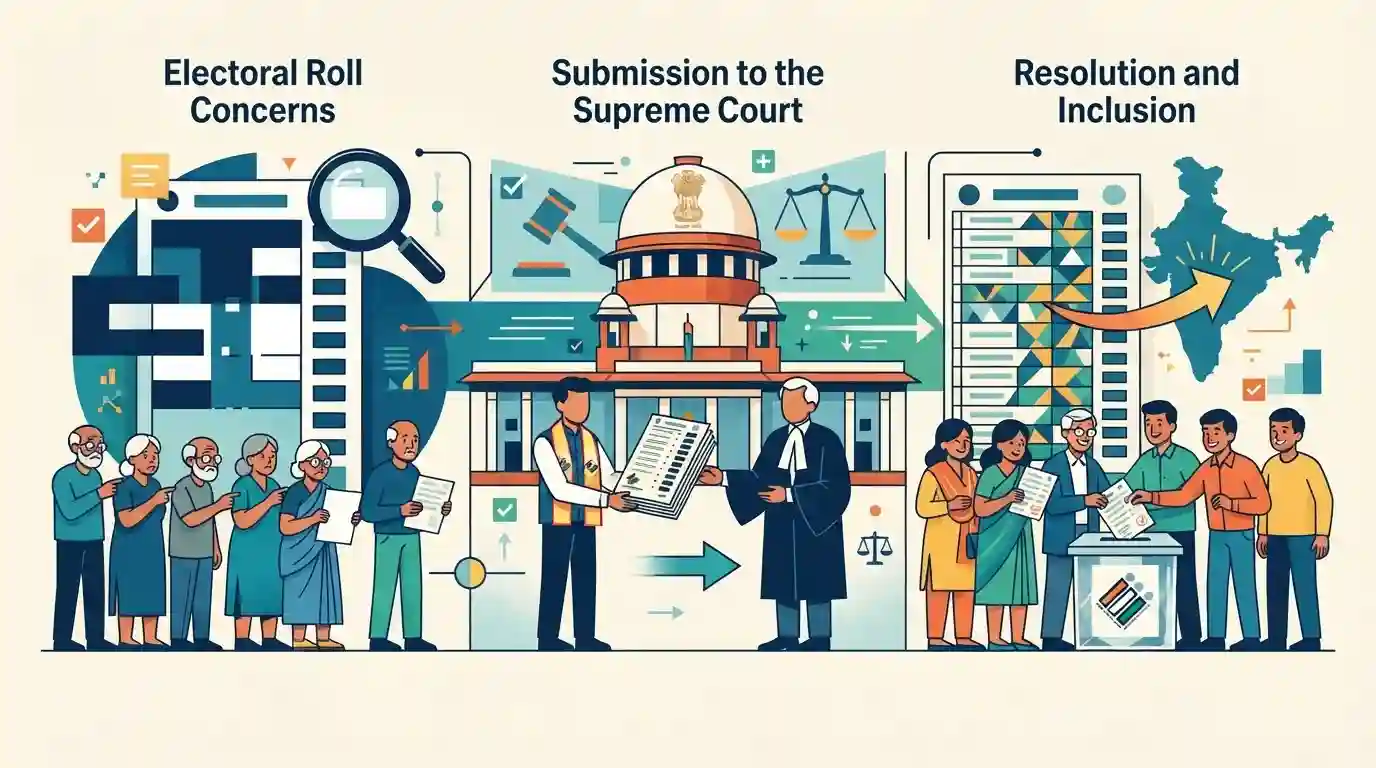
The Election Commission of India told the Supreme Court that voters who were left out during the enumeration process can submit their enumeration forms, addressing concerns regarding voter inclusion and electoral roll accuracy.
Key Points
- The Election Commission of India (ECI) informed the Supreme Court that voters left out during enumeration can submit enumeration forms.
- The case pertains to electoral rolls preparation, verification, and ensuring no eligible citizen is disenfranchised.
- The process underscores the statutory mechanism under electoral laws managed by the poll body.
Important Terms
Election Commission of India

An autonomous constitutional authority responsible for administering election processes in India under Article 324, ensuring free and fair elections to Parliament, State Legislatures, and the offices of the President and Vice-President.
UPSC context
UPSC GS Paper II (Polity and Governance): Functions, responsibilities, and constitutional status of constitutional bodies.
Supreme Court of India
The apex judicial body of India under Article 124, possessing original, appellate, and writ jurisdictions, and acting as the ultimate interpreter of the Constitution and protector of fundamental rights.
UPSC context
UPSC GS Paper II (Polity and Governance): Structure, organization, and functioning of the judiciary and judicial review.
Representation of the People Act
Key legislation enacted by Parliament under Article 327 of the Constitution to regulate the conduct of elections, qualifications/disqualifications for membership, and corrupt practices.
UPSC context
UPSC GS Paper II (Polity and Governance): Salient features of the RPA, 1950 and 1951, and electoral reforms.
Prelims Trap
the fundamental right to vote guaranteed under Part III of the Constitution
Aspirants often confuse voting rights as a Fundamental Right under Part III, whereas it is only a statutory/constitutional right derived through the Representation of the People Act.
Static Concepts Connected
What are the constitutional provisions and statutory basis governing the preparation of electoral rolls in India?
- Article 324: Grants the Election Commission of India the power of superintendence, direction, and control of the preparation of electoral rolls.
- Article 325: Mandates a single general electoral roll for every territorial constituency and prohibits exclusion on grounds only of religion, race, caste, or sex.
- RPA Acts 1950 & 1951: The Representation of the People Act, 1950, provides for the allocation of seats and demarcation of constituencies, while the RPA, 1951, handles actual conduct of elections and voter registration details.
Cross-Topic Patterns
ECI Autonomy vs. Judicial Review
While Article 324 grants plenary powers to the ECI, the Supreme Court frequently intervenes when statutory processes like enumeration risk disenfranchising citizens, highlighting the balance between administrative autonomy and judicial review.

Expect a statement-based question combining Article 324, Article 325, and the statutory nature of voting rights under the RPA 1950/1951.
Linked PYQs · 3
Linked PYQs · 3
- 2023PrelimsGS1
Consider the following statements in respect of election to the President of India: 1. The members nominated to either House of the Parliament or the Legislative Assemblies of States are also eligible to be included in the Electoral College. 2. Higher the number of elective Assembly seats, higher is the value of vote of each MLA of that State. 3. The value of vote of each MLA of Madhya Pradesh is greater than that of Kerala. 4. The value of vote of each MLA of Puducherry is higher than that of Arunachal Pradesh because the ratio of total population to total number of elective seats in Puducherry is greater as compared to Arunachal Pradesh. How many of the above statements are correct?
- 2017PrelimsGS1
For election to the Lok Sabha, a nomination paper can be filed by
- 2020PrelimsGS1
Consider the following statements: 1. According to the Constitution of India, a person who is eligible to vote can be made a minister in a State for six months even if he/she is not a member of the Legislature of that State. 2. According to the Representation of People Act, 1951, a person convicted of a criminal offence and sentenced to imprisonment for five years is permanently disqualified from contesting an election even after his release from prison. Which of the statements given above is/are correct?
