Election Commission Directive Procedures and Transparency
Source:The Hindu ↗
Why It Matters
The controversy touches upon the functional autonomy, integrity, and operational transparency of the Election Commission of India. It emphasizes the need for strict adherence to formal administrative procedures (e-governance) to maintain public trust in democratic processes.
Summary
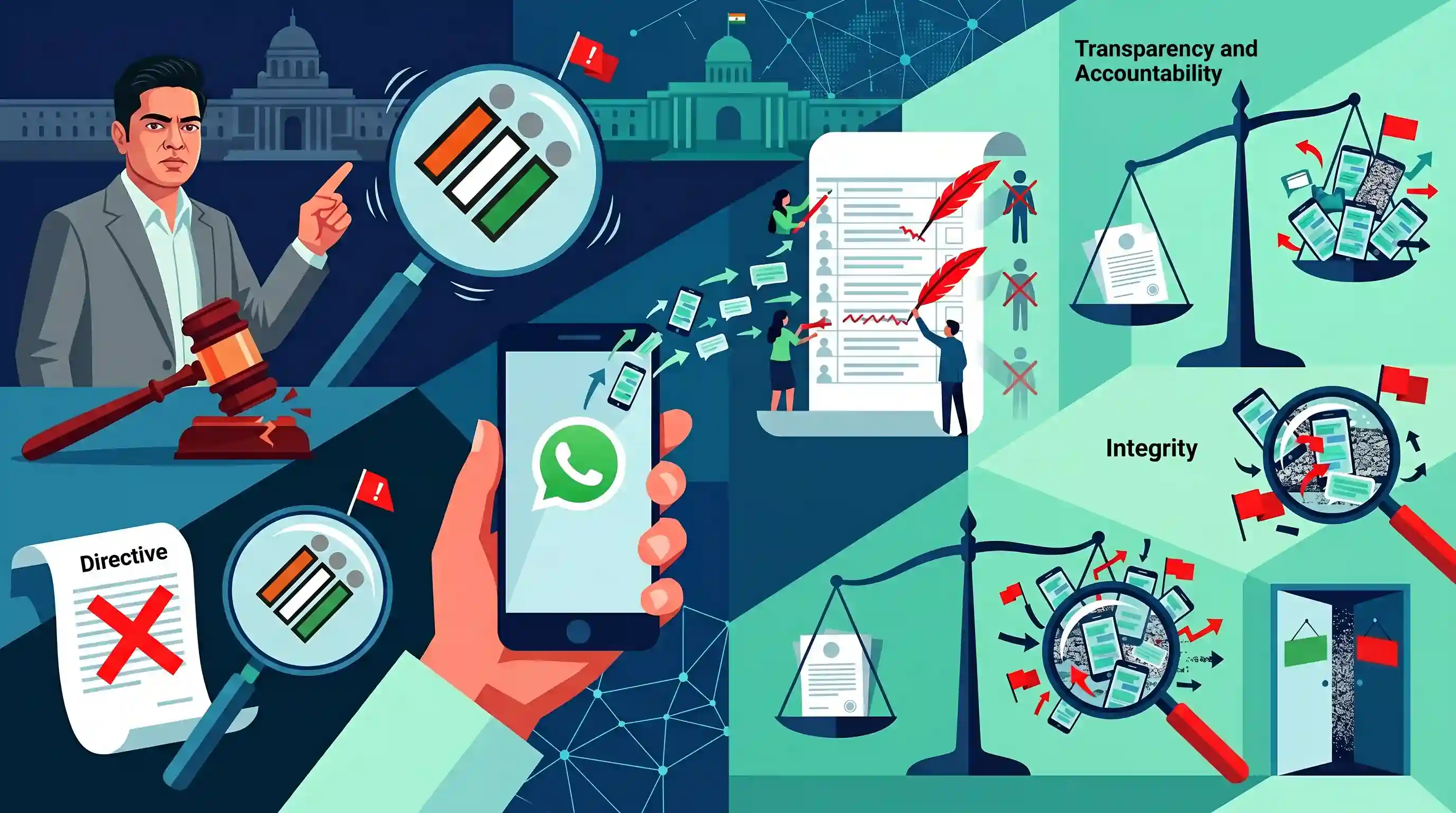
TMC leader Abhishek Banerjee has accused Election Commission of India (ECI) officials of violating Supreme Court directives by issuing official instructions to micro-observers regarding electoral roll revisions via WhatsApp. The allegations claim that these informal directives are intended to inflate voter deletion numbers in West Bengal. This raises critical concerns regarding the transparency, accountability, and integrity of the ECI's processes, while highlighting the governance pitfalls of using informal communication channels for official administrative mandates.
Key Points
- TMC's Abhishek Banerjee alleged that ECI officials are issuing instructions to micro-observers during the Special Intensive Revision (SIR) in West Bengal via WhatsApp groups.
- The allegations assert that these directives aim to inflate voter deletion numbers by selectively directing which birth certificates are acceptable.
- The Supreme Court has previously directed that administrative instructions must be issued formally through circulars, rather than through informal messaging platforms like WhatsApp.
- The incident raises concerns about the transparency, official record-keeping, and accountability of the Election Commission during critical democratic exercises.
Important Terms
Election Commission of India (ECI)

An autonomous constitutional body responsible for administering Union and State election processes. It ensures free and fair polls for the Lok Sabha, Rajya Sabha, and State Legislative Assemblies.
UPSC context
GS II: Constitutional Bodies. Core for questions on election administration and the independence of democratic institutions.
Special Intensive Revision (SIR)
A comprehensive door-to-door verification drive by the ECI to update voter lists. It involves removing duplicates or deceased entries and adding new voters to ensure electoral roll accuracy.
UPSC context
GS II: Electoral Reforms. Tests understanding of procedural mechanisms for maintaining "clean" and inclusive voter lists.
Article 324
The constitutional provision vesting the "superintendence, direction, and control" of elections in the ECI. It provides the legal mandate for preparing electoral rolls and conducting all major elections.
UPSC context
GS II: Constitution. Fundamental for explaining the ECI’s plenary powers and its role in protecting democratic processes.
Micro-Observers
Personnel, typically Central government employees, deployed to assist and monitor election-related tasks. In roll revisions, they provide oversight but lack statutory authority to decide voter eligibility.
UPSC context
GS II: Election Management. Relevant for understanding field-level oversight and the hierarchy of poll-related duties.
Electoral Roll
The official list of individuals registered and eligible to vote in a specific constituency. Accuracy of this roll is vital for ensuring universal adult suffrage.
UPSC context
GS II: Elections. Basic concept under the Representation of the People Act, 1950, and voter rights.
Administrative Accountability
The governance requirement that official administrative actions must follow formal, recorded channels. This ensures officials remain answerable for their directives and prevents the misuse of informal communication.
UPSC context
GS II: Transparency & Accountability. Addresses pitfalls of using unofficial digital platforms for formal state mandates.
Prelims Trap
Micro-Observers appointed by the ECI possess the statutory authority to pass final orders deleting voters from the electoral roll.
Micro-Observers only assist and monitor the process. The statutory power to add or delete names from the electoral roll rests solely with the Electoral Registration Officers (EROs).
Static Concepts Connected
Who has the authority to prepare and revise electoral rolls in India?
- Constitutional Mandate: Article 324 vests the superintendence, direction, and control of electoral roll preparation exclusively with the Election Commission of India (ECI).
- Statutory Backing: Section 21 of the Representation of the People Act, 1950, provides the legal framework governing the preparation and revision of these rolls.
- Final Authority: Electoral Registration Officers (EROs) hold the actual statutory power to accept claims, resolve objections, or order deletions, not observers.
What are the administrative and legal issues with using informal apps for official state mandates?
- RTI Evasion: Informal messaging bypasses standard government record-keeping and archiving, complicating transparency and compliance with the Right to Information (RTI) Act.
- Due Process: The Supreme Court has mandated that statutory notices and administrative orders require formal channels to ensure authentication and legal validity.
- Information Security: Using third-party commercial platforms risks data privacy, violates standard operating procedures, and undermines the institutional auditability of administrative actions.
Cross-Topic Patterns
ECI powers vs Statutory Rules
Links Article 324 plenary powers with statutory limits under RPA 1950, highlighting that ECI directives cannot override established legal processes for voter verification.
E-Governance & RTI Act evasion
Using WhatsApp for administrative orders highlights a growing governance grey-area where official actions evade institutional auditability under the RTI Act, 2005.

Expect a 2026 Prelims statement testing the exact statutory authority of EROs versus ECI Observers in modifying electoral rolls.
Linked PYQs · 5
Linked PYQs · 5
- 2022MainsGS2
Discuss the role of the Election Commission of India in the light of the evolution of the Model Code of Conduct.
- 2018MainsGS2
In the light of recent controversy regarding the use of Electronic Voting Machines (EVM), what are the challenges before the Election Commission of India to ensure the trustworthiness of elections in India?
- 2024MainsGS2
e-governance is not just about the routine application of digital technology in service delivery process. It is as much about multifarious interactions for ensuring transparency and accountability. In this context evaluate the role of the 'Interactive Service Model' of e-governance.
- 2023MainsGS2
e-governance, as a critical tool of governance, has ushered in effectiveness, transparency and accountability in governments. What inadequacies hamper the enhancement of these features ?
- 2017MainsGS4
Examine the relevance of the following in the context of civil service: Transparency, Accountability, Fairness and justice, Courage of conviction, Spirit of service.
