ECI Extends Bengal Electoral Roll Revision Hearings Following SC Order
Source:The Hindu ↗
Why It Matters
Highlights the practical challenges and immense scale of preparing accurate electoral rolls in India. It also demonstrates the constitutional interplay between the Election Commission's autonomy in election management and the Supreme Court's role in ensuring administrative fairness and safeguarding voting rights.
Summary
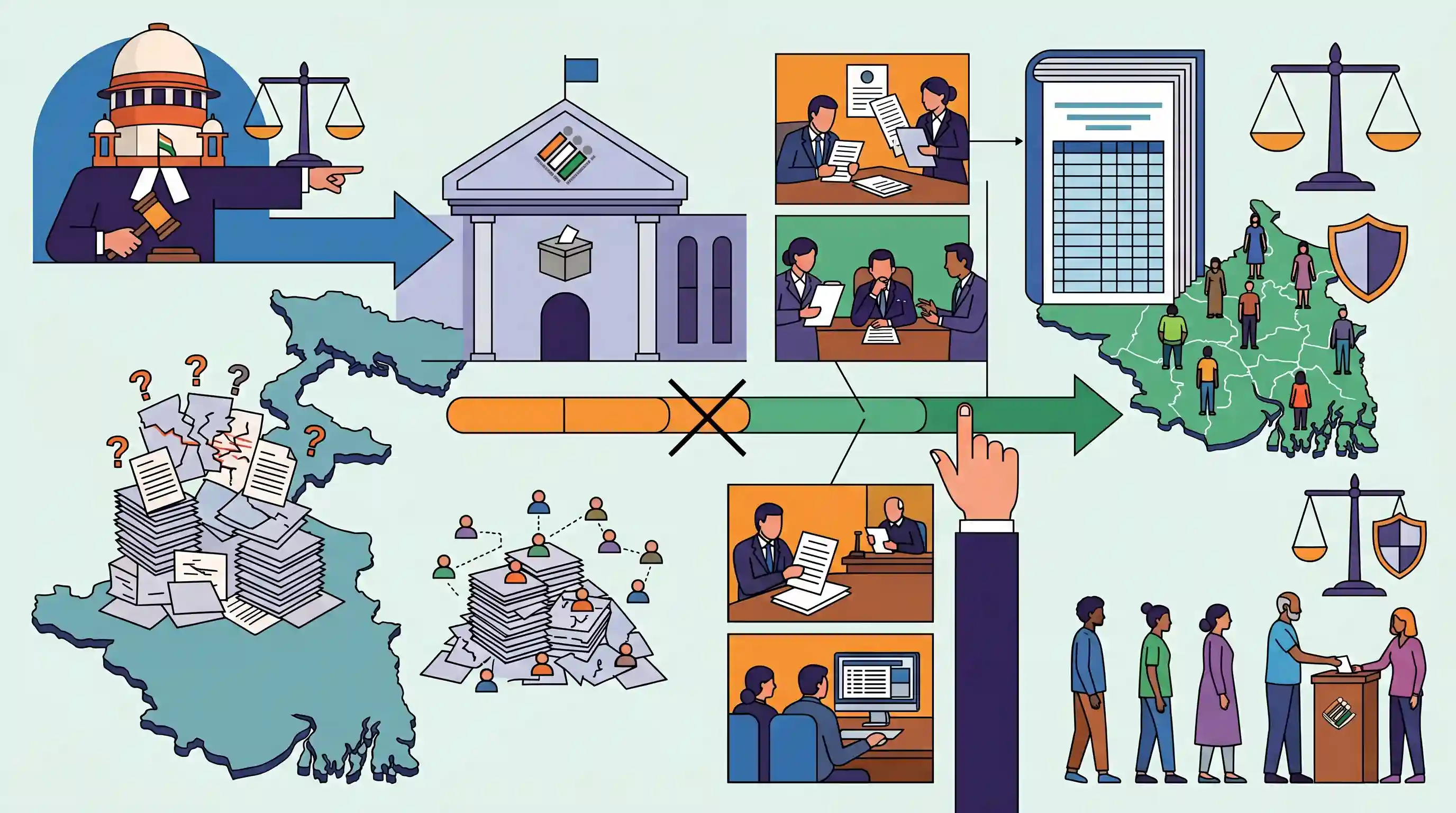
The Election Commission of India (ECI) has extended the deadline for Special Intensive Revision (SIR) hearings of electoral rolls in West Bengal to February 14, following a directive from the Supreme Court. Consequently, the final electoral rolls will be published on February 28. The extension was requested by the Chief Electoral Officer (CEO) of West Bengal to address a significant backlog of pending hearings, scrutiny, and digitisation tasks. This backlog largely stems from the need to process over 94.49 lakh voters summoned over 'logical discrepancies' and 31.68 lakh 'unmapped voters'. The Supreme Court's intervention underscores the necessity of ensuring accurate electoral rolls before final publication, balancing strict electoral schedules with the right to fair representation.
Key Points
- The ECI extended the deadline for Special Intensive Revision (SIR) hearings in West Bengal to February 14, 2026.
- Final electoral rolls for the state are now scheduled to be published on February 28, 2026.
- The extension was mandated by a Supreme Court division bench order directing at least a one-week delay to allow for thorough hearings.
- The West Bengal Chief Electoral Officer sought the extension due to pending hearings, scrutiny, and digitisation work.
- Massive discrepancies were noted, with 94.49 lakh people summoned for 'logical discrepancies' and 31.68 lakh classified as 'unmapped voters'.
Important Terms
Election Commission of India (ECI)

A permanent constitutional body established under Article 324 to ensure the conduct of free and fair elections to the Parliament and State Legislatures.
UPSC context
GS Paper II: Constitutional Bodies/Elections. Core institutional framework for Indian democracy and Article 324.
Special Intensive Revision (SIR)
A comprehensive electoral roll update involving door-to-door verification and legacy data cross-referencing to eliminate deceased, duplicate, or ineligible voters.
UPSC context
GS Paper II: Electoral Reforms. Relevant for topics on electoral integrity and technology in governance.
Form 7
A statutory application under the Registration of Electors Rules, 1960, used to object to an inclusion or request deletion of a name from electoral rolls.
UPSC context
GS Paper II: Election Process. Tests knowledge of legal mechanisms for electoral roll accuracy and the Representation of the People Act.
Logical Discrepancies
Algorithmic flags in electoral databases identifying inconsistencies, such as impossible age gaps or mismatched family-tree data, requiring manual verification.
UPSC context
GS Paper II: Governance. Intersection of algorithmic governance, administrative procedures, and the potential for voter disenfranchisement.
Unmapped Voters
Registered electors whose digital records cannot be linked to historical "legacy" electoral rolls, requiring additional documentation to establish residency and eligibility.
UPSC context
GS Paper II: Social Justice/Representation. Concerns administrative hurdles in registration and inclusive representation in the digital age.
Chief Electoral Officer (CEO)
A state-level officer designated by the ECI to supervise election-related work and electoral roll preparation within a specific State or Union Territory.
UPSC context
GS Paper II: Indian Polity. Key to understanding the administrative hierarchy of election management between Central and State levels.
Prelims Trap
"Article 329(b) completely bars the Supreme Court from reviewing ECI decisions regarding the preparation and revision of electoral rolls."
Article 329(b) bars judicial interference in the conduct of elections (post-notification). However, the preparation and revision of electoral rolls are pre-election administrative processes and remain subject to judicial review.
Static Concepts Connected
Which Act governs the preparation and revision of Electoral Rolls in India?
- RPA 1950: RPA 1950 deals primarily with the allocation of seats, delimitation of constituencies, and the preparation/revision of electoral rolls.
- Chief Electoral Officer: Under Section 13A of RPA 1950, the CEO is appointed by the ECI in consultation with the State Government to supervise roll preparation.
- Special Revision: Section 21 of RPA 1950 empowers the ECI to order a special revision of electoral rolls for reasons recorded in writing.
What is the scope of Judicial Review over ECI's actions?
- Plenary Powers: Under Article 324, the ECI has absolute powers to regulate electoral processes in areas where statutory laws are silent (Mohinder Singh Gill case).
- Article 329(b) Bar: Article 329(b) bars courts from interfering in electoral matters once the election notification is issued, restricting challenges to post-election Election Petitions only.
- Roll Revision Exception: Pre-election processes like electoral roll revision do not fall under the Article 329(b) bar, allowing Supreme Court intervention to ensure fairness.
Cross-Topic Patterns
Tech in Electoral Purification vs. Privacy
The use of software to flag 'logical discrepancies' ties into the ongoing debate over the Election Laws (Amendment) Act linking Aadhaar to voter IDs and related data privacy concerns.
Judicial Review of ECI Directives
The Supreme Court intervening in ECI's roll revision deadlines mirrors recent judicial scrutiny over ECI appointments and VVPAT counting, highlighting a trend of judicial balancing against ECI's plenary powers.

Expect a tricky Prelims statement differentiating between RPA 1950 (electoral rolls) and RPA 1951 (conduct of elections) regarding ECI.
Linked PYQs · 3
Linked PYQs · 3
- 2022MainsGS2
Discuss the role of the Election Commission of India in the light of the evolution of the Model Code of Conduct.
- 2017MainsGS2
To enhance the quality of democracy in India the Election Commission of India has proposed electoral reforms in 2016. What are the suggested reforms and how far are they significant to make democracy successful?
- 2017PrelimsGS1
Consider the following statements: 1. The Election Commission of India is a five-member body. 2. Union Ministry of Home Affairs decides the election schedule for the conduct of both general elections and bye-elections. 3. Election Commission resolves the disputes relating to splits/mergers of recognised political parties. Which of the statements given above is/are correct?
