Voter Roll Deletions and Election Commission Accountability
Source:Indian Express ↗
Why It Matters
The integrity of electoral rolls is foundational to free and fair elections; understanding controversies around voter deletions addresses core issues of democratic accountability and constitutional rights of citizens.
Summary
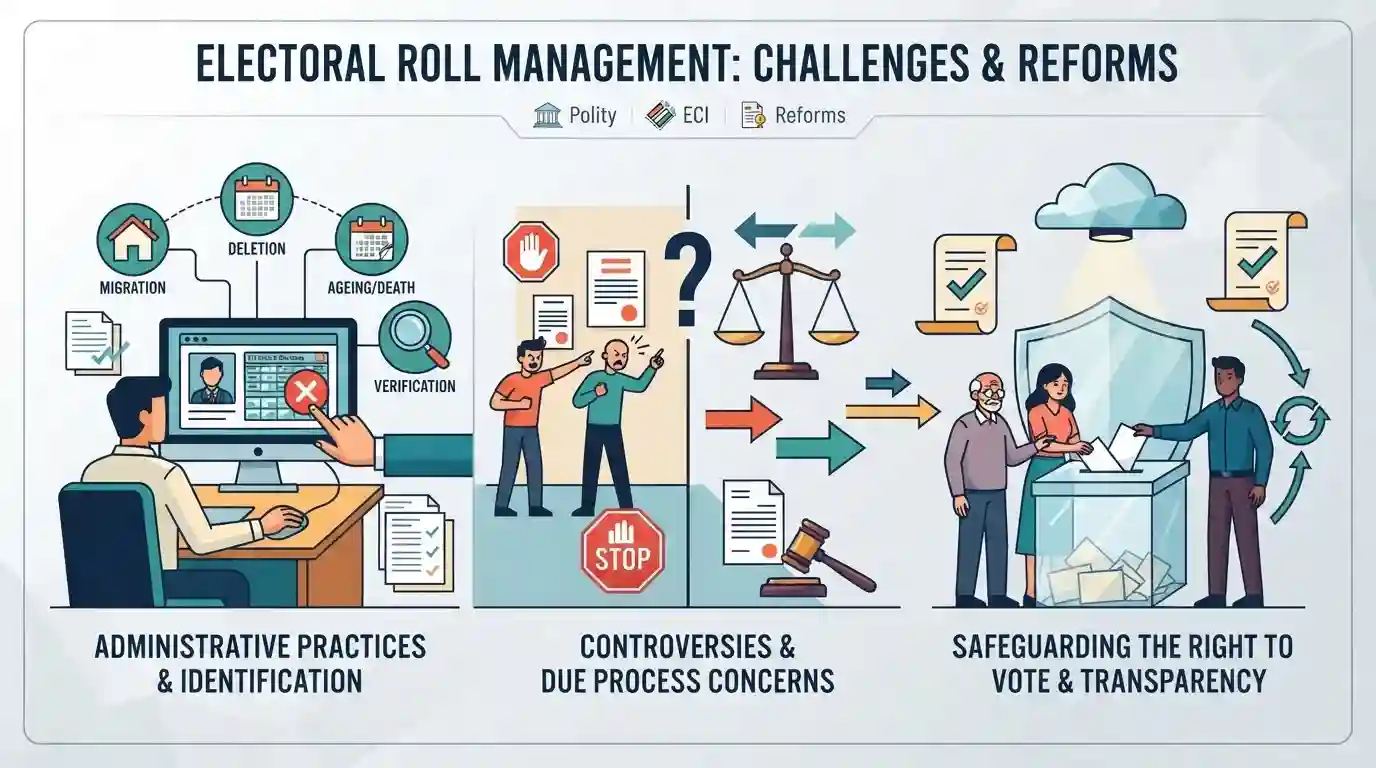
An analysis of the controversies and administrative practices surrounding the deletion of voters from electoral rolls by the Election Commission of India, highlighting the need for transparency, adherence to due process, and safeguarding the right to vote.
Key Points
- Concerns surrounding transparency and verification protocols during the deletion of voters from electoral rolls by the Election Commission of India.
- The critical need for institutional accountability, due process, and safeguarding democratic franchise rights in voter list management.
- Balancing administrative efficiency in cleaning up voter rolls with preventing arbitrary disenfranchisement of eligible citizens.
Important Terms
Election Commission of India

An autonomous constitutional authority established under Article 324 of the Constitution to superintend, direct, and control the conduct of free and fair elections in India.
UPSC context
UPSC CSE Prelims and Mains (GS Paper II: Polity & Governance) — tests statutory roles, independence, and challenges regarding electoral administration.
Representation of the People Act
Parliamentary enactments (1950 and 1951) that regulate the preparation of electoral rolls, conduct of elections, and qualifications/disqualifications for membership in Parliament and State Legislatures.
UPSC context
UPSC CSE Mains GS Paper II (Polity & Governance) — crucial for studying electoral laws, reforms, and dispute redressal mechanisms.
Prelims Trap
The Election Commission of India can arbitrarily delete any voter's name from electoral rolls during routine revisions without statutory notice.
Aspirants often assume the Election Commission of India deletes names on its own accord without any statutory procedure, ignoring the quasi-judicial role of EROs under Section 22 of the RPA 1950.
Static Concepts Connected
What are the constitutional provisions and statutory mechanisms governing the preparation and revision of electoral rolls in India?
- Article 324:: Grants superintendence, direction, and control of elections, including electoral rolls, to the Election Commission of India.
- Section 22 RPA 1950:: Empowers Electoral Registration Officers (EROs) to correct entries, include, or delete names after due inquiry and notice.
- Form 7:: Used specifically for filing objections to existing entries or requesting the deletion of names from electoral rolls.
Cross-Topic Patterns
Voter Rolls + Grassroots Democracy
Voter roll integrity directly impacts local governance accountability and third-tier electoral participation under the 73rd and 74th Constitutional Amendment Acts.
Electoral Disenfranchisement + Fundamental Rights
Arbitrary voter deletions engage Article 14 (equality before law) and Article 21 (right to life and personal liberty) through procedural unreasonableness.

Voter roll revision powers under RPA 1950 and Article 324 frequently feature in matching-type or multi-statement Polity questions.
Linked PYQs · 3
Linked PYQs · 3
- 2024MainsGS2
Examine the need for electoral reforms as suggested by various committees with particular reference to "one nation one election" principle.
- 2022MainsGS2
Discuss the role of the Election Commission of India in the light of the evolution of the Model Code of Conduct.
- 2017MainsGS2
To enhance the quality of democracy in India the Election Commission of India has proposed electoral reforms in 2016. What are the suggested reforms and how far are they significant to make democracy successful?
