Election Commission Form 6 Voter Rolls and Electoral Integrity
Source:Indian Express ↗
Why It Matters
Understanding the procedures of voter registration and electoral roll revision helps aspirants grasp the operational mechanism of Indian democracy and statutory provisions under the RP Acts.
Summary
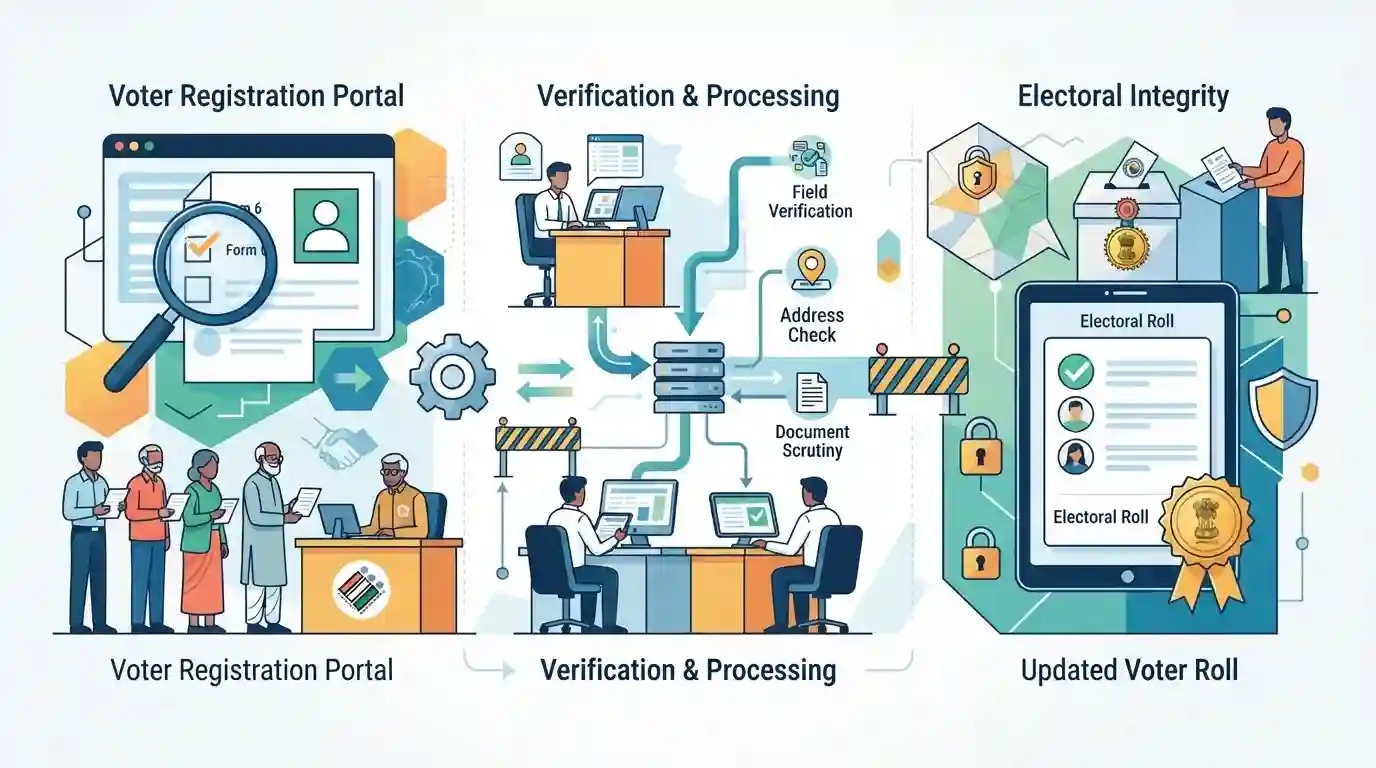
The article discusses the Election Commission's counter-affidavit regarding Form 6 and the procedures governing voter roll updates and electoral registration in India, highlighting legal and administrative mechanisms to maintain electoral integrity.
Key Points
- The Election Commission uses Form 6 for registering new voters and including names in electoral rolls.
- Counter-affidavits filed by the poll panel explain the procedural safeguards and protocols regarding voter roll management and verification.
- Ensuring the integrity of electoral rolls is crucial for free and fair elections under the constitutional framework of India.
Important Terms
Representation of the People Act 1950

A central parliamentary legislation enacted to regulate the preparation of electoral rolls, allocation of seats, and delimitation of constituencies for elections to Parliament and state legislatures in India.
UPSC context
GS Paper II (Polity and Governance). Tests understanding of electoral laws, voter roll updates, and federal parliamentary structures.
Representation of the People Act 1951
An act of Parliament governing the actual conduct of elections, qualifications and disqualifications for membership, registration of political parties, and resolution of electoral disputes in India.
UPSC context
GS Paper II (Polity and Governance). Crucial for questions on disqualification of legislators, corrupt practices, and election petitions.
Election Commission of India
An autonomous constitutional authority established under Article 324 of the Constitution of India, responsible for administering elections to Parliament, State Legislatures, and the offices of President and Vice-President.
UPSC context
GS Paper II (Constitutional Bodies). Tests independence, powers, administrative role, and challenges regarding electoral integrity in India.
Supreme Court of India
The apex judicial court of India under the Constitution, possessing power of judicial review and final authority to interpret constitutional questions and electoral disputes.
UPSC context
GS Paper II (Judiciary). Tests the court's role in safeguarding fundamental rights, electoral reforms, and administrative accountability of executive bodies.
Static Concepts Connected
What are the key statutory provisions governing voter registration and electoral rolls in India?
- Constitutional Basis: Article 324 vests superintendence, direction, and control of electoral rolls in the Election Commission of India.
- 1950 Act: RPA 1950 provides for the allocation of seats, delimitation of constituencies, and preparation of electoral rolls.
- Statutory Rules: Registration of Electors Rules 1960 prescribe detailed procedures, including Form 6 for new voter registration.
- Penal Provisions: Section 31 of RPA 1950 penalizes false declarations in Form 6 applications with up to one year imprisonment.
Cross-Topic Patterns
RPA 1950 vs RPA 1951 Distinction
RPA 1950 governs electoral rolls and delimitation, whereas RPA 1951 handles actual conduct of elections, corrupt practices, and election petitions. Exam questions frequently mix up sections between these two core statutes.
Constitutional Bodies vs Statutory Rules
ECI's power to manage rolls derives directly from Article 324, but statutory procedures are strictly bound by the 1950 Act and Registration of Electors Rules 1960.

Expect a statement-based prelims question pairing Form 6 provisions with Section 31 penalties under RPA 1950 and multiple qualifying dates.
Linked PYQs · 2
Linked PYQs · 2
- 2020PrelimsGS1
Consider the following statements: 1. According to the Constitution of India, a person who is eligible to vote can be made a minister in a State for six months even if he/she is not a member of the Legislature of that State. 2. According to the Representation of People Act, 1951, a person convicted of a criminal offence and sentenced to imprisonment for five years is permanently disqualified from contesting an election even after his release from prison. Which of the statements given above is/are correct?
- 2017PrelimsGS1
For election to the Lok Sabha, a nomination paper can be filed by
