Epidemiological Challenges of Ebola Outbreaks in Central Africa
Source:The Hindu ↗
આ શા માટે મહત્વનું છે
Ebola is a highly lethal pathogen requiring rapid global health response. Understanding its transmission, vaccination strategies, and the structural/geographical challenges of containing outbreaks is vital for General Studies Paper III (Science & Technology / Disaster Management) and Paper II (International Issues/Governance).
સારાંશ
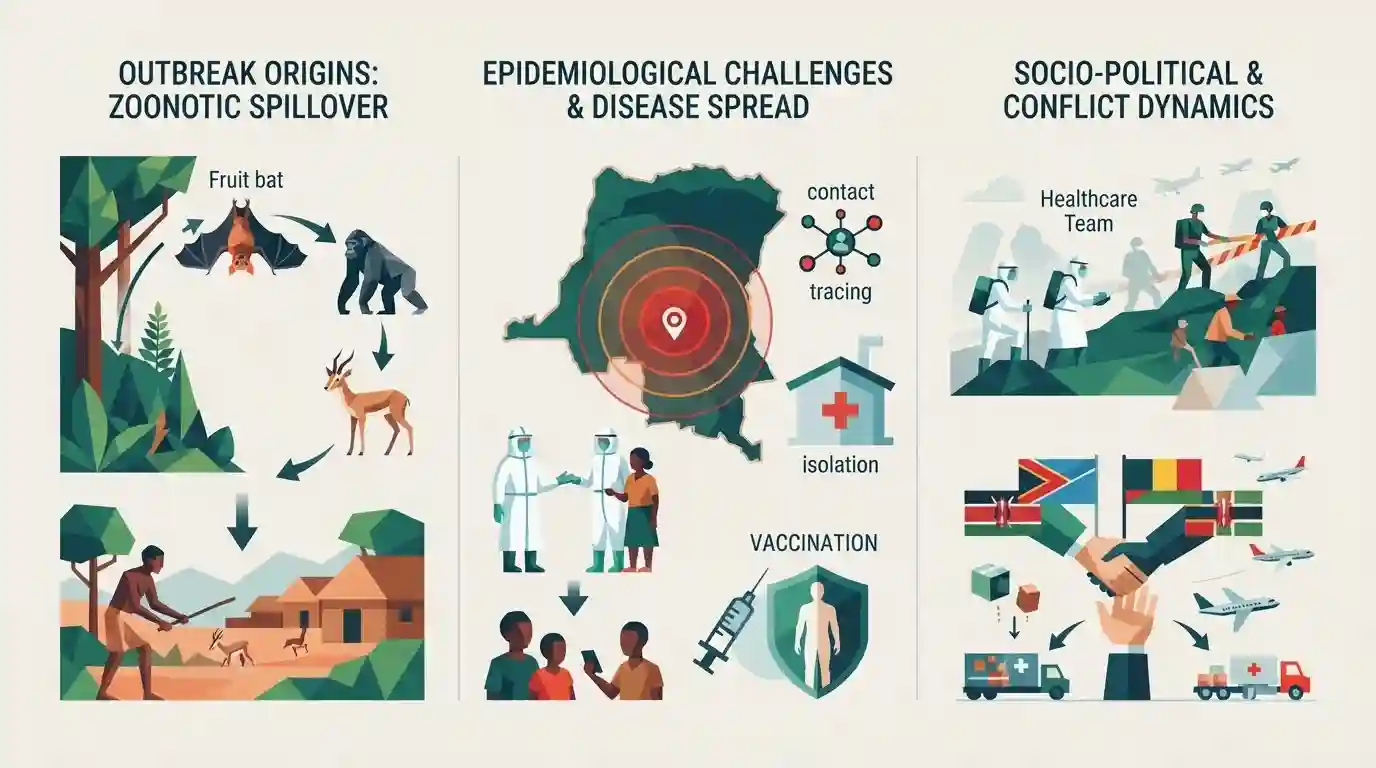
This article explains the recurring threat of Ebola outbreaks in the Democratic Republic of Congo (DRC). Highlighting the medical, epidemiological, and socio-political dimensions, the article discusses how the virus spreads from natural reservoirs to human populations and details the complex challenges faced by health authorities in containing it. It underscores the critical role of vaccines, community surveillance, and international cooperation in managing viral hemorrhagic fevers in volatile regions.
મુખ્ય મુદ્દા
- Ebola Virus Disease (EVD) is a severe, often fatal illness in humans, caused by the Ebola virus, which was first identified near the Ebola River in the Democratic Republic of Congo (DRC) in 1976.
- The DRC faces recurring outbreaks of the Zaire ebolavirus strain, driven by the presence of natural reservoirs (specifically fruit bats of the Pteropodidae family) in the country's dense tropical forests.
- Transmission occurs through close, direct contact with the infectious bodily fluids of infected individuals, deceased patients, or wild animals (such as monkeys, forest antelopes, and fruit bats) found ill or dead in the rainforest.
- Controlling outbreaks in the DRC is frequently complicated by socio-political challenges, including armed conflict, weak healthcare infrastructure, and community mistrust, which impede surveillance, contact tracing, and safe burial practices.
- Key strategies to manage outbreaks include the use of single-dose vaccines (like Ervebo) through 'ring vaccination' strategies, deployment of monoclonal antibody therapeutics, community engagement, and regional surveillance.
મહત્વપૂર્ણ શબ્દો
Zoonotic diseases

Infectious diseases—such as Ebola, Rabies, or COVID-19—caused by pathogens that naturally transmit from vertebrate animals to humans.
UPSC context
Crucial for GS-III (Science & Technology, Environment) to understand disease spillovers, the 'One Health' approach, and pandemic prevention.
Ebola virus disease (EVD)
A severe, frequently fatal viral hemorrhagic fever in humans. It transmits through direct contact with the blood or bodily fluids of infected individuals or wild animals.
UPSC context
Tests GS-III (Health, Disaster Management) knowledge regarding the etiology of infectious diseases and public health emergency responses.
Congo Basin
A major Central African geographic region spanning six countries. It hosts the world's second-largest tropical rainforest and massive tropical peatlands, serving as a globally critical carbon sink.
UPSC context
Highly relevant for GS-I (Geography) and GS-III (Environment) concerning tropical ecosystems, biodiversity hotspots, and global carbon sequestration.
Viral hemorrhagic fever (VHF)
A group of severe multi-organ illnesses caused by distinct RNA viruses (including Ebola and Marburg). They damage the cardiovascular system, causing fever, systemic dysfunction, and internal bleeding.
UPSC context
Essential for GS-III (Science & Technology) to understand the pathology and epidemiology of highly lethal, easily transmissible viruses.
World Health Organization (WHO)
A specialized United Nations agency responsible for directing and coordinating international public health, setting global standards, and leading responses to global health emergencies.
UPSC context
Key for GS-II (International Organizations) concerning global health governance, institutional mandates, and emergency interventions in developing nations.
પ્રિલિમ્સ ટ્રેપ
Ebola virus is a highly contagious airborne disease similar to COVID-19.
Ebola is not airborne. It transmits strictly through direct contact with infectious bodily fluids (blood, vomit) of symptomatic or deceased individuals, or contaminated surfaces.
સંલગ્ન સ્થિર ખ્યાલો
What is the "Ring Vaccination" strategy used for Ebola?
- Targeted Approach: Vaccinating immediate contacts, and contacts-of-contacts, of a confirmed patient rather than the entire population.
- Buffer Creation: It forms a protective epidemiological buffer of immunity around the infected individual, halting the transmission chain.
- Historical Success: This exact strategy was famously and successfully deployed in the 1970s to eradicate smallpox globally.
What are "Natural Reservoirs" in the context of zoonotic diseases?
- Definition: A natural reservoir is a species that harbors a pathogen long-term without experiencing severe disease or death itself.
- Ebola Context: For Ebola, fruit bats of the Pteropodidae family are the primary suspected natural hosts, hiding the virus asymptomatically in tropical rainforests.
- Zoonotic Spillover: When the pathogen jumps from the reservoir or an intermediate host into human populations, it triggers an outbreak.
આંતર-વિષય પેટર્ન
Congo Basin & Critical Minerals
The DRC is frequently mapped in Prelims for its equatorial geography (Congo Basin) and its geopolitical status as a leading producer of critical transition minerals like cobalt.
WHO's PHEIC Declarations
Understanding the criteria for the WHO declaring a Public Health Emergency of International Concern (PHEIC) is vital, linking Ebola with recent precedents like Mpox and COVID-19.

Questions mixing Ebola's non-airborne transmission, the specific 'ring vaccination' strategy, and DRC's geography are highly probable.
સંલગ્ન PYQ · 2
સંલગ્ન PYQ · 2
- 2015PrelimsGS1
Among the following, which were frequently mentioned in the news for the outbreak of Ebola virus recently?
- 2023PrelimsGS1
Which one of the following is a part of the Congo Basin?
