Eastern UP Emerging as Economic Hub Driven by Youth Demographic
Source:indianmasterminds ↗
Why It Matters
The article highlights key data points and schemes specific to Uttar Pradesh's economic growth and demographic profile. Facts such as the $1 trillion economy target, youth population percentage (56-60%), and schemes like Mukhyamantri Yuva Udyami Yojana are highly relevant for the UP-specific sections in the UPPSC Prelims exam.
Summary
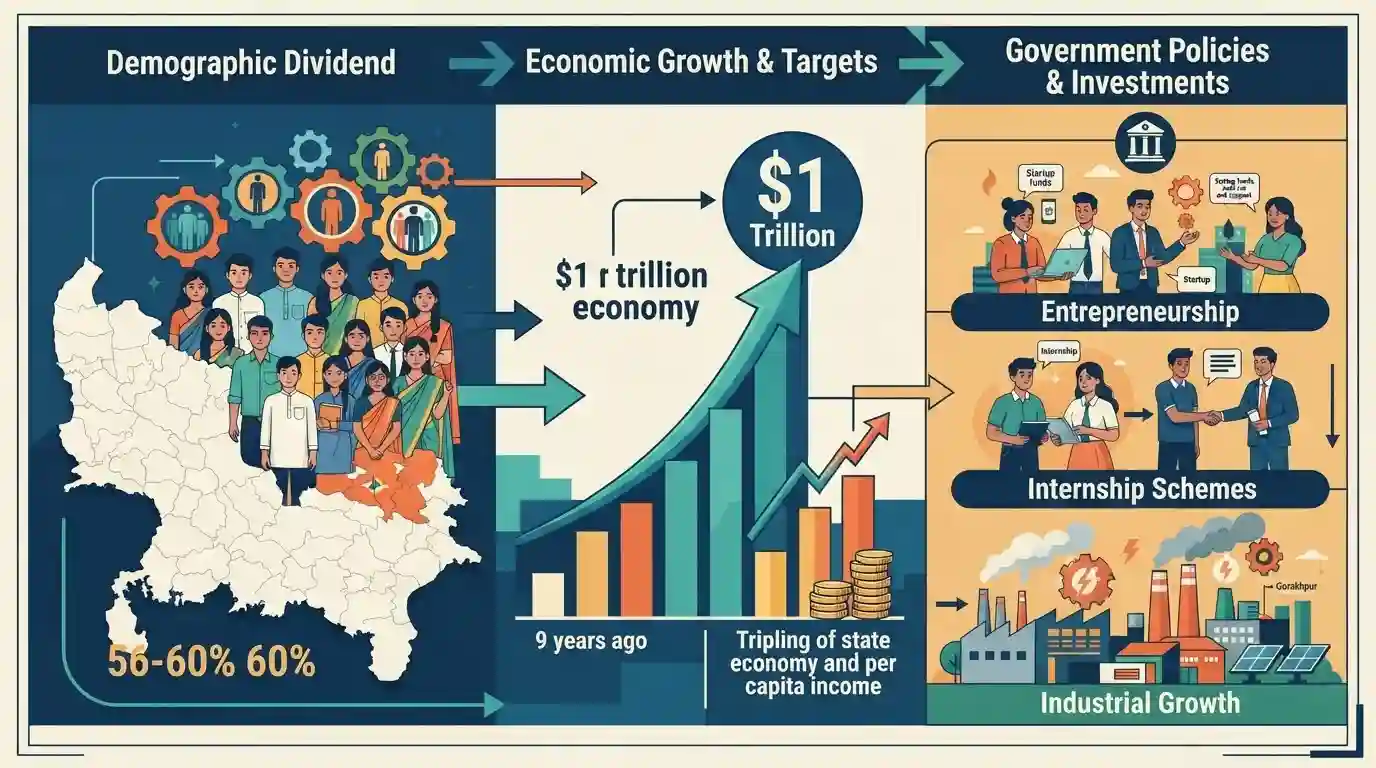
Chief Minister Yogi Adityanath has highlighted the socio-economic transformation of Eastern Uttar Pradesh, framing the region as an emerging economic hub propelled by its youth power. The state's demographic advantage is significant, with youth making up 56-60% of the population. The government is aiming for a $1 trillion economy within three years, citing that per capita income and the overall state economy have tripled in the last nine years. Key initiatives driving youth empowerment and entrepreneurship include the Mukhyamantri Yuva Udyami Yojana and state/central internship schemes, alongside significant industrial investments in areas like Gorakhpur.
Key Points
- Eastern UP is undergoing a transformation from being associated with 'mafia and mosquitoes' to emerging as an economic hub driven by a young demographic.
- Uttar Pradesh has a significant demographic dividend, with 56% to 60% of its population comprising youth, positioning it as a major workforce provider.
- Key youth empowerment schemes like the PM Internship Scheme, CM Internship Scheme, and Mukhyamantri Yuva Udyami Yojana aim to boost employment and entrepreneurship with incentives like interest-free loans up to Rs 5 lakh.
- The overall state economy and per capita income have tripled in the last nine years, and the government targets making UP a $1 trillion economy within the next three years.
- Regional development is evident in Gorakhpur and surrounding areas, which have attracted substantial investments creating 50,000 jobs and seen the establishment of five new universities.
Important Terms
Prime Minister Internship Scheme

A central initiative aiming to provide one crore youth with structured, paid internships in top companies over five years. It offers a monthly stipend and a one-time grant to bridge the education-employment gap.
UPSC context
Important for GS Paper II and III covering government policies, youth empowerment, and skill development interventions.
Chief Minister Internship Scheme
A state-level policy in Uttar Pradesh complementing central efforts, designed to provide local youth with practical on-the-job training, thereby improving their skills and long-term employability in suitable jobs.
UPSC context
Connects to GS Paper II (State Government Interventions) and the utilization of India's demographic dividend.
Mukhyamantri Yuva Udyami Yojana
An Uttar Pradesh state scheme designed to encourage youth entrepreneurship by offering interest-free loans up to ₹5 lakh for establishing new industrial units or service enterprises.
UPSC context
Relevant for GS Paper III and UP PCS regarding state economic policies, MSME promotion, and employment generation.
Gorakhpur Industrial Development Authority (GIDA)
Established in 1989, GIDA is the nodal agency responsible for driving planned industrial growth, infrastructure development, and investment in the Purvanchal (Eastern UP) region.
UPSC context
Crucial for GS Paper III topics on infrastructure, regional industrialization, and UP state-specific economic geography.
Madan Mohan Malaviya University of Technology
A state technical university in Gorakhpur, UP, established in 2013 by reconstituting a 1962 engineering college. It serves as a regional hub for higher education, research, and technology incubation.
UPSC context
Pertinent to GS Paper II (Education, Human Resources) and highlights regional institution-building in Eastern UP.
Prelims Trap
A state's 'demographic dividend' is achieved simply when over 50% of its population is categorized as 'youth'.
Demographic dividend specifically refers to the economic growth potential when the share of the *working-age population* (15-59 years) is larger than the dependent population, not merely having a large "youth" cohort.
Static Concepts Connected
What defines a 'Demographic Dividend' in an economy?
- Working-Age Ratio: A period where the working-age population (typically 15-59 years) significantly exceeds the dependent population (children and elderly).
- Temporary Window: It is a temporary window of opportunity; India's demographic dividend phase is expected to peak and then conclude around 2055-56.
- Pre-requisites: It does not guarantee growth automatically; it requires targeted investments in human capital—education, health, and skill development—to prevent a 'demographic disaster'.
What factors drive intrastate regional disparities in India?
- Historical factors: Land tenure systems like the Zamindari system in eastern regions historically discouraged agricultural investments and capital formation compared to Mahalwari/Ryotwari areas.
- Infrastructure gaps: Uneven historical allocation of resources for physical infrastructure (roads, reliable power) tends to favor already developed hubs, compounding backwardness elsewhere.
- Institutional deficits: Limited access to institutional credit and modern skilling centers in backward regions stifles local entrepreneurship and forces out-migration.
Cross-Topic Patterns
Demographic Dividend + Skilling Imperative
State internship schemes and credit programs act as crucial localized bridges to convert the demographic bulge into actual economic productivity, mirroring national initiatives like Skill India.
Regional Disparity + Infrastructure Pushes
The economic revival of historically backward regions like Purvanchal relies heavily on recent massive infrastructure developments, such as expressways and dedicated industrial corridors.

Mains 2026 could test how state-level interventions in skilling and MSME credit are crucial to correct historical intrastate regional disparities.
Linked PYQs · 4
Linked PYQs · 4
- 2021UPPSC_PRELIMSGS1
Which of the following is NOT the eligibility criterion before filling registration/ application forms for Uttar Pradesh Mukhya Mantri Swarojgar Yojna 2021 ?
- 2021UPPSC_PRELIMSGS1
Which of the following Schemes in Uttar Pradesh were introduced in Budget of 2021-22? I. Atmanirbhar Krishak Samanvit Vikas Yojna II. Mukhya Mantri Saksham Suposhan Yojna III. Mukhya Mantri Pravasi Shramik Udyamita Vikas Yojna IV. Yuva Udyamita Vikas Abhiyan Select the correct answer from the codes given below.
- 2011UPPSC_PRELIMSGS1
Which one of the following statements regarding Uttar Pradesh, according to the provisional figures of 2011 Census is not correct?
- 2017UPPSC_PRELIMSGS1
With effect from 1 April, 2017 the minimum wage for unskilled labour in Uttar Pradesh has been fixed at:
