Eastern Railway Level Crossing Interlocking and Safety Mission
Source:social-news-xyz ↗
Why It Matters
Modernization of Indian Railways' infrastructure is a critical component of national development. Initiatives that eliminate manual human intervention in signaling and track clearance at level crossings are essential steps to achieve a zero-accident record on the railway network.
Summary
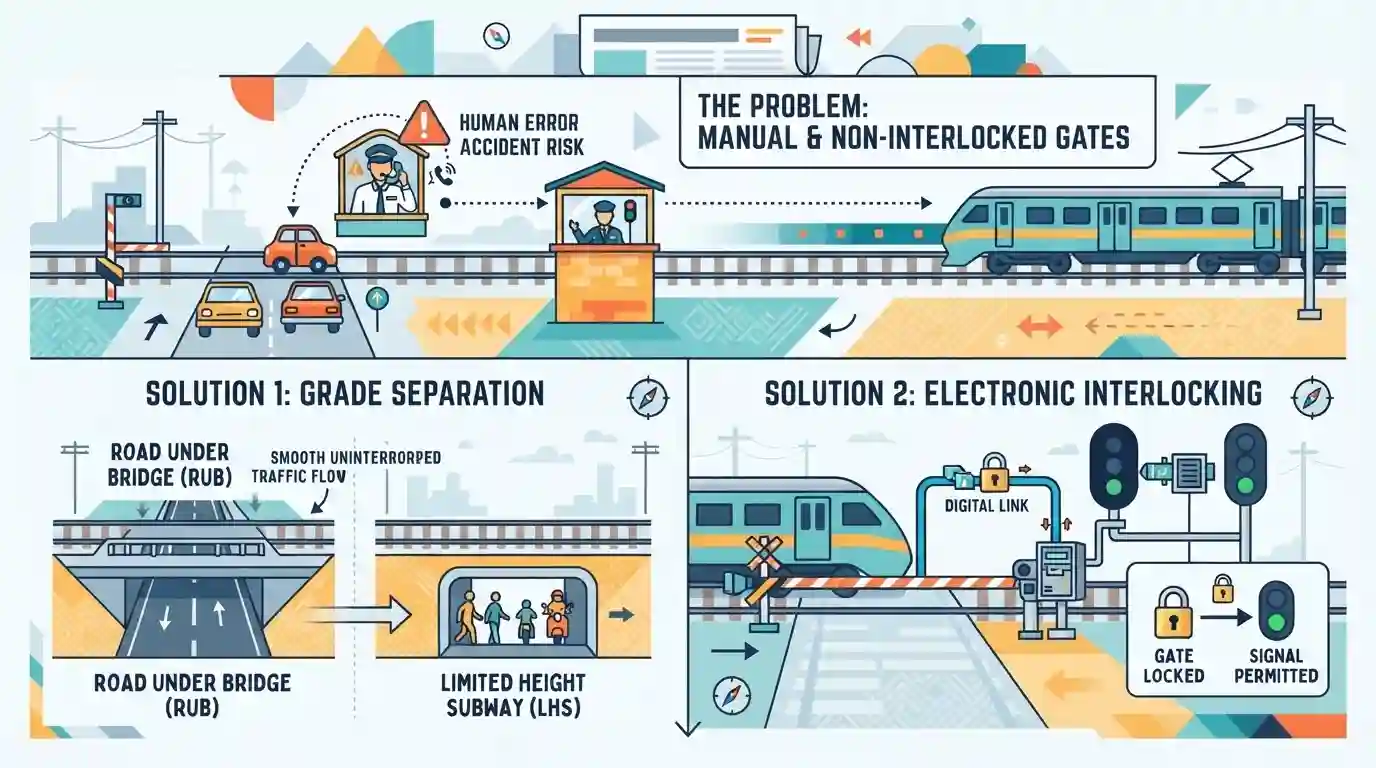
Following a recent train accident in Berhampore, West Bengal, the Eastern Railway has launched a mission to eliminate non-interlocked level crossing gates across its network. The manual system, reliant on telephonic communication between gatemen and station masters, is prone to fatal human errors. The ER plans to construct Road Under Bridges (RUBs) and Limited Height Subways (LHS) to replace these crossings. In locations where underpasses are unviable, the railways will install electronic interlocked gates that synchronize directly with the signaling system, ensuring train signals only turn green when the road gate is safely locked.
Key Points
- Eastern Railway (ER) is set to eliminate non-interlocked level crossing gates to enhance safety and prevent accidents.
- The initiative follows a tragic collision at a level crossing in Berhampore, West Bengal.
- Non-interlocked gates rely on manual telephonic communication which is susceptible to human error.
- ER plans to replace these with Road Under Bridges (RUBs) and Limited Height Subways (LHS).
- Where subways are not feasible, electronic interlocked gates will be installed; these ensure signals turn green only when the gate is securely closed and locked against road traffic.
Important Terms
Level Crossing (LC)

An intersection where a railway line crosses a road or path at the same level, presenting significant points of conflict and public safety risks.
UPSC context
GS Paper III (Infrastructure/Disaster Management); tests transport safety and infrastructure conflicts.
Interlocking System (Railways)
A safety mechanism that electronically synchronizes level crossing physical gates with the railway signaling system, preventing green signals unless the gates are securely closed.
UPSC context
GS Paper III (Infrastructure & Technology); tests knowledge of technology-led safety and railway modernisation.
Road Under Bridge (RUB)
A grade-separated structure allowing a road to safely pass beneath railway tracks, eliminating the need for a level crossing and reducing the risk of collisions.
UPSC context
GS Paper III (Infrastructure Development); tests grade separation, safety modernization, and traffic management.
Kavach
An indigenously developed Automatic Train Protection (ATP) system that prevents collisions, enforces speed limits, and applies brakes automatically if a danger signal is passed.
UPSC context
GS Paper III (S&T / Infrastructure); tests indigenously developed transport safety systems and Atmanirbhar Bharat projects.
Eastern Railway (ER)
One of the major zones of Indian Railways, headquartered in Kolkata, West Bengal, responsible for operating crucial rail corridors in eastern India.
UPSC context
GS Paper III (Infrastructure); tests understanding of regional rail networks and railway administration zones.
Prelims Trap
Indian Railways has completely eliminated all manned and unmanned level crossings across its broad-gauge network.
Aspirants often confuse 'unmanned level crossings' (fully eliminated on Broad Gauge routes in 2019) with 'manned level crossings', which still exist and are currently being targeted for interlocking or elimination.
Static Concepts Connected
What is Electronic Interlocking (EI) and how does it prevent railway accidents?
- Core Mechanism: A microprocessor-based system that manages signaling, track points, and level-crossing gates to ensure conflict-free train routing.
- Fail-Safe Logic: Locks signals to red if the route ahead is occupied or if the level-crossing gate is not physically closed and locked.
What were the key recommendations of the Anil Kakodkar Committee (2012) on Railway Safety?
- Crossing Elimination: Recommended the progressive, complete elimination of all level crossings (both manned and unmanned) using grade separators.
- Financing Safety: Proposed a non-lapsable Railway Safety Fund to finance critical structural safety interventions over a five-year period.
Cross-Topic Patterns
Infrastructure Finance + Federalism
Funding grade-separators (ROBs/RUBs) often requires state cost-sharing and land acquisition, transforming simple railway safety upgrades into complex federal coordination challenges.
Indigenisation + Critical Tech
Deploying Kavach alongside electronic interlocking aligns with India's goal of achieving SIL-4 safety standards using domestic technology, reducing import reliance in critical transport infrastructure.

Kakodkar Committee safety mandates and Kavach SIL-4 specifications are highly likely to feature in upcoming GS-3 infrastructure questions.
Linked PYQs · 1
Linked PYQs · 1
- 2022WBCS_PRELIMSGS1
Which one of the following is not correctly matched?
