India Strategic Diplomacy in Multilateral Groupings
Source:Indian Express ↗
Why It Matters
Understanding India's foreign policy objectives, strategic autonomy, and role in regional and global organizations like the Quad, SCO, and East Asia Summit is crucial for the Mains GS2 paper.
Summary
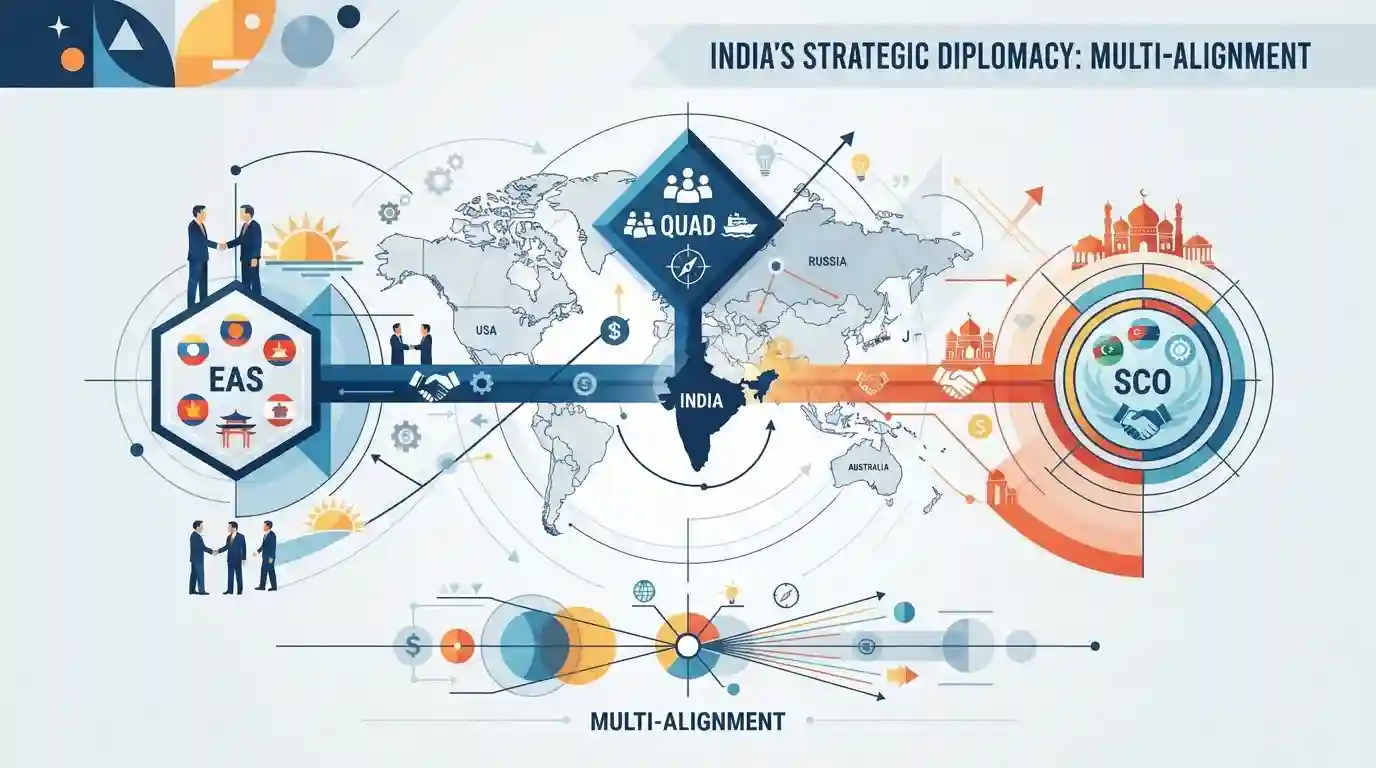
An overview of India's strategic diplomacy across major multilateral and minilateral frameworks—namely the East Asia Summit, Quad, and Shanghai Cooperation Organisation (SCO)—highlighting India's approach of multi-alignment in contemporary international relations.
Key Points
- India engages in multi-alignment through overlapping minilateral and multilateral groupings like the Quad, SCO, and East Asia Summit.
- The Quad focuses on a free, open, and inclusive Indo-Pacific and maritime security cooperation.
- The Shanghai Cooperation Organisation (SCO) addresses Eurasian security, counter-terrorism, and regional connectivity.
- The East Asia Summit provides a premier leader-led forum for strategic dialogue and cooperation across the broader Asia-Pacific region.
Important Terms
East Asia Summit

An ASEAN-led regional forum established in 2005 comprising 18 countries, serving as a key platform for leaders to address political, security, and economic challenges in the Indo-Pacific.
UPSC context
GS Paper II (International Relations): Essential for questions on ASEAN centrality, minilateralism, and India's Act East policy.
Quad
An informal strategic security dialogue between India, the United States, Japan, and Australia focused on maintaining a free, open, and inclusive Indo-Pacific region.
UPSC context
GS Paper II (International Relations): Important for evaluating Indo-Pacific geopolitics, minilateral groupings, and India's strategic autonomy.
Shanghai Cooperation Organisation
A permanent intergovernmental Eurasian security and economic alliance comprising ten member states, focused on regional stability, trade, and counter-terrorism cooperation via RATS.
UPSC context
GS Paper II (International Relations): Relevant for India's Central Asian policy, Eurasian connectivity, and balancing multilateral engagements.
Static Concepts Connected
What are the founding members and core objectives of the East Asia Summit (EAS)?
- Composition: Established in 2005, the EAS comprises 10 ASEAN nations plus 8 dialogue partners including India, China, Japan, Russia, and the US.
- Mandate: It serves as a premier leader-led forum for strategic, political, and economic dialogue on regional challenges in the Indo-Pacific.
What is the mandate of the Shanghai Cooperation Organisation's RATS mechanism?
- Headquarters: RATS stands for Regional Anti-Terrorist Structure, headquartered in Tashkent, Uzbekistan.
- Core Function: It coordinates joint counter-terrorism efforts against the 'Three Evils': terrorism, separatism, and extremism among member states.
Cross-Topic Patterns
Multi-alignment vs. Non-alignment in Indian Foreign Policy
India's active membership in both the US-led Quad and the China-Russia dominated SCO exemplifies contemporary strategic autonomy, balancing Western Indo-Pacific coalitions with Eurasian continental connectivity.
East Asia Summit & Indo-Pacific Geopolitics
The East Asia Summit anchors India's Act East Policy, translating diplomatic dialogue into robust maritime security and supply chain resilience across the Indo-Pacific.

Multi-alignment across overlapping minilaterals (Quad, SCO, EAS) will feature in prelims matching statements on strategic autonomy.
Linked PYQs · 3
Linked PYQs · 3
- 2023MainsGS2
‘Virus of Conflict is affecting the functioning of the SCO’ In the light of the above statement point out the role of India in mitigating the problems.
- 2024MainsGS2
‘The West is fostering India as an alternative to reduce dependence on China's supply chain and as a strategic ally to counter China's political and economic dominance.’ Explain this statement with examples.
- 2021MainsGS2
Critically examine the aims and objectives of SCO. What importance does it hold for India?
