Rajasthan Boosts Ease of Doing Business via RajNivesh Portal
Source:udaipur-times ↗
Why It Matters
Highlights Rajasthan's recent policy measures (RajNivesh portal, Deregulation) to attract investments, foster industrial growth, and improve the state's ranking in the Ease of Doing Business index. Also relevant for tracking changing trends in female labor force participation.
Summary
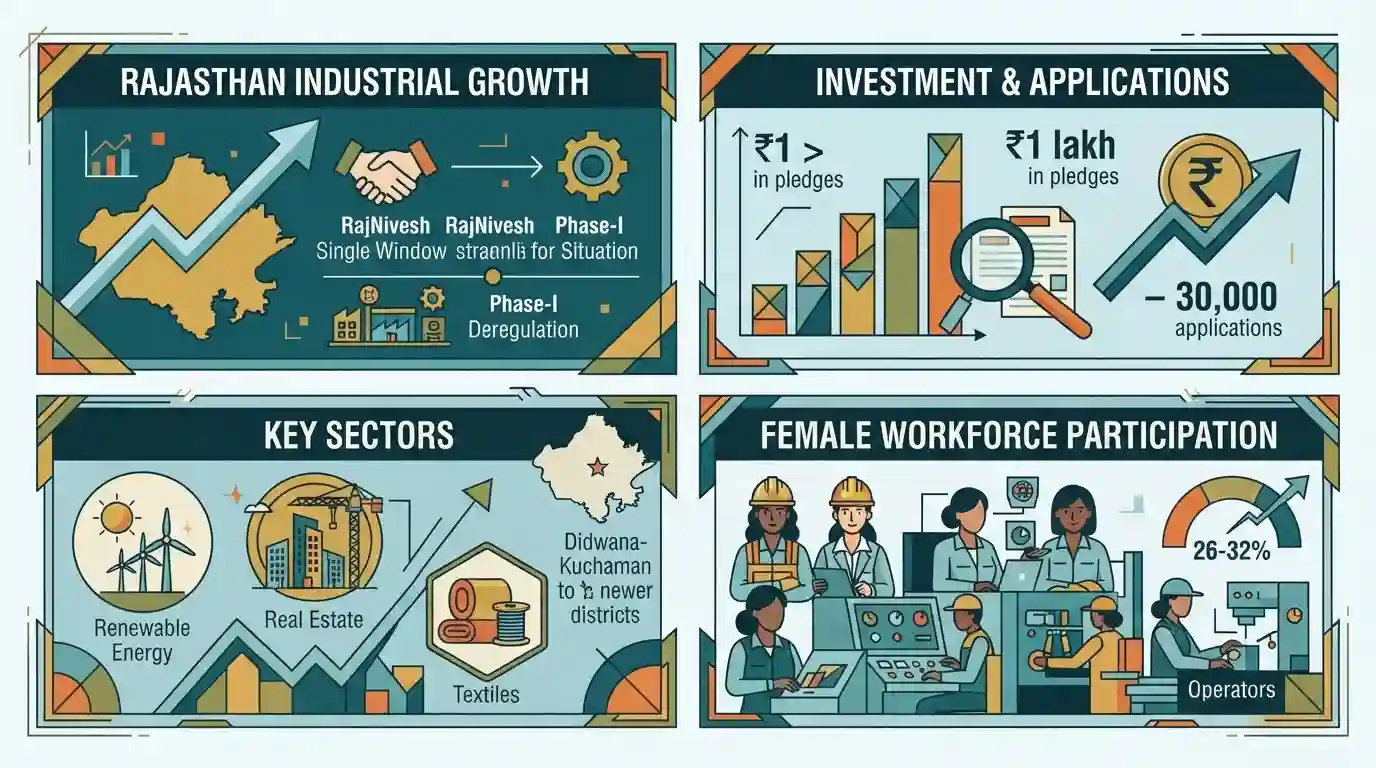
Rajasthan is enhancing its industrial climate and Ease of Doing Business through its RajNivesh Single Window System and Phase-I deregulation. Over 30,000 applications were processed in Q1 2026, resulting in massive investment pledges exceeding ₹1 lakh crore in June. Key sectors such as Renewable Energy, Real Estate, and Textiles are driving this growth, which is spreading to newer districts like Didwana-Kuchaman. Furthermore, the state is witnessing improved female workforce participation, with 26-32% of women entering technical and operational roles.
Key Points
- Rajasthan's RajNivesh Single Window System processed over 30,000 applications between April and June 2026, marking a significant boost in the Ease of Doing Business.
- The implementation of Deregulation Phase-I simplified approvals, transitioned services online, and established risk-based inspections to reduce compliance burdens.
- The state attracted ₹1,03,003.64 crore in investment pledges in June alone, with strong interest in emerging districts like Didwana-Kuchaman, Sirohi, and Beawar.
- Key investment sectors include Real Estate, Renewable Energy, Textiles, Tourism, and Gems & Jewellery.
- Female workforce participation has seen a positive trend, with women comprising 26-32% of technical and operational roles in the newly invested sectors.
Prelims Trap
The NITI Aayog releases the Ease of Doing Business rankings for Indian states under the Business Reforms Action Plan.
The Business Reforms Action Plan (BRAP) for states is assessed and released by the DPIIT (Ministry of Commerce and Industry), not NITI Aayog.
Static Concepts Connected
What is the Business Reforms Action Plan (BRAP)?
- Nodal Agency: Assessed by the Department for Promotion of Industry and Internal Trade (DPIIT) under the Ministry of Commerce and Industry.
- Objective: Ranks Indian states and UTs based on their implementation of reforms in areas like single window systems, labor, and environment clearances.
- Methodology: Recent iterations have shifted from relying purely on government claims to a 100% feedback-based assessment from actual investors and businesses.
How is the Female Labour Force Participation Rate (FLFPR) measured and trending?
- Measurement: Measured annually via the Periodic Labour Force Survey (PLFS), which is conducted by the NSSO under MoSPI.
- Recent Trend: India's FLFPR has steadily increased in recent years, reaching 41.7% in 2023-24, contrary to older narratives of a declining female workforce.
- Rural Dominance: This surge is largely driven by rural women engaged in agriculture and self-employment, rather than urban formal sector jobs.
Cross-Topic Patterns
EoDB accelerating climate targets
Streamlined single window systems in land-rich states are becoming critical regulatory enablers for India to achieve its 500 GW non-fossil fuel capacity target by 2030.
Administrative reorganization driving investment
The creation of newer districts paired with digital single-window portals pushes industrial tier-2/tier-3 decentralization, altering internal state migration patterns and resource allocation.

State-level BRAP criteria by DPIIT + rising rural FLFPR trends via PLFS are prime candidates for a multi-statement Prelims question.
Linked PYQs · 4
Linked PYQs · 4
- 2025RPSC_PRELIMSGS1
The Ease of Doing Business ranking for states is issued by
- 2024RPSC_PRELIMSGS1
Ease of Doing Business ranking for the states in India is released by –
- 2021RPSC_PRELIMSGS1
According to the Census – 2011, what was the work participation rate in India and Rajasthan respectively?
- 2025RPSC_PRELIMSGS1
The correct order of decreasing contribution of different sectors in Rajasthan’s Gross Fixed Capital Formation is
