Gujarat Decentralizes Land Allotment Powers for Ease of Business
Source:cmogujarat ↗
Why It Matters
This move represents a major administrative reform in Gujarat aimed at administrative decentralization and promoting ease of doing business, which is frequently tested in GPSC governance and economic administration segments.
Summary
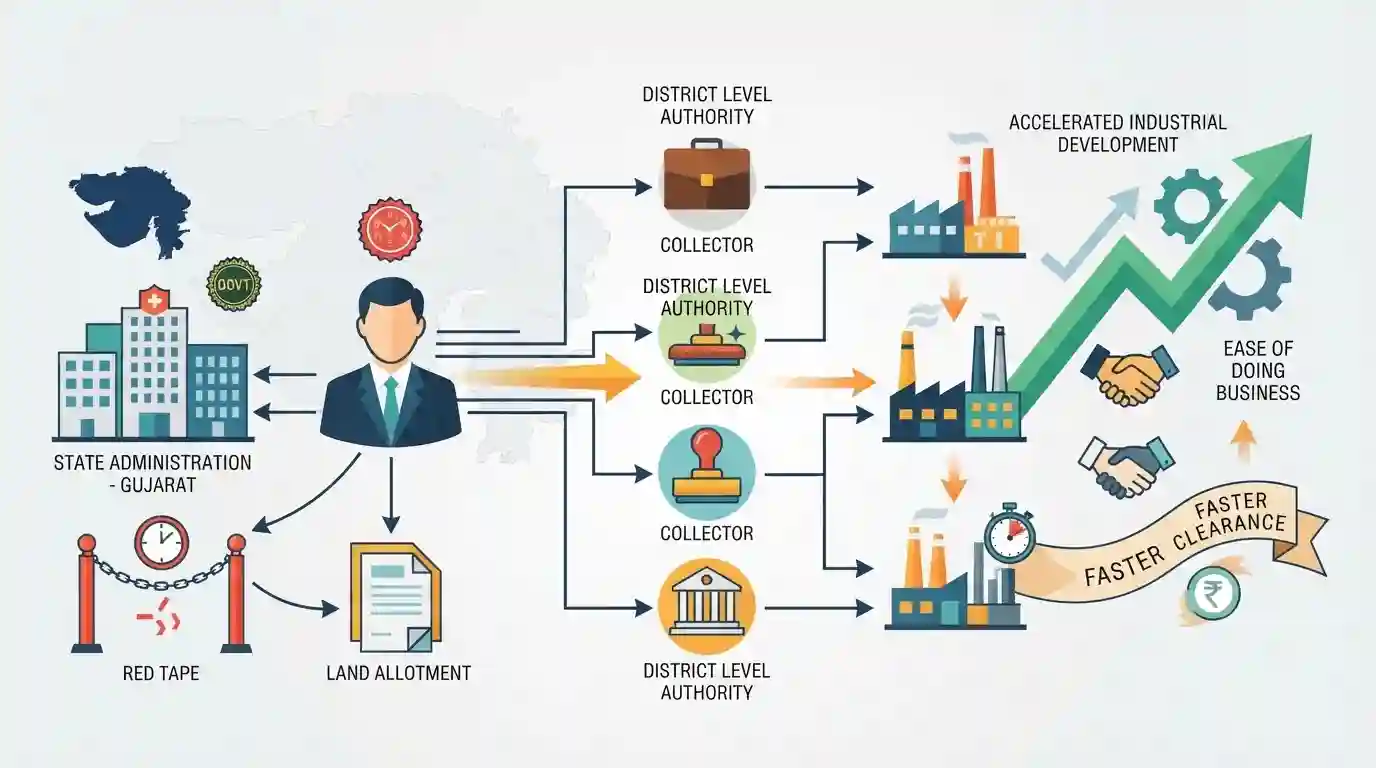
The Government of Gujarat has decentralized land allotment mechanisms by granting enhanced powers to district-level authorities. This decision aims to bolster Ease of Doing Business (EoDB), accelerate industrial development, reduce red tape, and empower local administrations like District Collectors to clear project proposals faster.
Key Points
- The Government of Gujarat decentralized land allotment procedures by delegating enhanced financial and administrative powers to district-level authorities.
- The initiative aims to eliminate bureaucratic delays, cut red tape, and expedite industrial growth and project implementation at the grassroots level.
- Empowering District Collectors and local administrative bodies aligns with the state's objective of enhancing the ease of doing business and attracting domestic and foreign investment.
Important Terms
Ease of Doing Business Policy

A business regulatory index and reform framework focused on simplifying procedures, reducing compliance burdens, and accelerating clearances to foster a transparent and investment-friendly ecosystem for industries.
UPSC context
GPSC Paper-II/III (Governance, Economy & Industrial Policy): Tests administrative reforms, regulatory streamlining, and investment facilitation mechanisms in the state.
Government of Gujarat
The executive branch of the state of Gujarat responsible for formulating policies, administrative frameworks, and decentralized governance initiatives to spur infrastructure and socio-economic development.
UPSC context
GPSC Paper-I/II (Indian Polity and State Administration): Essential for questions regarding state executive powers, administrative decentralization, and policy implementation.
Chief Minister's Office Gujarat
The apex political and bureaucratic office headed by the Chief Minister of Gujarat, guiding policy formulation, strategic decision-making, and administrative supervision across state departments.
UPSC context
GPSC Paper-II (Governance and Public Administration): Tests the role of the political executive and top-level institutional leadership in governance reforms.
Static Concepts Connected
What are the key administrative roles and statutory powers of a District Collector in Gujarat?
- Revenue & Magisterial: Dual Capacity acts as both the district head of revenue administration and District Magistrate maintaining law and order.
- Land Administration: Land Management oversees land acquisition, allotment, revenue collection, and maintenance of land records (Bhuabhilekh).
- Crisis Leadership: Disaster Management heads the District Disaster Management Authority (DDMA) during natural calamities and emergencies.
Cross-Topic Patterns
Decentralization & Industrial Corridors in Gujarat
Decentralization of land powers to district collectors directly aids industrial corridors like DMIC and GIFT City by compressing pre-investment timelines and reducing friction.
State-level Fiscal Delegation & Administrative Reform
Delegating financial caps up to Rs 1 crore shifts operational burdens from Gandhinagar, embodying cooperative federalism at the state level.

Expect statement-based questions on the revised financial caps (e.g., Collector's limit raised to Rs 1 crore) and decentralized land powers.
Linked PYQs · 2
Linked PYQs · 2
- 2017GPSC_PRELIMSGS1
According to the Balwantrai Mehata Committee, the district collector should be :
- 2025GPSC_PRELIMSGS1
According to the Socio-Economic Review, 2024-2025 of Gujarat, Gujarat comes in ______ category in Logistic Ease Across Different States (LEADS), 2024.
