Myanmar earthquake and civil war create severe humanitarian crisis
Source:Indian Express ↗
Why It Matters
Myanmar is a critical neighbor to India, sharing a long, porous border. The compounding crises of civil war and a massive earthquake present profound humanitarian and security challenges. For UPSC aspirants, this illustrates the intersection of geopolitics, internal security, and disaster management, testing the role of international aid (UN, ASEAN) and the operational difficulties of delivering relief in non-permissive environments.
Summary
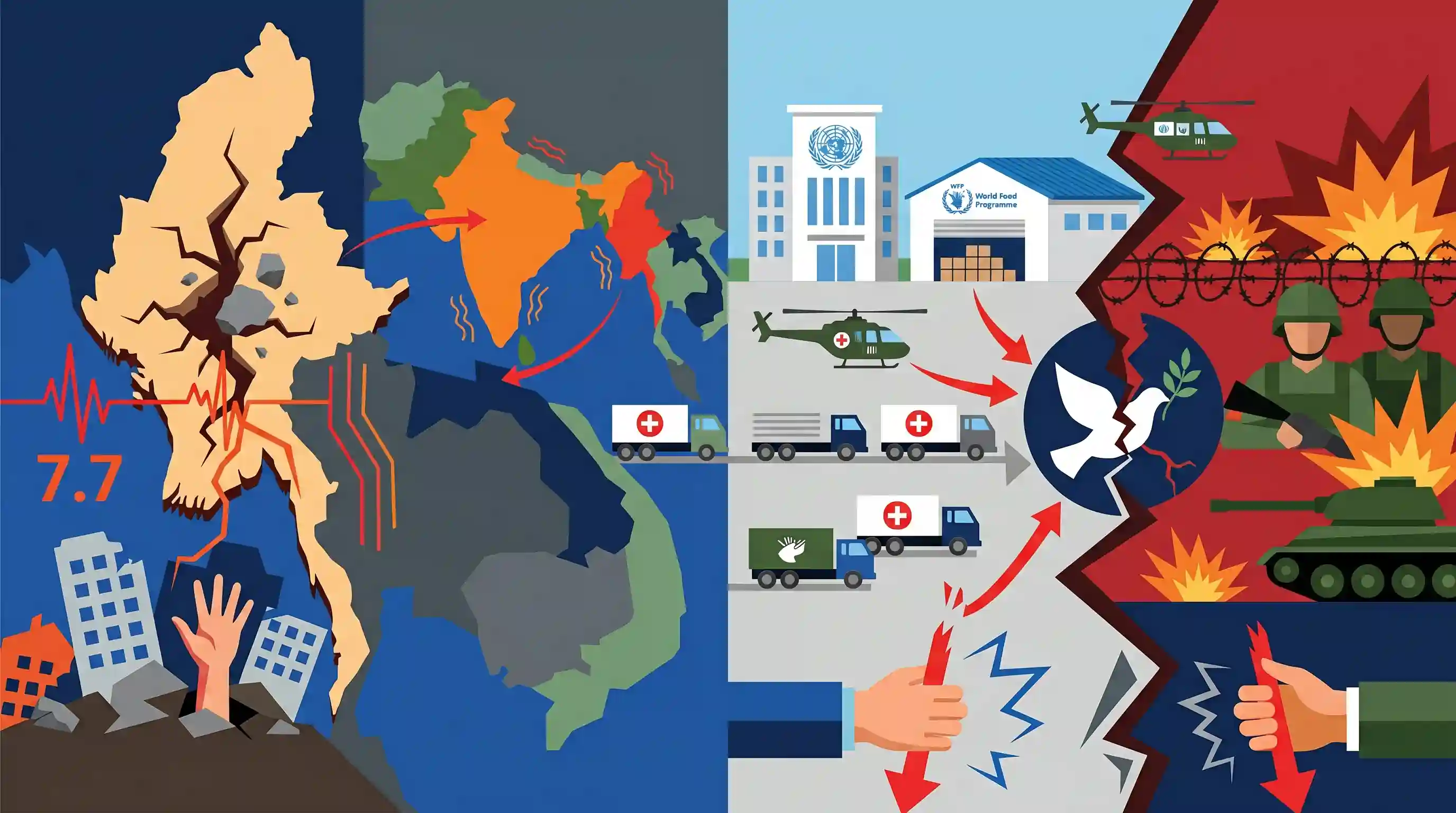
A devastating 7.7 magnitude earthquake in Myanmar has exacerbated the country's severe humanitarian crisis, already fueled by a civil war following the 2021 military coup. With thousands dead and millions affected, international organizations like the UN and WFP are urgently calling for unimpeded aid access. However, ongoing conflict and reported violations of a temporary ceasefire by the military junta are severely hindering rescue and relief operations, highlighting the immense challenges of managing natural disasters in conflict-ridden zones and drawing attention to the broader regional stability implications.
Key Points
- A catastrophic 7.7 magnitude earthquake hit Myanmar, resulting in over 3,000 deaths and affecting around 3 million people.
- The natural disaster compounds an ongoing humanitarian crisis caused by the 2021 military coup and ensuing civil war between the junta and resistance forces.
- Despite calls for a temporary ceasefire to allow humanitarian assistance, reports indicate continued military airstrikes and fighting on the ground.
- The UN and WFP are appealing for unrestricted access to deliver aid, highlighting the complexities of disaster response in active conflict zones.
- Numerous countries and regional bodies, including India and ASEAN, are attempting to provide relief, reflecting the regional implications of Myanmar's instability.
Important Terms
ASEAN

A regional intergovernmental organization comprising ten Southeast Asian nations, including Myanmar. It promotes political and security cooperation and lead diplomatic efforts like the Five-Point Consensus to resolve Myanmar's crisis.
UPSC context
GS Paper II: Important for International Relations, regional groupings, and India's 'Act East Policy' regarding neighborhood stability.
World Food Programme (WFP)
The food-assistance branch of the United Nations and the world’s largest humanitarian organization. It leads emergency food and cash distributions in Myanmar, especially in conflict and earthquake-affected regions.
UPSC context
GS Paper II & III: Relevant to international organizations, humanitarian aid dynamics, and global food security challenges.
Five-Point Consensus
A diplomatic peace plan adopted by ASEAN in 2021 calling for an immediate cessation of violence in Myanmar, constructive dialogue, and the provision of humanitarian assistance through a special envoy.
UPSC context
GS Paper II: Critical for understanding regional conflict resolution mechanisms and challenges in India's extended neighborhood.
Operation Brahma
India’s 2025 humanitarian assistance and disaster relief (HADR) operation launched to provide aid, medical supplies, and rescue support to Myanmar following a catastrophic 7.7 magnitude earthquake.
UPSC context
GS Paper II & III: Tests knowledge of India's 'Neighborhood First' policy and the military's role in regional disaster management.
Military Junta
The military government of Myanmar, officially known as the State Administration Council (SAC), which seized power in a February 2021 coup, triggering widespread civil war and humanitarian challenges.
UPSC context
GS Paper II: Important for analyzing political instability in the neighborhood and its impact on India's security and connectivity projects.
United Nations (UN)
An international organization founded in 1945 to maintain global peace and security. In Myanmar, it coordinates humanitarian clusters and advocates for unimpeded aid access amidst ongoing conflict.
UPSC context
GS Paper II: Vital for understanding the mandate and limitations of global governance institutions in conflict zones.
Prelims Trap
The Myanmar earthquake was caused by the subduction of the Indian Plate under the Eurasian Plate.
The Sagaing Fault is a major active strike-slip boundary (lateral horizontal movement), not a subduction zone, despite being near the Indo-Eurasian collision.
Static Concepts Connected
What characterizes a 'Complex Emergency'?
- Dual crisis: The simultaneous occurrence of a natural hazard and severe political conflict, civil war, or state breakdown.
- Aid barriers: Humanitarian relief efforts are actively blocked by military or political actors, making conventional disaster response unviable.
- Systemic collapse: Results in disproportionately high casualties, mass displacement, and severe human rights violations due to the collapse of state mechanisms.
What is the Free Movement Regime (FMR) with Myanmar?
- Historical context: Historically allowed border tribes to travel up to 16 km across the boundary without a visa, facilitating traditional ethnic and trade ties.
- Current status: India recently decided to scrap the FMR and fence the Indo-Myanmar border to curb insurgent movements, smuggling, and illegal immigration.
- Security implications: The policy shift heavily impacts border states like Mizoram and Manipur, dealing with demographic changes and refugee influxes from Myanmar's civil war.
Cross-Topic Patterns
HADR as Foreign Policy
India uses disaster relief (like Operation Karuna) as a diplomatic tool to maintain its 'Neighborhood First' policy while avoiding direct political endorsement of the military junta.
Internal Security & Border Refugees
Disasters in Myanmar directly trigger unchecked refugee influxes into Mizoram and Manipur, complicating border management frameworks like the Free Movement Regime (FMR) and domestic ethnic balances.
ASEAN's Centrality Crisis
The junta's defiance of the 'Five-Point Consensus' and blockade of aid exposes the structural limitations of ASEAN's consensus-based, non-interference model during acute geopolitical crises.

Expect a 2026 Prelims question linking India's border management (FMR scrapping) with Myanmar's complex emergency and refugee spillover.
Linked PYQs · 3
Linked PYQs · 3
- 2020MainsGS3
Discuss the recent measures initiated in disaster management by the Government of India departing from the earlier reactive approach.
- 2022MainsGS2
India is an age-old friend of Sri Lanka.’ Discuss India's role in the recent crisis in Sri Lanka in the light of the preceding statement.
- 2019MainsGS3
Disaster preparedness is the first step in any disaster management process. Explain how hazard zonation mapping will help disaster mitigation in the case of landslides.
