Southwest Monsoon Onset Mechanics and Indian Ocean Dynamics
Source:The Hindu ↗
Why It Matters
The Indian monsoon is foundational to Indian Geography (GS1) and Agriculture/Economy (GS3). Understanding the mechanics of its onset, its dual branches (Arabian Sea and Bay of Bengal), and global climate phenomena affecting it (like El Nino) are essential core concepts tested regularly in both Prelims and Mains.
Summary
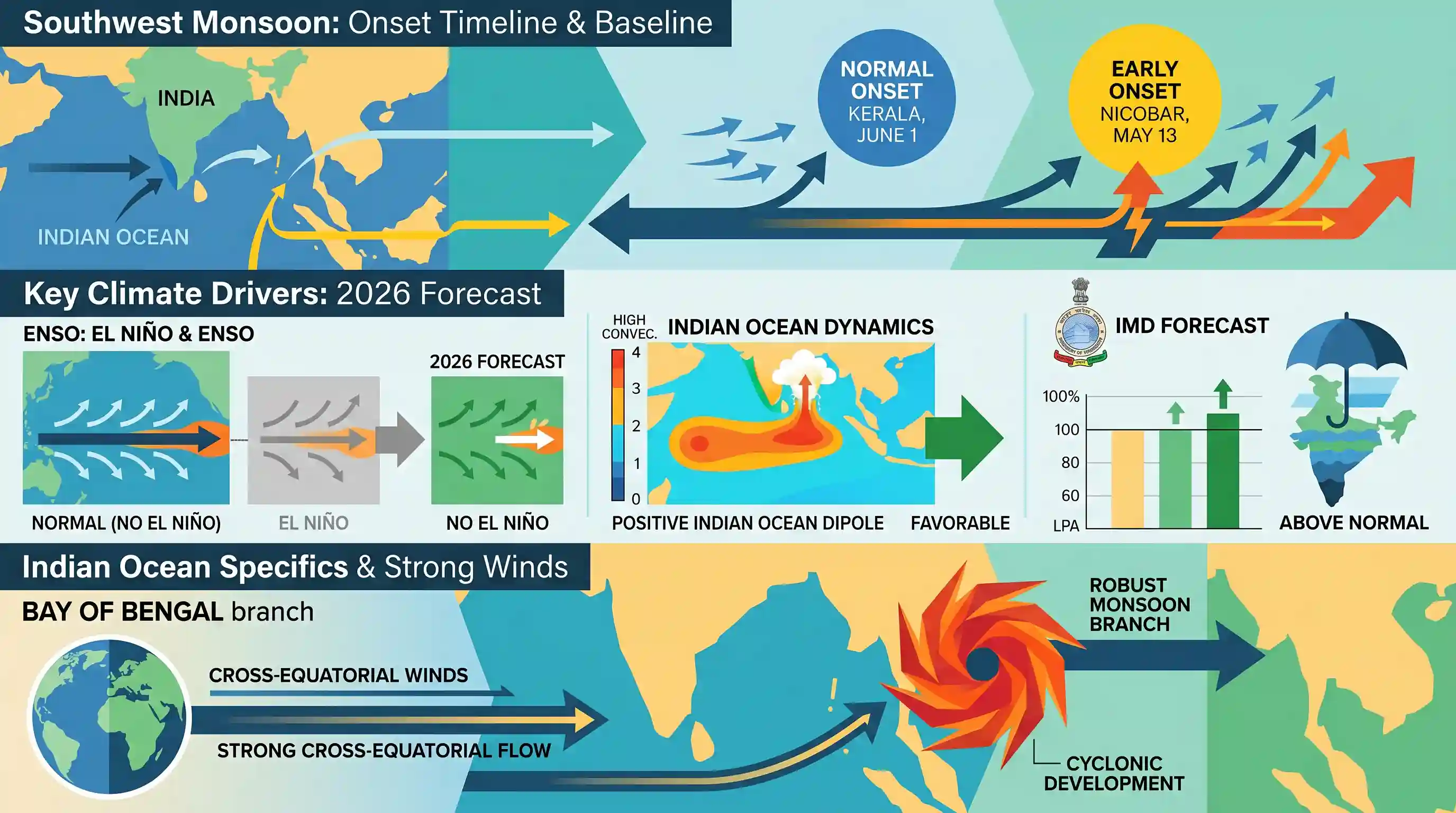
The India Meteorological Department (IMD) has announced that the Southwest monsoon is expected to arrive early over the Nicobar islands by May 13, driven by a strong cross-equatorial wind flow. While the normal onset date for the monsoon in Kerala remains June 1, these robust initial conditions in the Bay of Bengal—coupled with the absence of the El Nino phenomenon this year—support the IMD's forecast of an 'above normal' monsoon season. The strong winds may also herald cyclonic development in the Bay of Bengal branch of the monsoon.
Key Points
- The India Meteorological Department (IMD) predicted an early onset of the Southwest monsoon over the Nicobar islands by May 13, nearly a week earlier than normal.
- The early arrival is attributed to an unusually strong cross-equatorial flow of winds from the southern hemisphere, which can also indicate potential cyclone development in the region.
- Typically, the monsoon reaches Kerala around June 1, taking about 10 days to travel from the Nicobar region.
- The Southwest monsoon comprises two main branches: the Arabian Sea branch and the Bay of Bengal branch.
- The IMD has ruled out the El Nino phenomenon for this year's monsoon season and forecast above-normal rainfall.
Important Terms
India Meteorological Department (IMD)

The principal government agency responsible for meteorological observations, weather forecasting, and seismology in India.
UPSC context
GS Paper 1 (Geography) and GS Paper 3 (Disaster Management); tests institutional knowledge of weather prediction.
Southwest Monsoon
A seasonal wind system (June–September) that provides over 70% of India's annual rainfall, driven by a pressure gradient between the Indian landmass and the ocean.
UPSC context
GS Paper 1 (Geography); core concept for Indian climatology and agricultural economics.
Cross-equatorial flow
The movement of Southern Hemisphere trade winds across the equator; these are deflected right (Coriolis force) to become moisture-laden Southwest monsoon winds.
UPSC context
GS Paper 1 (Geography); tests understanding of global wind circulation and monsoon mechanisms.
El Niño
A climate pattern involving the unusual warming of surface waters in the central and eastern tropical Pacific, which typically suppresses the Indian monsoon.
UPSC context
GS Paper 1 (Geography); critical for understanding inter-annual rainfall variability and ENSO.
Bay of Bengal branch
One of the two primary streams of the Southwest monsoon; it moves over the Andaman Sea and provides rainfall to East and Northeast India.
UPSC context
GS Paper 1 (Geography); tests knowledge of regional monsoon distribution and arrival patterns.
Onset of Monsoon
IMD's specific criteria for declaring the monsoon's start in Kerala, involving rainfall (60% of 14 stations recording ≥2.5mm), wind speed, and Outgoing Longwave Radiation (OLR).
UPSC context
GS Paper 1 (Geography); focuses on the scientific benchmarks used to track the monsoon's progress.
Long Period Average (LPA)
The average annual rainfall recorded over a 50-year period (currently 87 cm for 1971–2020), used by IMD to benchmark 'normal' or 'above normal' seasons.
UPSC context
GS Paper 3 (Economy/Geography); relevant for understanding monsoon forecasts and their impact on agriculture.
Prelims Trap
"The Southwest monsoon hits the Indian landmass first at the Kerala coast."
While Kerala is the first mainland state, the monsoon arrives 1-2 weeks earlier over the Andaman and Nicobar Islands (Indian territory).
Static Concepts Connected
What drives the cross-equatorial wind flow of the Southwest Monsoon?
- Mascarene High: A high-pressure zone near Madagascar that acts as the source region for the Southeast trade winds.
- Coriolis Force: Deflects these trade winds to the right (becoming Southwest winds) as they cross the equator into the Northern Hemisphere.
- Somali Jet: A low-level jet stream that accelerates this cross-equatorial moisture flow toward the Indian subcontinent.
How does IMD classify monsoon rainfall categories?
- Long Period Average (LPA): The baseline average rainfall over a 50-year period, currently pegged at 87 cm using 1971-2020 data.
- Normal Rainfall: Defined as cumulative rainfall falling between 96% and 104% of the LPA.
- Above Normal: Officially declared when the cumulative seasonal rainfall is between 104% and 110% of the LPA.
Cross-Topic Patterns
Pre-monsoon Cyclogenesis in Bay of Bengal
Strong cross-equatorial winds that accelerate monsoon onset also converge moisture, creating ideal thermodynamic conditions for tropical cyclones before the monsoon fully sets in.
ENSO impacts on Macroeconomic Policy
The absence of El Nino signals a robust Kharif crop, directly influencing RBI's food inflation modeling and government Minimum Support Price (MSP) calculations.

Expect a multi-statement Prelims question testing the sequence of monsoon onset across Indian territories alongside IMD's LPA benchmarks.
Linked PYQs · 5
Linked PYQs · 5
- 2014PrelimsGS1
The seasonal reversal of winds is the typical characteristic of
- 2011PrelimsGS1
La Nina is suspected to have caused recent floods in Australia. How is La Nina different from El Nino? 1. La Nina is characterised by unusually cold ocean temperature in equatorial Indian Ocean whereas El Nino is characterised by unusually warm ocean temperature in the equatorial Pacific Ocean. 2. El Nino has adverse effect on south-west monsoon of India, but La Nina has no effect on monsoon climate. Which of the statements given above is/are correct?
- 2017PrelimsGS1
With reference to 'Indian Ocean Dipole (IOD)' sometimes mentioned in the news while forecasting Indian monsoon, which of the following statements is/are correct? 1. IOD phenomenon is characterised by a difference in sea surface temperature between tropical Western Indian Ocean and tropical Eastern Pacific Ocean. 2. An IOD phenomenon can influence an El Nino's impact on the monsoon. Select the correct answer using the code given below:
- 2002PrelimsGS1
For short-term climate prediction, which one of the following events, detected in the last decade, is associated with occasional weak monsoon rains in the India subcontinent?
- 2014MainsGS1
Most of the unusual climatic happenings are explained as an outcome of the El-Nino effect. Do you agree?
