IMD Monsoon Onset Criteria and Early Progression Factors
Source:Indian Express ↗
Why It Matters
The Indian monsoon is a central pillar of UPSC Geography (GS1). Aspirants must understand the precise IMD criteria for monsoon onset, as well as the regional (cyclones) and global (ENSO, IOD) factors that influence its timing and performance, as these concepts are repeatedly tested in both Prelims and Mains.
Summary
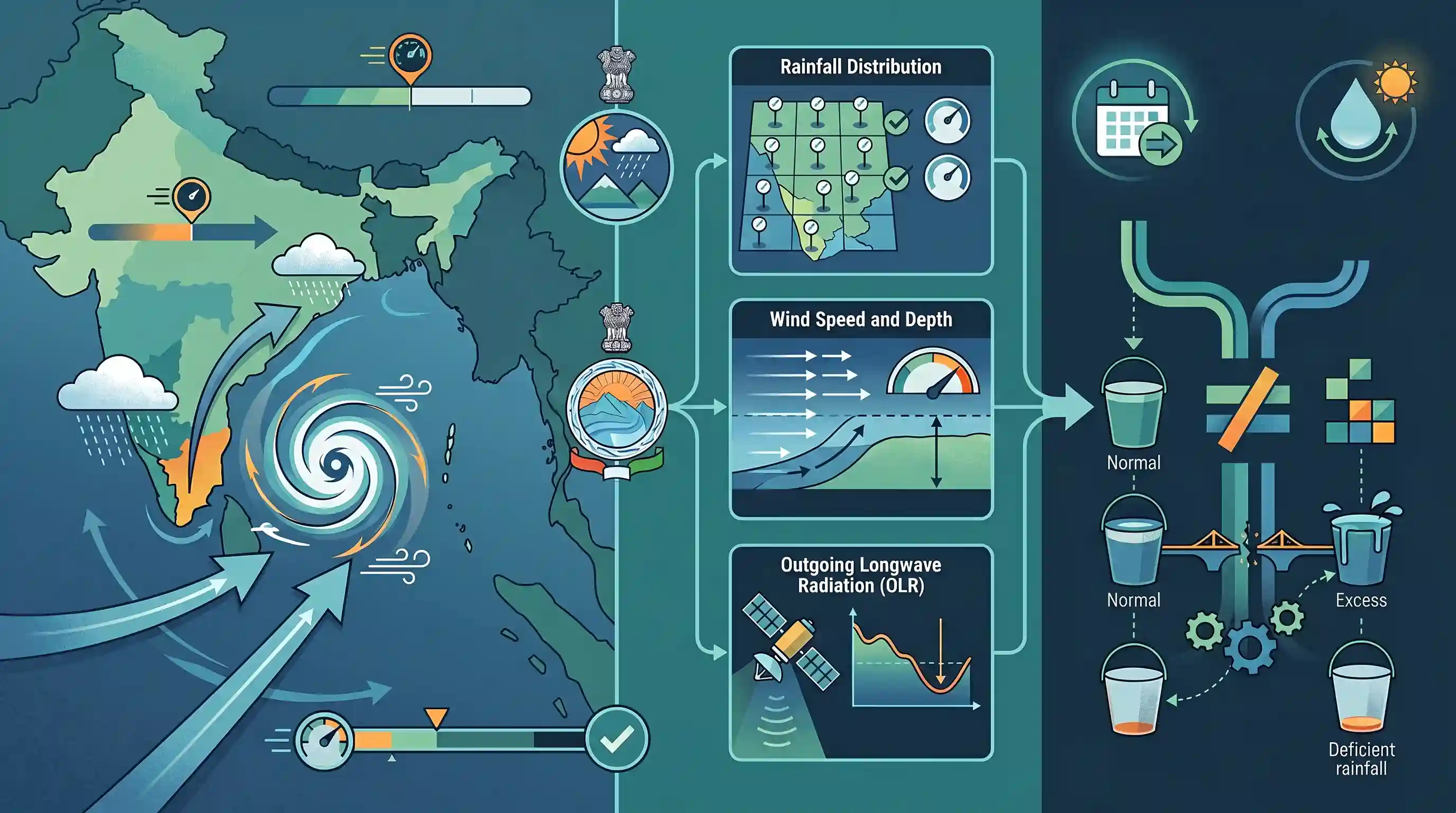
The article explains the meteorological factors contributing to the early onset of the Southwest Monsoon in India. It highlights how pre-monsoon cyclonic disturbances in the Bay of Bengal can accelerate the advance of monsoon winds towards Kerala and the Andaman Sea. Additionally, it outlines the strict objective criteria used by the India Meteorological Department (IMD) to officially declare the monsoon onset, which include specific measurements of rainfall distribution, wind speed and depth, and Outgoing Longwave Radiation (OLR). Crucially, the article notes that an early onset is merely a marker of the monsoon's arrival and has no direct correlation with the overall quantum of rainfall India will receive during the four-month season.
Key Points
- The India Meteorological Department (IMD) declares the monsoon onset over Kerala based on three objective criteria: specific rainfall thresholds (at least 2.5 mm in 60% of designated stations), wind field strength and depth, and Outgoing Longwave Radiation (OLR) levels.
- An early onset of the southwest monsoon is often catalyzed by pre-monsoon cyclonic systems in the Bay of Bengal, which pull the monsoon trough and moisture-laden winds towards the Indian landmass.
- Global ocean-atmosphere phenomena, such as a transition towards La Niña conditions or a positive Indian Ocean Dipole (IOD), can strengthen cross-equatorial winds and favor an early or robust monsoon progression.
- The timing of the monsoon onset (early or delayed) does not dictate the total volume or distribution of rainfall for the entire June-September monsoon season.
Important Terms
Southwest Monsoon

The primary four-month rainy season (June–September) in India, driven by moisture-laden winds from the Indian Ocean following the seasonal reversal of wind patterns.
UPSC context
GS Paper I (Geography); critical for Indian agriculture, water security, and economic stability.
India Meteorological Department (IMD)
The nodal agency under the Ministry of Earth Sciences responsible for meteorological observations, weather forecasting, and seismology in India.
UPSC context
GS Paper III (Disaster Management); central to national disaster warnings and agricultural planning.
Monsoon Onset Criteria
Specific objective benchmarks involving rainfall consistency at 14 stations, depth/speed of westerly winds, and Outgoing Longwave Radiation (OLR) used to declare the monsoon's arrival.
UPSC context
GS Paper I (Geography); tests understanding of technical meteorological parameters and regional onset patterns.
Outgoing Longwave Radiation (OLR)
A measure of energy emitted from Earth to space; in meteorology, low OLR values signify deep convective clouds and heavy rainfall potential.
UPSC context
GS Paper I (Geography/Climatology); a technical indicator often featured in Prelims regarding monsoon monitoring.
Long Period Average (LPA)
The average rainfall recorded over a 50-year period, used by the IMD as a benchmark to determine if a monsoon season is normal, deficient, or excess.
UPSC context
GS Paper III (Economy/Agriculture); vital for understanding climate variability and agricultural impact reports.
Monsoon Onset Vortex
A synoptic-scale cyclonic circulation that forms over the Arabian Sea or Bay of Bengal, often acting as a catalyst for the monsoon's arrival.
UPSC context
GS Paper I (Geography); explores the relationship between tropical cyclones and seasonal wind movements.
Prelims Trap
"High Outgoing Longwave Radiation (OLR) indicates active monsoon conditions and dense cloud cover."
UPSC swaps high/low parameters. Dense clouds absorb terrestrial radiation, meaning a LOW OLR (<200 W/m²) at the top of the atmosphere indicates the deep convection and heavy cloudiness required for onset.
Static Concepts Connected
What are the IMD's objective criteria for declaring monsoon onset over Kerala?
- Rainfall threshold: At least 60% of 14 designated stations in the region must record 2.5 mm or more rainfall for two consecutive days after May 10.
- Wind field: Westerly winds must have sufficient speed and depth (up to 600 hPa) in the specified equatorial and coastal region.
- OLR levels: Outgoing Longwave Radiation (OLR) must drop below 200 W/m², confirming the presence of deep, dense cloud cover.
How do pre-monsoon cyclonic disturbances in the Bay of Bengal affect monsoon advance?
- Moisture pull: Cyclonic depressions create a strong low-pressure void that pulls the monsoon trough and moisture-laden southwesterly winds toward the Indian landmass.
- Catalyst effect: Rather than disrupting the system, these early pre-monsoon cyclones often act as catalysts, accelerating the monsoon's advance over the Andaman Sea and Kerala coast.
Cross-Topic Patterns
La Niña + Positive IOD synergy
Transitions to La Niña and positive IOD both strengthen cross-equatorial winds. UPSC frequently tests these ocean-atmosphere phenomena together to assess their combined impact on the Indian summer monsoon.
Onset timing vs. Total seasonal quantum
Aspirants intuitively link early onset to surplus rain. However, onset timing is merely a localized meteorological marker and has no statistical correlation with pan-India seasonal rainfall distribution.

Expect a multi-statement Prelims question combining the technical IMD onset criteria (specifically OLR values) with La Niña transitions.
Linked PYQs · 4
Linked PYQs · 4
- 2017PrelimsGS1
With reference to 'Indian Ocean Dipole (IOD)' sometimes mentioned in the news while forecasting Indian monsoon, which of the following statements is/are correct? 1. IOD phenomenon is characterised by a difference in sea surface temperature between tropical Western Indian Ocean and tropical Eastern Pacific Ocean. 2. An IOD phenomenon can influence an El Nino's impact on the monsoon. Select the correct answer using the code given below:
- 2011PrelimsGS1
La Nina is suspected to have caused recent floods in Australia. How is La Nina different from El Nino? 1. La Nina is characterised by unusually cold ocean temperature in equatorial Indian Ocean whereas El Nino is characterised by unusually warm ocean temperature in the equatorial Pacific Ocean. 2. El Nino has adverse effect on south-west monsoon of India, but La Nina has no effect on monsoon climate. Which of the statements given above is/are correct?
- 2014MainsGS1
Most of the unusual climatic happenings are explained as an outcome of the El-Nino effect. Do you agree?
- 2015MainsGS1
How far do you agree that the behaviour of the Indian monsoon has been changing due to humanizing landscapes? Discuss.
