Climate factors driving early southwest monsoon onset in India
Source:Indian Express ↗
Why It Matters
Understanding the mechanics of the Indian Monsoon and the criteria for its onset is foundational for UPSC Physical Geography (GS1). Questions frequently probe the impact of global phenomena like ENSO, IOD, and cyclones on the spatial and temporal distribution of rainfall in India, which directly affects agriculture and the economy.
Summary
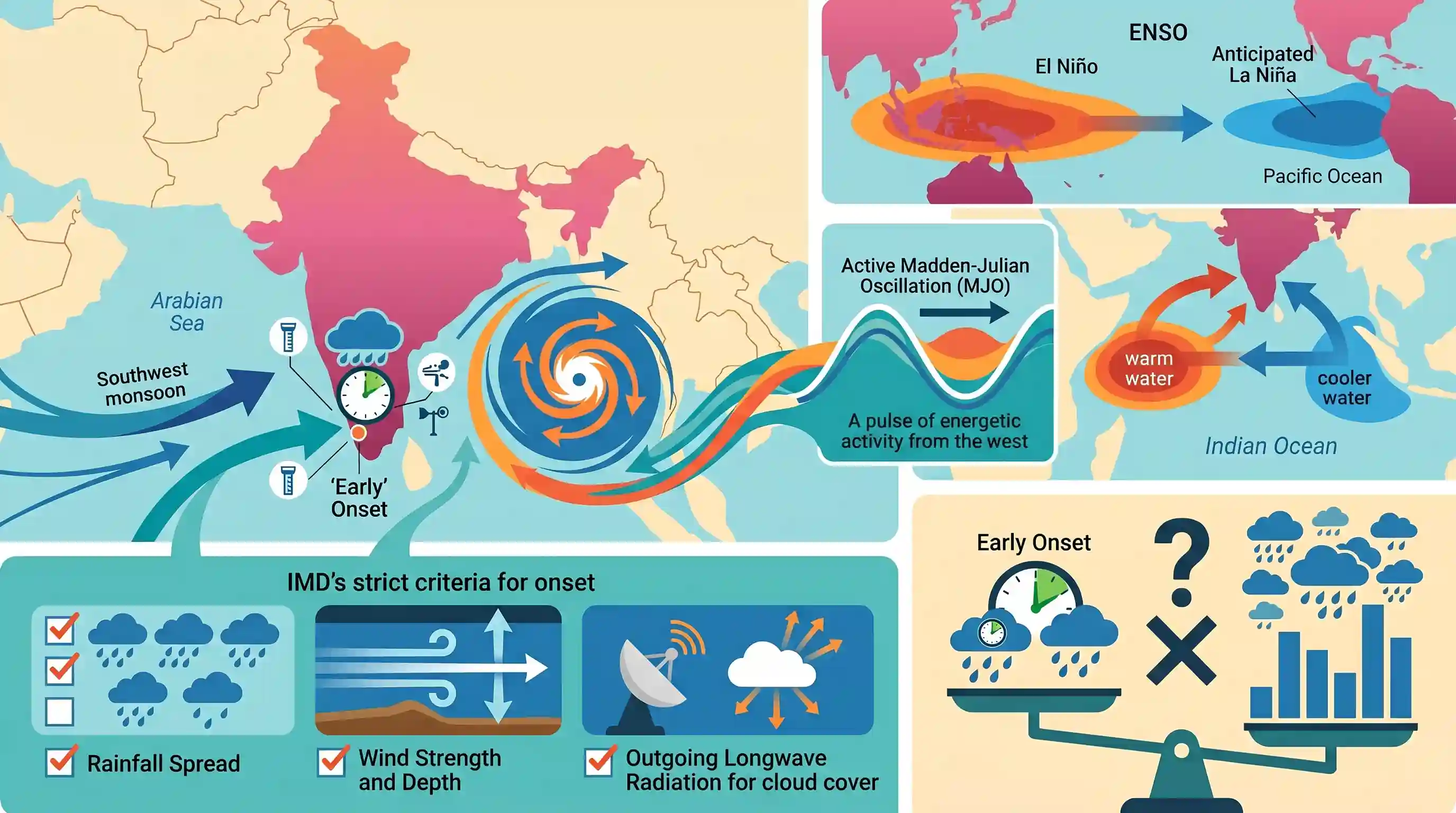
The India Meteorological Department (IMD) declared the onset of the southwest monsoon over Kerala earlier than the normal June 1 date. This early arrival was driven by several favorable climatic factors, notably the severe cyclonic storm Remal, which pulled the monsoon current over the Bay of Bengal, and an active Madden-Julian Oscillation (MJO). The broader climate backdrop includes the waning of El Niño and an anticipated shift to La Niña, along with a developing positive Indian Ocean Dipole (IOD). The IMD's declaration relies on strict criteria regarding rainfall spread, wind strength and depth, and cloud cover (measured via Outgoing Longwave Radiation). However, an early onset is simply a marker of the season's start and does not necessarily correlate with total quantum or distribution of seasonal rainfall.
Key Points
- The onset of the southwest monsoon over Kerala is declared by the IMD based on specific criteria including rainfall, wind, and Outgoing Longwave Radiation (OLR).
- Rainfall criterion: 14 designated meteorological stations in Kerala and Lakshadweep must record at least 2.5 mm of rain for two consecutive days after May 10.
- Wind criterion: Depth of westerlies must be up to 600 hPa and wind speed should be 15-20 knots at the 925 hPa level.
- OLR criterion: Outgoing Longwave Radiation, which signifies cloudiness, must be below 200 W/m² over the defined area.
- An early onset this year was aided by Cyclone Remal pulling the monsoon current over the Bay of Bengal, favorable Madden-Julian Oscillation (MJO) phase, and a transition from El Niño to ENSO-neutral/La Niña conditions.
- An early onset merely marks the beginning of the rainy season and does not guarantee more overall rainfall or lack of dry spells during the four-month season.
Important Terms
India Meteorological Department (IMD)

Nodal agency under the Ministry of Earth Sciences for meteorological observations, weather forecasting, and seismology. Established in 1875, it is a Regional Specialized Meteorological Centre of the WMO.
UPSC context
GS-I (Geography) and GS-III (Disaster Management). Central to institutional frameworks for weather monitoring.
Southwest Monsoon
A seasonal wind system (June-September) bringing moisture-laden winds from the Indian Ocean to the subcontinent, accounting for roughly 75% of India's annual rainfall.
UPSC context
GS-I (Geography) and GS-III (Agriculture). Essential for understanding India's climate and food security.
Madden-Julian Oscillation (MJO)
An eastward-moving disturbance of clouds, rainfall, and winds near the equator that circles the globe every 30-60 days, influencing monsoon pulses and breaks.
UPSC context
GS-I (Geography). Tests understanding of intra-seasonal variability and atmospheric dynamics in the tropics.
Indian Ocean Dipole (IOD)
A climate pattern characterized by sea-surface temperature differences between the western (Arabian Sea) and eastern (near Indonesia) tropical Indian Ocean; its positive phase enhances monsoon rainfall.
UPSC context
GS-I (Geography). Key for explaining regional monsoon drivers and their interaction with ENSO.
El Niño-Southern Oscillation (ENSO)
A periodic variation in sea-surface temperatures (El Niño/La Niña) and pressure in the tropical Pacific that impacts global weather and can suppress or boost Indian rainfall.
UPSC context
GS-I (Geography) and GS-III (Agriculture). Fundamental for long-range forecasting and drought risk assessment.
Outgoing Longwave Radiation (OLR)
A measure of energy emitted by Earth; low OLR values signify dense, tall cloud cover, used by IMD as a technical threshold for declaring monsoon onset.
UPSC context
GS-I (Geography). Reflects scientific criteria for determining climatic transitions and convective activity.
Prelims Trap
"An early onset of the southwest monsoon guarantees above-normal total seasonal rainfall."
Aspirants conflate chronological onset with total rainfall. Early onset is merely a timeline marker and does not predict the total quantum of rainfall or the absence of dry spells.
Static Concepts Connected
What are IMD's specific criteria for declaring monsoon onset over Kerala?
- Rainfall: 14 designated stations in Kerala and Lakshadweep must record at least 2.5 mm of rain for two consecutive days.
- Wind field: Depth of westerlies must reach 600 hPa with wind speeds of 15-20 knots at the 925 hPa level.
- Cloudiness (OLR): Outgoing Longwave Radiation (OLR) must fall below 200 W/m², confirming thick cloud cover and deep convection.
How does the Madden-Julian Oscillation (MJO) differ from ENSO?
- Temporal scale: MJO is an intra-seasonal eastward-moving pulse (30-60 days), whereas ENSO is an inter-annual phenomenon occurring over years.
- Monsoon impact: An active (convective) MJO phase positioned over the Indian Ocean enhances monsoon onset and rainfall, acting as a transient booster.
Cross-Topic Patterns
Pre-monsoon cyclones & monsoon onset
Bay of Bengal cyclones (e.g., Remal) can physically alter the monsoon trough's advance. This seamlessly links atmospheric hazards (cyclones) with Indian agricultural planning and sowing windows.
OLR as a proxy metric
UPSC frequently tests technical remote-sensing metrics. Outgoing Longwave Radiation (OLR) is heavily utilized by IMD to measure cloud-top temperatures and assess deep convection for the monsoon.

Expect a 2026 Prelims question testing IMD's technical onset criteria (OLR, wind depth) alongside the intra-seasonal impact of the MJO.
Linked PYQs · 4
Linked PYQs · 4
- 2014PrelimsGS1
The seasonal reversal of winds is the typical characteristic of
- 2014MainsGS1
Most of the unusual climatic happenings are explained as an outcome of the El-Nino effect. Do you agree?
- 2017PrelimsGS1
With reference to 'Indian Ocean Dipole (IOD)' sometimes mentioned in the news while forecasting Indian monsoon, which of the following statements is/are correct? 1. IOD phenomenon is characterised by a difference in sea surface temperature between tropical Western Indian Ocean and tropical Eastern Pacific Ocean. 2. An IOD phenomenon can influence an El Nino's impact on the monsoon. Select the correct answer using the code given below:
- 2011PrelimsGS1
La Nina is suspected to have caused recent floods in Australia. How is La Nina different from El Nino? 1. La Nina is characterised by unusually cold ocean temperature in equatorial Indian Ocean whereas El Nino is characterised by unusually warm ocean temperature in the equatorial Pacific Ocean. 2. El Nino has adverse effect on south-west monsoon of India, but La Nina has no effect on monsoon climate. Which of the statements given above is/are correct?
