West Asia Shocks Moderate India Economic Momentum in March
Source:The Hindu ↗
Why It Matters
Understanding the interplay between geopolitical events (like West Asia conflicts) and domestic macroeconomic indicators is critical for analyzing India's economic resilience, trade balance, and necessary fiscal or monetary policy adjustments in response to global energy and supply shocks.
Summary
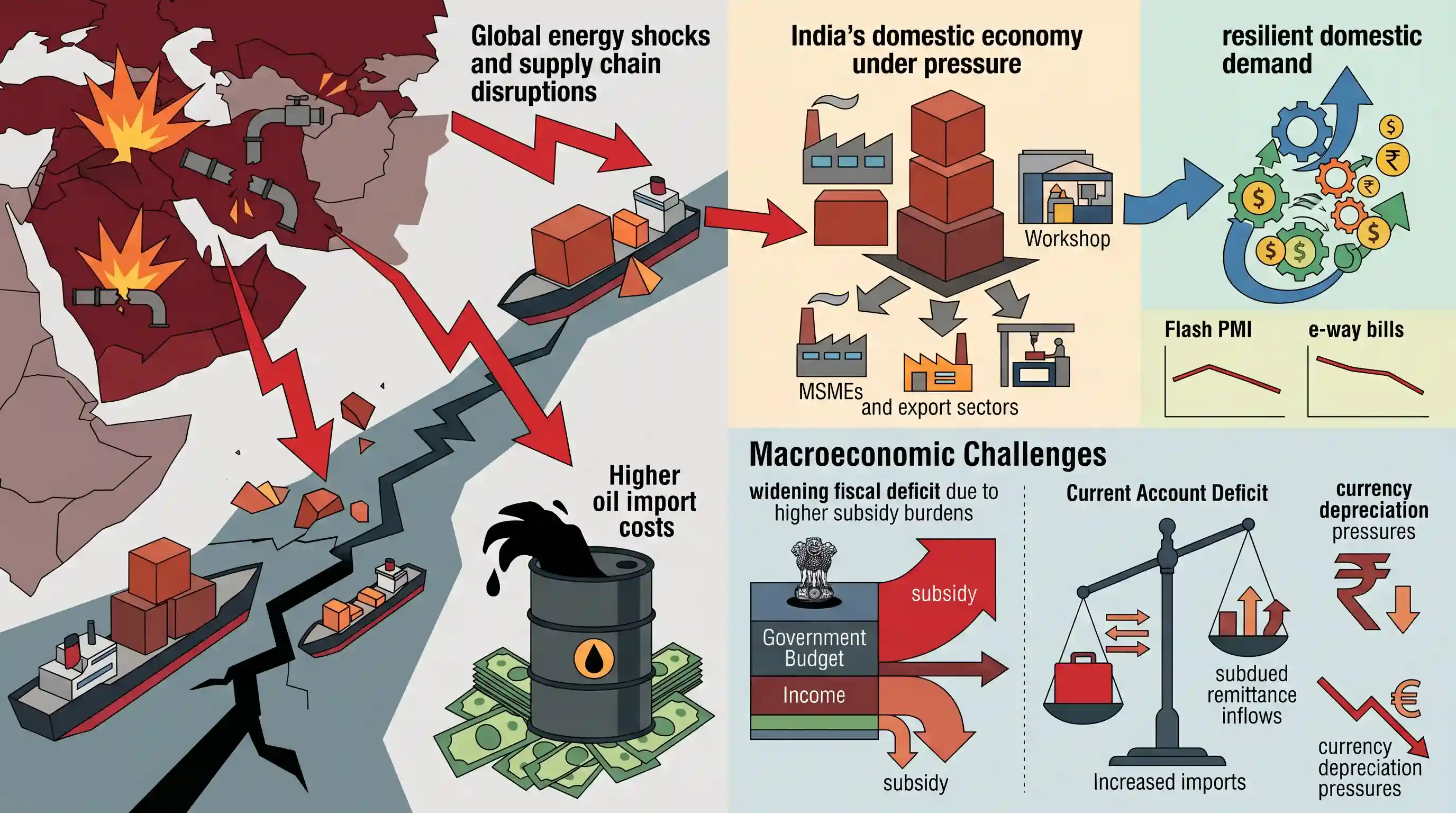
The Finance Ministry's Monthly Economic Review for March 2026 notes a moderation in India's economic momentum due to global energy shocks and supply chain disruptions stemming from conflicts in West Asia. High-frequency indicators like e-way bills and the Flash PMI show softening, although domestic demand remains resilient. The war has escalated freight costs, disrupted shipping routes, and inflated India's oil import bill, squeezing export-oriented sectors and MSMEs. This global volatility presents significant macroeconomic challenges, including currency depreciation pressures, a widening fiscal deficit due to higher subsidy burdens, and subdued remittance inflows.
Key Points
- The Finance Ministry's Monthly Economic Review indicates a slowdown in early economic indicators for March 2026, primarily driven by external shocks from West Asia.
- India's strong dependence on West Asia for energy, trade, and remittances ($40 billion annually) makes it highly vulnerable to regional geopolitical conflicts.
- Escalating freight and insurance costs due to shipping rerouting are hurting export competitiveness and straining production in MSMEs and continuous-process industries.
- Despite external headwinds, domestic demand remains resilient, supported by steady vehicle registrations, expanding digital payments, and positive rural sentiments.
- A rising oil import bill and higher subsidy requirements for fuel and fertilizers are exerting depreciating pressure on the rupee and widening India's fiscal deficit.
Important Terms
e-way bill

A mandatory electronic document under the GST regime for the movement of goods valued over ₹50,000; it serves as a high-frequency indicator of domestic trade and logistics activity.
UPSC context
GS Paper III: Indian Economy. Used to monitor internal trade and track real-time economic momentum through high-frequency data.
MSME (Micro, Small and Medium Enterprises)
Enterprises classified by investment and turnover limits under the MSMED Act; they are critical contributors to India's GDP, manufacturing output, and employment generation.
UPSC context
GS Paper III: Indian Economy. Key for discussions on inclusive growth, industrial sector challenges, and export-oriented sectors.
Department of Economic Affairs (DEA)
The nodal agency within the Ministry of Finance responsible for formulating macroeconomic policies, managing public finances, and preparing the Union Budget and Economic Survey.
UPSC context
GS Paper II/III: Governance and Economy. Tests knowledge of institutional roles in fiscal policy and budget preparation.
Flash PMI
An early monthly estimate of the Purchasing Managers' Index based on 85-90% of survey responses, indicating manufacturing and services health before final data release.
UPSC context
GS Paper III: Economic Development. Acts as a leading indicator of economic expansion (above 50) or contraction (below 50).
Fiscal Deficit
The difference between the government’s total expenditure and its total non-debt receipts, representing the total borrowing required by the government to bridge the gap.
UPSC context
GS Paper III: Fiscal Policy. A key metric for assessing macroeconomic stability, debt sustainability, and the FRBM Act targets.
Current Account Deficit (CAD)
The shortfall between a nation's total export earnings and its total import payments, including net income from abroad and transfer payments.
UPSC context
GS Paper III: External Sector. Vital for understanding balance of payments, currency depreciation, and external sector resilience.
Prelims Trap
"PMI and E-way bill data are compiled and published by the Ministry of Finance."
The Finance Ministry cites them in reviews, but PMI is compiled by private entities (e.g., S&P Global) and E-way bills are managed by the GST Network.
Static Concepts Connected
What are the key features of the Purchasing Managers' Index (PMI)?
- Survey-based: It is an early economic indicator derived from monthly surveys of purchasing managers in private sector companies.
- Threshold values: A reading above 50 indicates expansion, below 50 indicates contraction, and exactly 50 means no change compared to the previous month.
- Private compilation: It is compiled and released by private entities like S&P Global, not by the RBI or the Ministry of Finance.
How do external energy shocks affect India's 'Twin Deficits'?
- Current Account: Higher crude oil prices inflate the merchandise trade deficit, directly widening the Current Account Deficit (CAD).
- Fiscal Deficit: Elevated global gas and oil prices increase the government's subsidy burden for fertilizers (ammonia/urea) and fuel, widening the fiscal deficit.
- Currency Impact: Widening twin deficits combined with imported inflation put severe depreciating pressure on the Indian Rupee.
Cross-Topic Patterns
Red Sea crisis + Fertilizer subsidies
West Asian instability spikes natural gas prices, the primary feedstock for urea. This directly inflates India's fertilizer subsidy bill, bridging geopolitics with agricultural economics.
Gulf remittances + BoP Invisibles
India's massive remittance inflows from the Gulf act as a crucial buffer for the CAD. Regional conflicts threaten this 'invisibles' surplus in the Balance of Payments.

Expect a multi-statement question linking West Asian chokepoints (Red Sea/Hormuz) directly to imported inflation and India's twin deficits.
Linked PYQs · 5
Linked PYQs · 5
- 2025MainsGS2
"Energy security constitutes the dominant kingpin of India's foreign policy, and is linked with India's overarching influence in Middle Eastern countries.” How would you integrate energy security with India's foreign policy trajectories in the coming years?
- 2017MainsGS2
The question of India's Energy Security constitutes the most important part of India's economic progress. Analyze India's energy policy cooperation with West Asian countries.
- 2018MainsGS3
How would the recent phenomena of protectionism and currency manipulations in world trade affect macroeconomic stability of India?
- 2024MainsGS2
‘The West is fostering India as an alternative to reduce dependence on China's supply chain and as a strategic ally to counter China's political and economic dominance.’ Explain this statement with examples.
- 2023PrelimsGS1
Consider the following statements: Statement-I: In the post-pandemic recent past, many Central Banks worldwide had carried out interest rate hikes. Statement-II: Central Banks generally assume that they have the ability to counteract the rising consumer prices via monetary policy means. Which one of the following is correct in respect of the above statements?
