Global Energy Shocks Moderate Indian Economic Momentum in March
Source:The Hindu ↗
Why It Matters
The article comprehensively outlines the vulnerability of the Indian economy to external shocks, particularly energy price volatility and conflict in West Asia. It highlights the direct transmission channels of global crises to India—via the trade balance, currency valuation, remittances, and fiscal burden—making it essential for understanding the macroeconomic effects of geopolitics on the Indian economy.
Summary
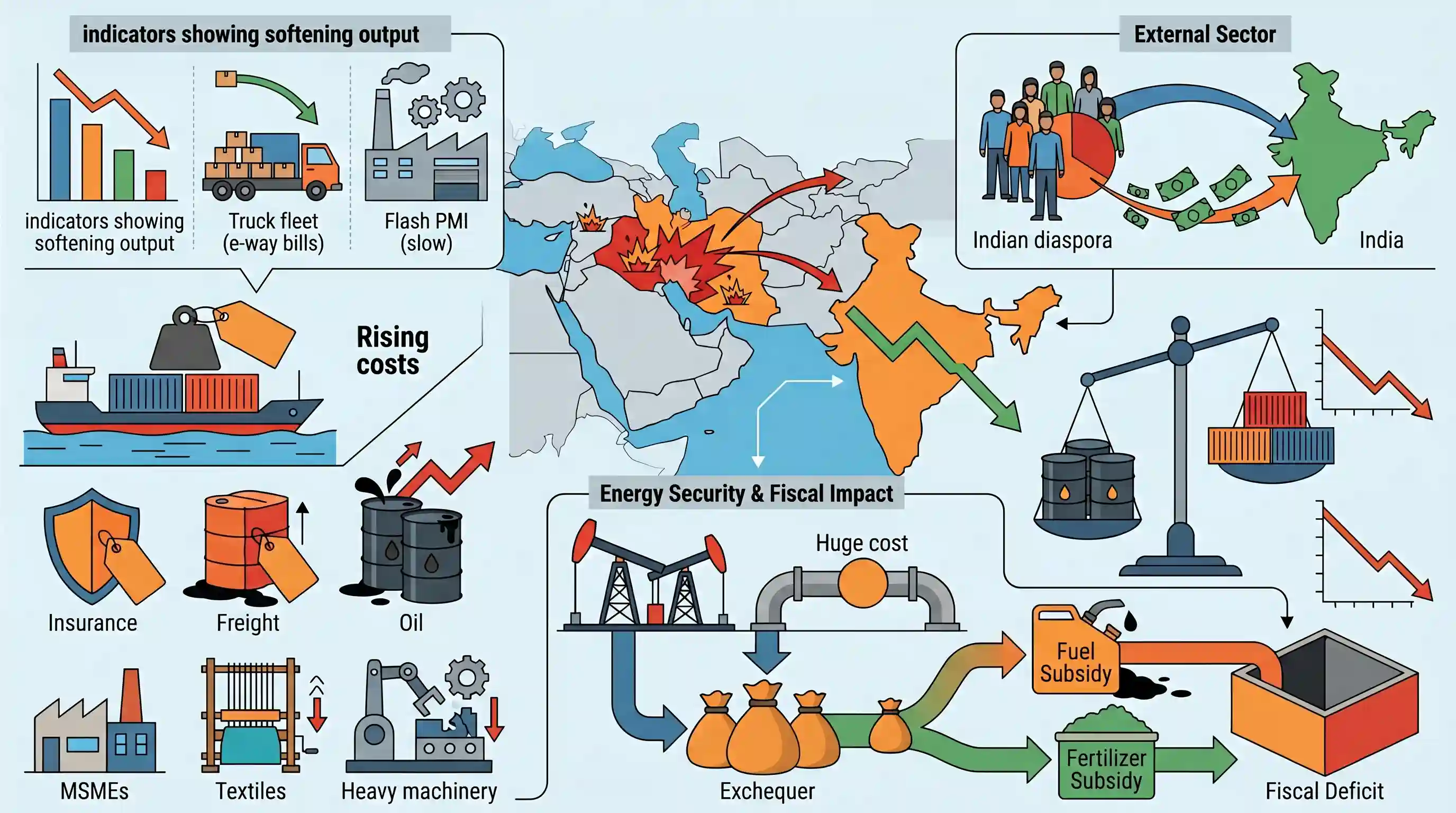
According to the Finance Ministry's Monthly Economic Review, the ongoing conflict in West Asia has begun moderating India's economic momentum as of March 2026. As a major energy importer with deep trade and remittance linkages to the Gulf, India faces a multi-layered risk profile. High-frequency indicators, such as e-way bill generation and Flash PMI, point to softening output. Surging freight, insurance, and fuel costs are acutely impacting MSMEs and export-oriented sectors like textiles and engineering goods. At the macroeconomic level, elevated petroleum import bills and potential drops in remittances—given that about 35% of India's total remittances originate from West Asia—are threatening to widen the Current Account Deficit (CAD) and exert depreciative pressure on the rupee. Additionally, an expected increase in fuel and fertiliser subsidy outgoes risks widening the fiscal deficit, prompting the need for calibrated policy responses.
Key Points
- The Finance Ministry's Monthly Economic Review for March 2026 indicates a moderation in India's economic momentum due to the West Asia conflict and resulting energy price shocks.
- High-frequency indicators, including e-way bill generation and Flash PMI, show softening output, while MSMEs face stress from surging freight, insurance, and fuel costs.
- Macroeconomic risks have heightened, with higher petroleum import bills and potential portfolio outflows putting pressure on India's Current Account Deficit (CAD) and leading to rupee depreciation.
- The conflict threatens remittance inflows; around 9.2 million Indians live in West Asia, contributing nearly 35% (approx. $40 billion) of India's annual remittances.
- The fiscal deficit may widen as the government is likely to face higher subsidy requirements for fuel and fertilisers to cushion the energy price shock.
Important Terms
Department of Economic Affairs (DEA)

A department within the Finance Ministry responsible for formulating economic policies, preparing the Union Budget, and publishing the Monthly Economic Review.
UPSC context
Relevant for GS Paper III (Budgeting) and Prelims; it's the nodal agency for macroeconomic data and fiscal policy.
High-Frequency Indicators (HFI)
Economic data points available at short intervals (daily/monthly) used to assess real-time momentum before quarterly GDP figures are released.
UPSC context
Critical for GS Paper III (Growth and Development); tests understanding of timely economic monitoring tools like PMI and IIP.
Current Account Deficit (CAD)
The gap occurring when a country's total imports of goods, services, and transfers exceed its total exports and earnings from abroad.
UPSC context
Core GS Paper III (External Sector/BoP) topic; specifically linked to energy imports and currency stability.
Fiscal Deficit
The difference between a government's total expenditure and its total non-debt receipts, representing the total amount of money the government needs to borrow.
UPSC context
Fundamental for GS Paper III (Fiscal Policy); focuses on the impact of subsidies and revenue-expenditure mismatches.
Remittances
Money sent by individuals working abroad to their families; India is the world's top recipient, with significant inflows from the Gulf region.
UPSC context
Relevant for GS Paper II (Diaspora) and GS Paper III (Invisibles in BoP); assesses external sector resilience and geopolitical risks.
MSMEs
Private sector business entities defined by their investment in plant/machinery and annual turnover; vital for employment and exports in India.
UPSC context
Key for GS Paper III (Inclusive Growth/Industrial Sector); tests impact of global supply chain disruptions on small-scale industries.
Prelims Trap
Remittances from West Asia are recorded under the Capital Account of India's Balance of Payments.
Remittances are classified under 'Invisibles' (specifically 'Private Transfers') in the Current Account, NOT the Capital Account.
Static Concepts Connected
What are the primary components of India's Current Account?
- Merchandise Trade: Export and import of physical, tangible goods. India historically runs a deficit here (Trade Deficit).
- Services Trade: Trade in intangible services such as IT, BPO, travel, and transportation. India typically runs a surplus here.
- Income & Transfers: Includes remittances from the diaspora (private transfers), grants, and investment income (dividends/interest payments).
What is the 'Twin Deficit' challenge in the Indian macro-economy?
- Fiscal Deficit: Occurs when the government's total expenditure exceeds its total non-debt receipts. Often exacerbated by unplanned subsidy payouts for fuel and fertilisers.
- Current Account Deficit: Occurs when the value of imported goods, services, and investment incomes exceeds exports. Highly sensitive to global crude oil price shocks.
- The Linkage: A high fiscal deficit (driven by imported oil subsidies) expands domestic money supply/inflation, which simultaneously worsens the CAD by making exports uncompetitive.
Cross-Topic Patterns
Gulf Geopolitics & Agri-Subsidy Burden
India's reliance on West Asian LNG and crude heavily dictates domestic urea production costs, directly linking geopolitical stability in the Gulf to India's agricultural fertiliser subsidy burden.
Maritime Chokepoints & MSME Margins
Disruptions in critical chokepoints like the Strait of Hormuz disproportionately erode the export competitiveness of low-margin MSME sectors (like textiles) via surging maritime insurance and freight rates.

Expect a multi-statement question linking West Asia conflicts to India's twin deficit (CAD + Fiscal) via remittances and oil imports.
Linked PYQs · 5
Linked PYQs · 5
- 2021PrelimsGS1
Consider the following statements : The effect of devaluation of a currency is that it necessarily 1. improves the competitiveness of the domestic exports in the foreign markets 2. increases the foreign value of domestic currency 3. improves the trade balance Which of the above statements is/are correct?
- 2022PrelimsGS1
With reference to the Indian economy, consider the following statements: 1. An increase in Nominal Effective Exchange Rate (NEER) indicates the appreciation of rupee. 2. An increase in the Real Effective Exchange Rate (REER) indicates an improvement in trade competitiveness. 3. An increasing trend in domestic inflation relative to inflation in other countries is likely to cause an increasing divergence between NEER and REER. Which of the above statements are correct?
- 2018MainsGS3
How would the recent phenomena of protectionism and currency manipulations in world trade affect macroeconomic stability of India?
- 2023MainsGS2
Indian diaspora has scaled new heights in the West. Describe its economic and political benefits for India.
- 2017MainsGS2
Indian diaspora has an important role to play in South-East Asian countries' economy and society. Appraise the role of Indian diaspora in South-East Asia in this context.
