External Affairs Minister embarks on strategic six-nation tour
Source:Indian Express ↗
Why It Matters
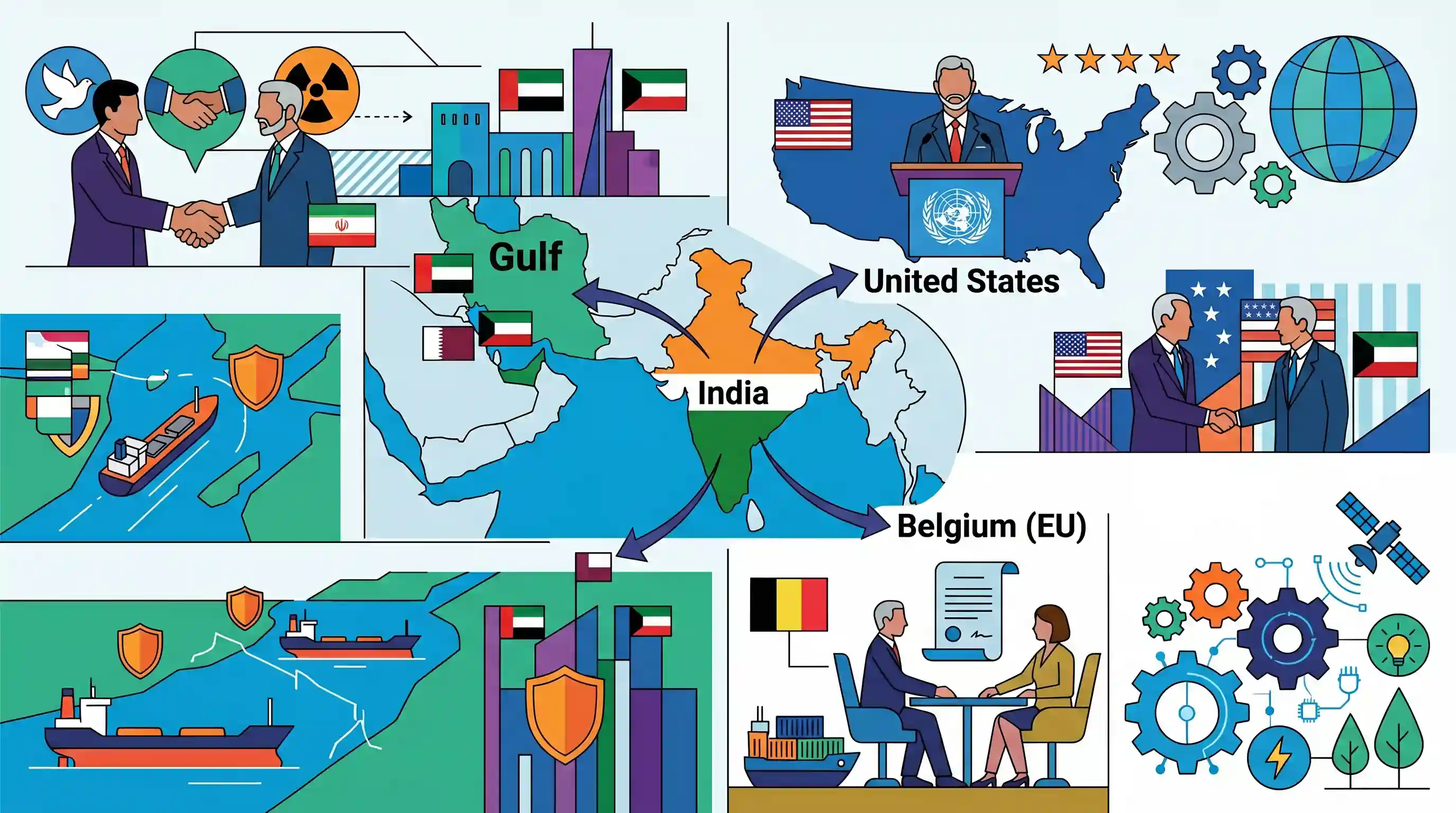
This tour highlights the pragmatism of India's multi-aligned foreign policy. It balances critical economic and energy security interests in West Asia, campaigns for global governance leadership at the UN, and consolidates high-tech trade cooperation with the European Union.
Summary
External Affairs Minister S. Jaishankar is embarking on a strategic six-nation tour to the Gulf, the United States, and Belgium. The visit aims to assess the US-Iran peace framework in West Asia, secure energy transit routes, officially launch India's campaign for a 2028-29 non-permanent UNSC seat, and advance the concluded India-EU Free Trade Agreement (FTA) through the India-EU Trade and Technology Council (TTC) in Brussels.
Key Points
- External Affairs Minister S. Jaishankar is departing on a 10-day, six-nation tour from July 5 to 15, 2026, visiting Qatar, Bahrain, Kuwait, Oman, the US, and Belgium.
- The Gulf leg (July 5-10) aims to assess the US-Iran peace framework and ongoing ceasefire talks mediated by Qatar and Oman. The West Asia conflict has threatened regional security, impacted India's diaspora, and driven up national energy prices due to disruptions in the Strait of Hormuz.
- In the US (New York, July 13), India will officially launch its campaign for a non-permanent seat on the UN Security Council (UNSC) for the 2028-29 tenure, seeking its 9th term.
- In Brussels (July 14-15), Jaishankar will attend the 3rd India-EU Trade and Technology Council (TTC) meeting to push forward the formal approval and legal vetting of the recently concluded India-EU FTA.
Important Terms
India-EU Free Trade Agreement (FTA)

A landmark economic treaty concluded in January 2026 to liberalize trade, lower tariffs on over 90% of goods, and enhance investment and regulatory cooperation between India and the European Union.
UPSC context
GS Paper II: Bilateral treaties; GS Paper III: Economy. Tests understanding of trade barriers and global economic integration.
US-Iran Peace Framework
A preliminary 14-point framework reached in June 2026 between the US and Iran, establishing a ceasefire, reopening the Strait of Hormuz, and initiating talks on sanctions and nuclear enrichment.
UPSC context
GS Paper II: Effect of global politics on India's interests. Tests comprehension of West Asia geopolitics, energy security, and maritime trade.
India-EU Trade and Technology Council (TTC)
A high-level strategic forum launched in 2022 to deepen coordination on digital connectivity, strategic technologies (like AI and semiconductors), green energy, and resilient supply chains between India and the EU.
UPSC context
GS Paper II: Bilateral groupings; GS Paper III: Science & Tech. Tests knowledge of technological diplomacy and secure supply chain collaboration.
UN Security Council (UNSC)
The primary United Nations body responsible for maintaining international peace and security, consisting of five permanent members with veto power and ten rotating non-permanent members.
UPSC context
GS Paper II: Important international institutions. Tests understanding of global governance reforms and India's campaigns for elected membership.
European Union (EU)
A political and economic union of 27 European member states operating as a single market, playing a key role in global trade, standard-setting, and regional security cooperation.
UPSC context
GS Paper II: Global groupings affecting India. Tests understanding of regional trade blocs and strategic partnerships in a multipolar world.
Prelims Trap
India has successfully reduced its import dependence on the Strait of Hormuz for both crude oil and liquefied petroleum gas (LPG) to below 50%.
While India successfully diversified its crude oil sources (reducing Middle East share to ~40-47%), its LPG and LNG import reliance on the Strait of Hormuz remains dangerously high at 95% and 64% respectively.
Static Concepts Connected
How are non-permanent members elected to the United Nations Security Council (UNSC)?
- Geographic Distribution: Governed by Article 23 of the UN Charter, distributing 10 seats geographically: 5 for Africa/Asia, 1 for Eastern Europe, 2 for LAC, and 2 for Western Europe/Others.
- Voting Threshold: Requires a two-thirds majority of the UN General Assembly (UNGA) members present and voting via secret ballot (minimum 129 votes if all 193 states vote).
- Term Limits: Members are elected for a two-year term, and a retiring member is ineligible for immediate re-election.
What is the India-EU Trade and Technology Council (TTC) and its structure?
- Strategic Status: Established in 2023, it is India's first such bilateral coordination platform and the EU's second (after its mechanism with the US).
- Three Working Groups: Group 1 focuses on Strategic Technologies, Digital Governance, and Digital Connectivity. Group 2 handles Green and Clean Energy Technologies. Group 3 targets Trade, Investment, and Resilient Value Chains.
Cross-Topic Patterns
Gas transition vs Maritime Chokepoints
India's domestic push to transition to a gas-based economy directly increases its strategic vulnerability to maritime choke-points like the Strait of Hormuz, linking climate transition to West Asian diplomacy.
FTAs and Tech-Standard Geopolitics
The synchronization of the India-EU FTA with the TTC illustrates how modern trade agreements are no longer just about tariffs, but about aligning technology standards and resilient supply chains against China.

Expect a 2026 question mapping India's energy choke-points (Hormuz/Bab-el-Mandeb) against its highly asymmetrical LPG/LNG import ratios.
Linked PYQs · 3
Linked PYQs · 3
- 2025MainsGS2
"Energy security constitutes the dominant kingpin of India's foreign policy, and is linked with India's overarching influence in Middle Eastern countries.” How would you integrate energy security with India's foreign policy trajectories in the coming years?
- 2017MainsGS2
The question of India's Energy Security constitutes the most important part of India's economic progress. Analyze India's energy policy cooperation with West Asian countries.
- 2015MainsGS2
Discuss the impediments India is facing in its pursuit of a permanent seat in UN Security Council.
