External Affairs Minister Jaishankar reviews bilateral ties in Doha
Source:The Hindu ↗
Why It Matters
The visit demonstrates India's proactive diplomacy in the Gulf region, which is critical for India's energy security, trade, and the welfare of its large diaspora. The successful management of crises (like the Navy veterans' release) and continued high-level engagement highlight the strategic depth of India-West Asia relations.
Summary
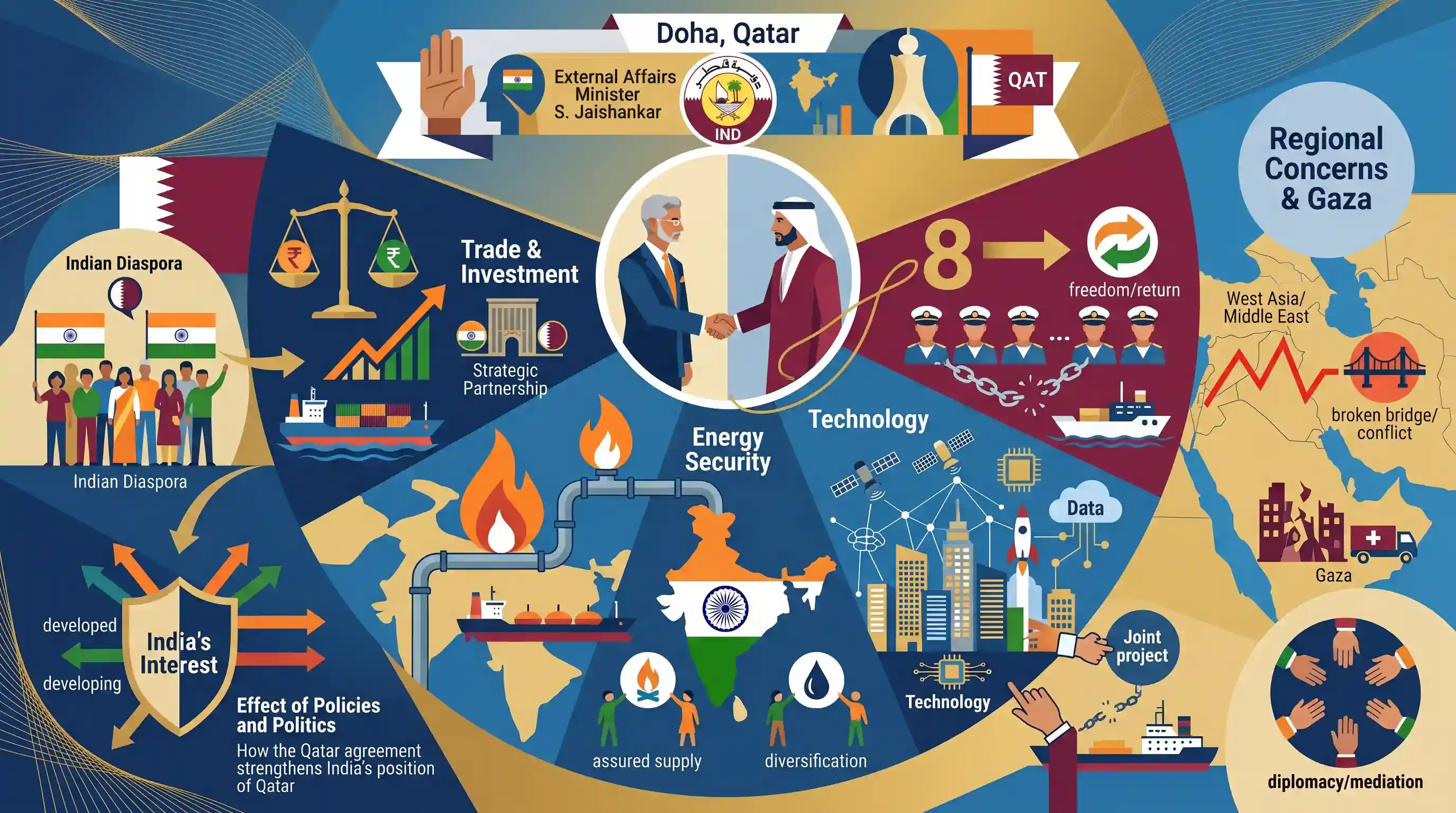
External Affairs Minister S. Jaishankar visited Doha, Qatar, to meet with his counterpart, reviewing and strengthening bilateral relations across trade, investment, energy, and technology. The talks also covered regional geopolitical concerns, notably the situation in Gaza. This high-level engagement underscores the robust and evolving diplomatic ties between India and Qatar, building on recent diplomatic successes such as the release of eight former Indian Navy personnel.
Key Points
- External Affairs Minister S. Jaishankar visited Doha to meet Qatar's Prime Minister and Foreign Minister to review bilateral relations.
- Discussions spanned multiple domains including political, trade, investment, energy, technology, culture, and people-to-people ties.
- The leaders exchanged perspectives on regional and global issues, with a specific focus on the ongoing situation in Gaza.
- The diplomatic visit highlights strengthening ties, arriving shortly after Qatar's release of eight Indian Navy veterans who had previously been sentenced to death.
Important Terms
India-Qatar Bilateral Relations

Comprehensive diplomatic, economic, and security ties between India and Qatar, recently elevated to a Strategic Partnership focusing on trade, investment, and energy cooperation.
UPSC context
GS Paper 2: Bilateral agreements involving India; tests understanding of regional diplomacy and strategic interests in the Gulf.
Energy Security
A nation's ability to ensure a reliable and affordable supply of energy; Qatar is India's largest supplier of Liquefied Natural Gas (LNG).
UPSC context
GS Paper 3: Infrastructure and Energy; explores India's import dependency and resource diversification strategies.
Indian Diaspora
The community of Indian citizens and people of Indian origin living in Qatar, currently the largest expatriate group there (~8 lakh people).
UPSC context
GS Paper 2: Effect of policies/politics of developed/developing countries on India's interests and the Indian diaspora.
Look West Policy
India's strategic framework for deepening engagement with Arab nations, Israel, and Iran to balance energy, security, and economic interests.
UPSC context
GS Paper 2: India's foreign policy and 'Extended Neighborhood' concept; tests strategic autonomy and regional balancing.
Dahra Global Case
A high-profile legal matter involving eight former Indian Navy personnel detained in Qatar on espionage charges, whose death sentences were commuted and released.
UPSC context
GS Paper 2: International Relations; a case study in 'Quiet Diplomacy' and consular protection of Indian nationals abroad.
West Asia Geopolitics
The region comprising Southwest Asian countries, critical to India due to energy imports, the diaspora, and maritime security in the Arabian Sea.
UPSC context
GS Paper 2: Regional groupings and stability; focuses on conflict management (e.g., Gaza) and maritime trade routes.
Prelims Trap
"Qatar is a member of OPEC and serves as India's largest supplier of crude oil."
Qatar left OPEC in 2019 to focus exclusively on natural gas. It is India's largest supplier of Liquefied Natural Gas (LNG), not crude oil.
Static Concepts Connected
What is the status and target of Natural Gas in India's energy mix?
- Current Share: Natural gas currently accounts for roughly 6% of India's primary energy mix.
- National Target: The government aims to increase this share to 15% by 2030 to transition to a 'gas-based economy'.
- Import Dependency: India relies on imports (LNG) to meet nearly half of its natural gas demand, predominantly from Qatar.
What is the Gulf Cooperation Council (GCC)?
- Member States: A political and economic alliance of six Middle Eastern countries: Saudi Arabia, Kuwait, UAE, Qatar, Bahrain, and Oman.
- Strategic Importance: Crucial for India due to massive hydrocarbon dependencies, huge inward remittances, and hosting a large Indian diaspora.
Cross-Topic Patterns
Gulf geopolitics and LNG security
Qatar’s role as a mediator in Gaza influences regional stability, which is a prerequisite for secure sea lines of communication and uninterrupted LNG supplies to India.
Diaspora leverage and strategic capital
The 800,000-strong Indian diaspora transcends economic remittances; it generates immense diplomatic goodwill and political leverage, which proved instrumental in securing the release of the Indian Navy veterans.

Expect a 2026 question mapping India's energy transition (LNG imports) against geopolitical volatility and mediator states like Qatar.
Linked PYQs · 3
Linked PYQs · 3
- 2025MainsGS2
"Energy security constitutes the dominant kingpin of India's foreign policy, and is linked with India's overarching influence in Middle Eastern countries.” How would you integrate energy security with India's foreign policy trajectories in the coming years?
- 2017MainsGS2
The question of India's Energy Security constitutes the most important part of India's economic progress. Analyze India's energy policy cooperation with West Asian countries.
- 2018MainsGS2
“India’s relations with Israel have, of late, acquired a depth and diversity, which cannot be rolled back.” Discuss.
