Energy diplomacy and diaspora welfare in West Asian engagement
Source:The Hindu ↗
Why It Matters
The article connects multiple pillars of India's foreign policy: securing vital energy and diaspora interests in the Gulf, navigating West Asian diplomatic shifts, launching a high-profile global campaign for the UNSC seat, and aligning with Western economies (EU) on critical and emerging technologies through the TTC. It is highly useful for answering mains questions on the integration of energy security, diaspora management, and multilateral diplomacy.
Summary
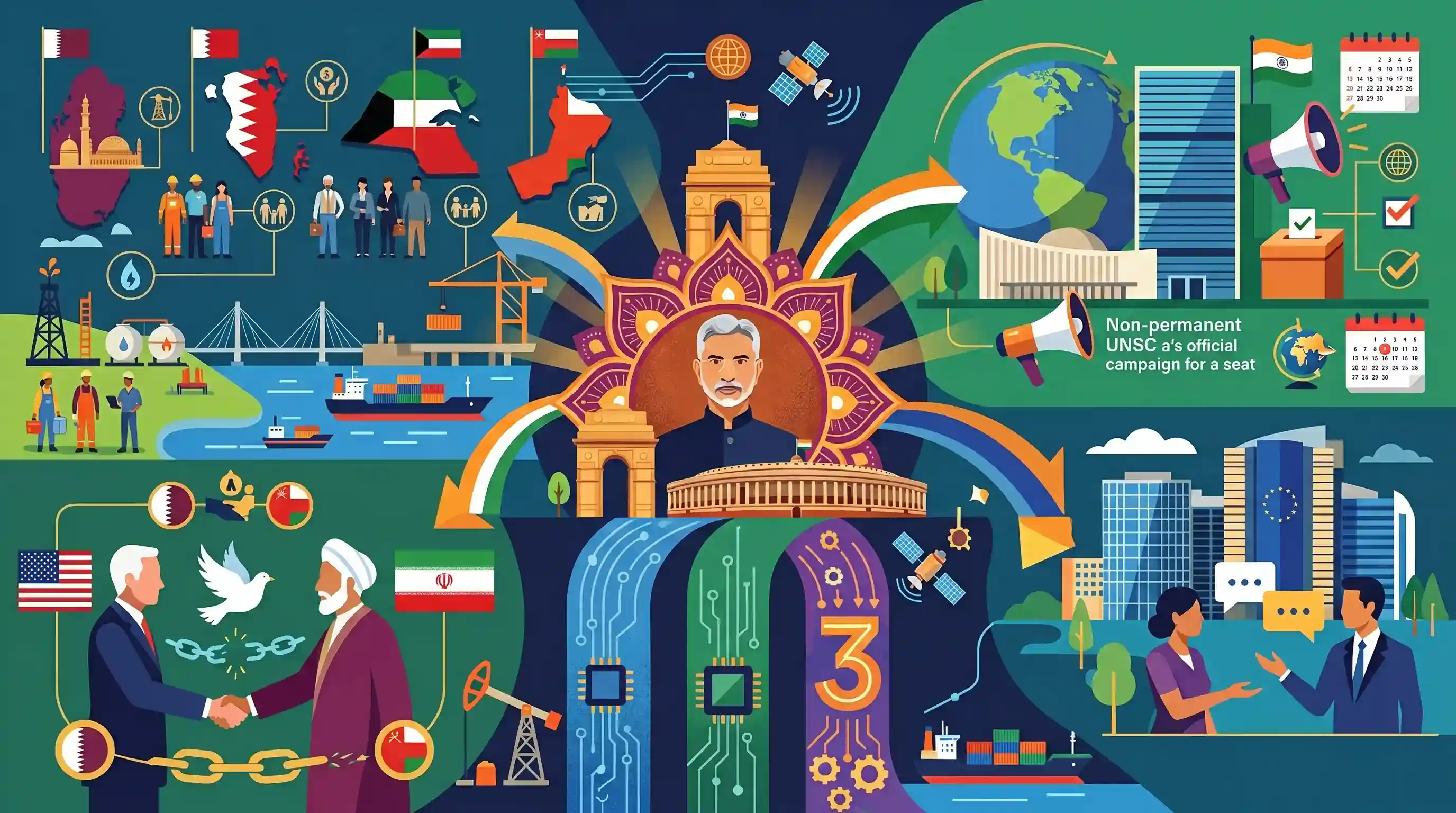
External Affairs Minister S. Jaishankar's multi-nation diplomatic tour (July 5-10, 2026) covering Qatar, Bahrain, Kuwait, and Oman focuses on bilateral cooperation in energy, trade, connectivity, and diaspora welfare. The visit is set against the backdrop of a major shift in West Asian geopolitics, with Qatar and Oman acting as mediators in facilitating the U.S.-Iran conflict-ending agreement. Following this tour, India will launch its official campaign in New York for a non-permanent seat on the UN Security Council (2028-29) and participate in the 3rd India-EU Trade and Technology Council (TTC) in Brussels to secure technological and trade supply chains.
Key Points
- External Affairs Minister S. Jaishankar embarked on a five-day diplomatic tour (July 5-10, 2026) covering four Gulf nations: Qatar, Bahrain, Kuwait, and Oman.
- In Doha, Jaishankar met Qatari Prime Minister Mohammed bin Abdulrahman Al-Thani to review bilateral cooperation in energy, trade, investments, connectivity, and security, and to strengthen the strategic partnership.
- Jaishankar thanked the Qatari leadership for ensuring the safety and well-being of the substantial Indian community (diaspora) residing in Qatar.
- The Gulf visit occurs amidst fast-changing West Asian geopolitics following an agreement to end the U.S.-Iran conflict; Qatar, Oman, and Pakistan have emerged as central mediators facilitating the ceasefire and hosting indirect U.S.-Iran talks.
- On July 13, 2026, the EAM will travel to New York to officially launch India's campaign for a non-permanent/tenure seat on the UN Security Council for the 2028-29 term.
- Following the U.S. visit, Jaishankar will participate in the 3rd India-EU Trade and Technology Council (TTC) meeting in Brussels on July 14-15 to deepen cooperation in high-technology trade, secure supply chains, and digital governance.
Important Terms
Gulf Cooperation Council (GCC)

A political, economic, and military alliance of six Arab nations bordering the Persian Gulf—Saudi Arabia, UAE, Qatar, Kuwait, Oman, and Bahrain—founded in 1981 to foster regional integration.
UPSC context
GS Paper II: Bilateral and regional groupings affecting India's interests. Tests diplomatic, energy, and diaspora ties.
India-EU Trade and Technology Council (TTC)
A high-level bilateral coordination platform established in 2023 to deepen strategic collaboration between India and the European Union in clean energy, digital governance, resilient trade, and secure technology supply chains.
UPSC context
GS Paper II: Bilateral groupings; GS Paper III: Science & Technology. Tests economic security and supply chain resilience.
United Nations Security Council (UNSC)
One of the six principal organs of the United Nations, tasked with maintaining international peace and security, consisting of five permanent and ten elected non-permanent members.
UPSC context
GS Paper II: Important International institutions. Tests India’s bid for permanent/non-permanent seats and multilateral reforms.
India-Qatar Strategic Partnership
A bilateral framework that elevates diplomatic, economic, and military ties, focusing on energy security, digital technology cooperation, infrastructure investments, maritime security, and the welfare of the massive Indian diaspora.
UPSC context
GS Paper II: Bilateral relations. Tests India’s energy security, geopolitical interests in West Asia, and expatriate community protection.
Prelims Trap
The India-EU Trade and Technology Council (TTC) is the first bilateral ministerial-level mechanism established by the EU with any global partner.
The EU established its first TTC with the United States in 2021. India is the EU's second such partner, though it is indeed India's first such bilateral forum.
Static Concepts Connected
What is the Gulf Cooperation Council (GCC) and its strategic significance for India?
- Composition and origin: Established in 1981 and headquartered in Riyadh; members include Saudi Arabia, UAE, Kuwait, Qatar, Oman, and Bahrain (excluding Iraq and Iran).
- Trade and diaspora: It is India's largest regional trading block partner, contributing roughly 15% of India's total global trade.
- Energy dependency: The GCC secures 35% of India's crude oil imports and nearly 70% of its natural gas (LNG/LPG) requirements.
How are UNSC non-permanent seats allocated and what is India's past footprint?
- Election mechanism: Ten non-permanent members are elected by the UN General Assembly for two-year terms, requiring a two-thirds majority vote.
- Regional distribution: Distributed among five regional groups: Africa/Asia (5), Eastern Europe (1), Latin America/Caribbean (2), Western Europe/Others (2).
- India's record: India is campaigning for its ninth term (2028-29), having last served during the 2021-22 period.
Cross-Topic Patterns
Chokepoint geopolitics and India's energy corridor
Maritime transit via the Strait of Hormuz links India's primary LNG source (Qatar) to its domestic market, making Persian Gulf stability a core national security interest.
Digital sovereignty and India-EU TTC
The TTC aligns India’s digital public infrastructure (DPI) with EU data regulations, securing critical mineral and high-tech supply chains against unilateral market dominance.

India's 2028-29 UNSC bid and EU-TTC tech-diplomacy will likely merge into a 2026 GS-2 question on strategic autonomy and middle-power hedging.
Linked PYQs · 5
Linked PYQs · 5
- 2025MainsGS2
"Energy security constitutes the dominant kingpin of India's foreign policy, and is linked with India's overarching influence in Middle Eastern countries.” How would you integrate energy security with India's foreign policy trajectories in the coming years?
- 2026PrelimsGS1
Ships from which of the following countries have to cross the Strait of Hormuz to reach out to the Indian Ocean ? 1. Bahrain 2. Syria 3. Qatar 4. Egypt Select the answer using the code given below :
- 2015MainsGS2
Discuss the impediments India is facing in its pursuit of a permanent seat in UN Security Council.
- 2024MainsGS2
‘The West is fostering India as an alternative to reduce dependence on China's supply chain and as a strategic ally to counter China's political and economic dominance.’ Explain this statement with examples.
- 2016PrelimsGS1
Which of the following is not a member of 'Gulf Cooperation Council'?
