India US Bilateral Talks and Strategic Partnership Challenges
Source:The Hindu ↗
Why It Matters
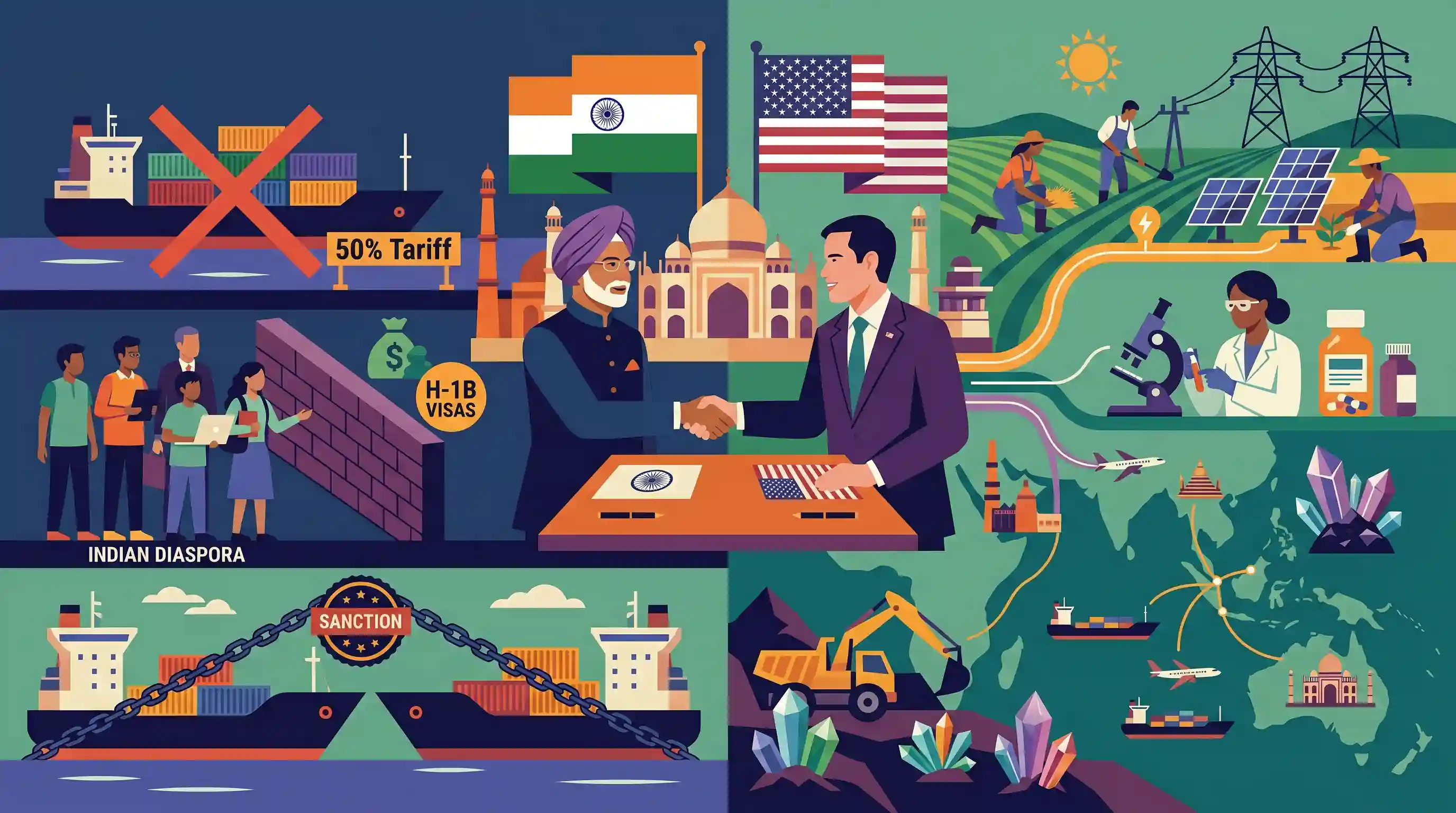
Highlights contemporary friction points (tariffs, visa policy, Iran sanctions) and areas of cooperation (critical minerals, Indo-Pacific) in India-US relations. Crucial for GS-2 IR questions analyzing the complexities and strategic autonomy challenges within the Indo-US strategic partnership.
Summary
External Affairs Minister S. Jaishankar met US Secretary of State Marco Rubio in New York to discuss the multifaceted India-US strategic partnership. The talks come at a critical juncture marked by recent friction points introduced by the US administration, notably a 50% tariff on Indian exports, sharp hikes in H-1B visa fees, and the revocation of the sanctions waiver for the strategic Chabahar Port project in Iran. Despite these challenges, the leaders focused on reinforcing cooperation in trade, energy, pharmaceuticals, critical minerals, and the broader Indo-Pacific architecture, indicating a commitment to stabilizing ties through continued dialogue.
Key Points
- EAM S. Jaishankar and US Secretary of State Marco Rubio held bilateral talks on the sidelines of the UN General Assembly in New York.
- The discussions took place amidst recent frictions caused by the US, including a 50% tariff on Indian goods, substantial H-1B visa fee hikes, and the cancellation of the sanctions waiver for India's Chabahar port project in Iran.
- The bilateral dialogue focused on trade, energy security, pharmaceuticals, and critical minerals, alongside broader strategic alignment in the Indo-Pacific region through the Quad.
- Both nations look to navigate these emerging differences, supported by a broader agreement between PM Modi and President Trump to resume bilateral trade talks.
Important Terms
H-1B Visa

A non-immigrant US visa allowing companies to employ foreign workers in specialty occupations (STEM/IT). It is vital for Indian IT majors and a major source of remittances.
UPSC context
GS Paper-2: Effect of policies of developed countries on India's interests and the Indian Diaspora. Tests understanding of service-sector mobility.
Chabahar Port
A strategic deep-water port in Iran’s Sistan-Baluchistan province. It provides India a transit route to Afghanistan and Central Asia, bypassing Pakistan, and links to the INSTC.
UPSC context
GS Paper-2: India and its neighborhood; strategic connectivity and bypassing regional chokepoints. Tests knowledge of maritime geopolitics.
Critical Minerals
Elements like lithium, cobalt, and rare earths essential for high-tech industries and green energy. India and the US cooperate through the "TRUST" initiative to secure supply chains.
UPSC context
GS Paper-3: Resources and Energy Security; GS Paper-2: Bilateral agreements. Tests awareness of technology-driven diplomacy.
Quad (Quadrilateral Security Dialogue)
An informal strategic forum comprising India, the US, Japan, and Australia. It promotes a 'Free and Open Indo-Pacific' while cooperating on maritime security and emerging technologies.
UPSC context
GS Paper-2: Regional and global groupings involving India. Tests understanding of multipolar balance and Indo-Pacific security.
Indo-Pacific Architecture
A geopolitical construct spanning the Indian and Pacific Oceans. It is the primary theater for India-US strategic convergence against regional assertiveness and for rules-based order.
UPSC context
GS Paper-2: International Relations. Tests conceptual clarity on maritime strategy and India's 'Act East' policy.
iCET (Initiative on Critical and Emerging Technology)
A framework launched in 2022 to elevate and expand strategic technology partnerships (AI, semiconductors, space) between India and the US, steered by their National Security Councils.
UPSC context
GS Paper-2: Bilateral agreements and high-tech cooperation. Tests knowledge of the modern 'engines' of the India-US partnership.
Prelims Trap
India enjoys a permanent US sanctions waiver for the development and operation of Chabahar port.
Sanctions waivers are executive decisions, not permanent exemptions. The US administration's recent revocation of the Chabahar waiver exposes Indian investments to sanctions risks under US law.
Static Concepts Connected
What is the strategic and geographic significance of the Chabahar Port for India?
- Gulf of Oman: Located in Iran's Sistan-Balochistan province on the Gulf of Oman, sitting safely outside the volatile Strait of Hormuz.
- Bypassing Pakistan: Provides India direct overland transit access to Afghanistan and resource-rich Central Asian Republics, overcoming Pakistan's land blockade.
- INSTC Synergy: Acts as a vital node complimenting the International North-South Transport Corridor (INSTC) to Russia and Europe.
How do H-1B visa restrictions relate to WTO's General Agreement on Trade in Services?
- GATS Mode 4: The temporary movement of IT professionals falls under Mode 4 of GATS: "Presence of natural persons."
- Non-Tariff Barriers: India often highlights that sharp visa fee hikes and quantitative caps act as restrictive non-tariff barriers to fair services trade.
Cross-Topic Patterns
Strategic convergence vs. Economic protectionism
India-US relations display a dual track: deepening strategic alignment in the Indo-Pacific (Quad) juxtaposed against rising bilateral economic frictions like 50% tariffs and visa curbs.
Critical minerals and China+1 strategy
Cooperation in critical minerals and pharma supply chains reflects a shared imperative to de-risk from Chinese dominance, linking economic security directly to foreign policy.

A 2026 prelims question pairing Chabahar's geographic nodes with US sanctions policy and India's Central Asia access is highly likely.
Linked PYQs · 3
Linked PYQs · 3
- 2019MainsGS2
‘What introduces friction into the ties between India and the United States is that Washington is still unable to find for India a position in its global strategy, which would satisfy India's national self-esteem and ambitions.’ Explain with suitable examples.
- 2012MainsGS2
How have the US sanctions against Iran affected India's bilateral relations with Iran?
- 2017PrelimsGS1
What is the importance of developing Chabahar Port by India?
