EAC-PM Study on Women Cash Transfer Schemes
Source:Indian Express ↗
Why It Matters
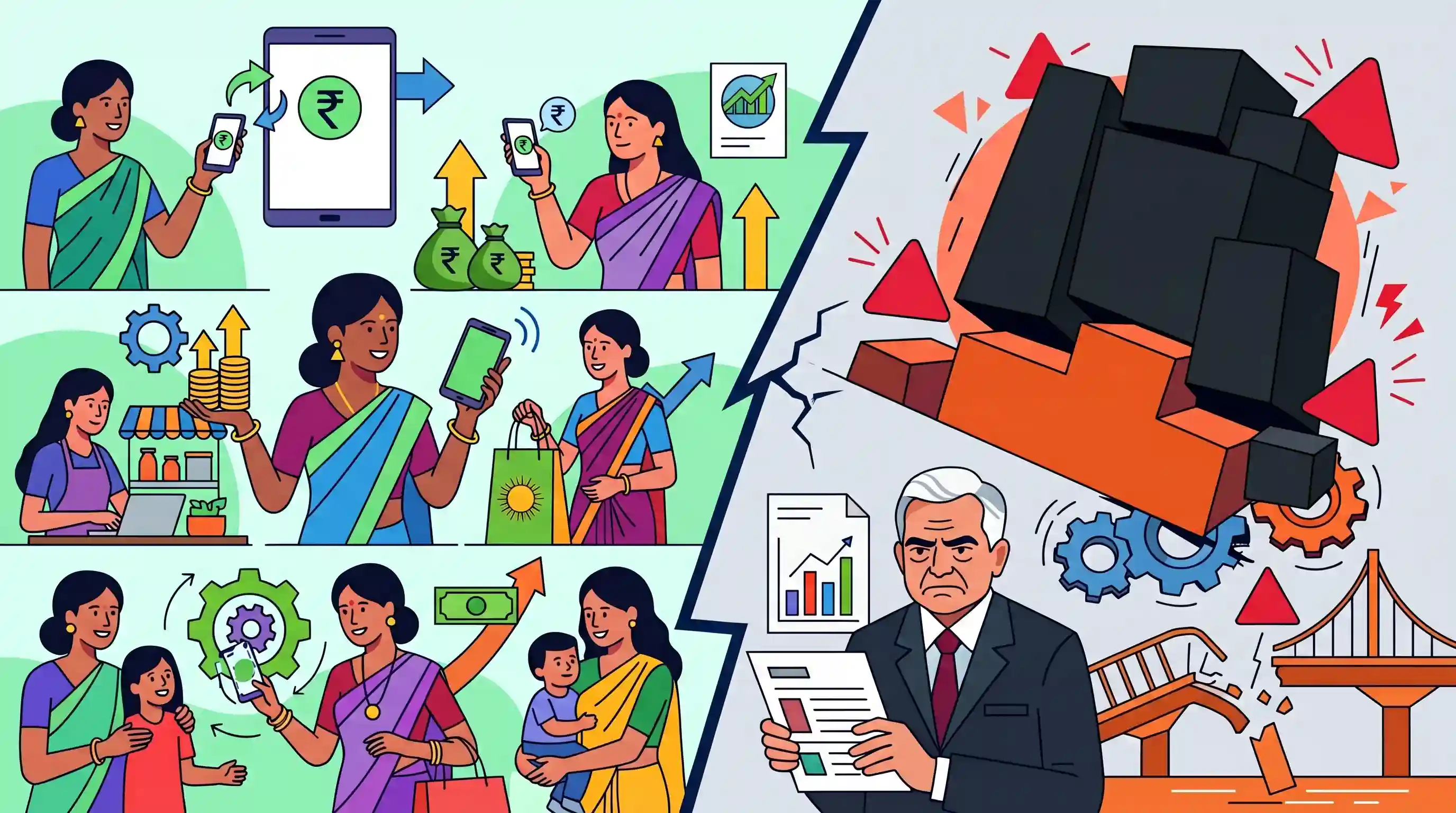
This article is highly relevant to the GS Paper 3 (Economy and Budgeting) and GS Paper 2 (Welfare Schemes) debates on 'Welfare vs. Fiscal Populism'. It provides concrete, empirical data from an EAC-PM paper showing the developmental benefits of direct cash transfers to women (UPI adoption, spillover savings, welfare-aligned expenditure) while acknowledging the valid macroeconomic warning signs of escalating state debts and potential crowding out of public capital expenditure.
Summary
An Economic Advisory Council to the Prime Minister (EAC-PM) working paper analyses unconditional direct cash transfers to women in Maharashtra (Mukhyamantri Majhi Ladki Bahin Yojana) and Odisha (Subhadra Yojana). The research highlights positive developmental outcomes, showing a 46% and 28% increase in spending respectively, positive household spillover effects, and accelerated UPI adoption. However, this empirical success is juxtaposed against mounting macroeconomic concerns voiced by the RBI and the Economic Survey 2025-26, which warn that state-level 'fiscal populism' and elevated state debt levels (expected to reach 29.2% of GDP in 2025-26) risk crowding out growth-enhancing capital expenditure.
Key Points
- An EAC-PM paper titled 'Unconditional Women Cash Transfer Programmes in India: Evidence from Maharashtra and Odisha' analyzed account-level monthly data of two prominent state-level direct cash transfer schemes.
- The study found that the cash transfers significantly boosted beneficiary spending, increasing it by 46% in Maharashtra (under Mukhyamantri Majhi Ladki Bahin Yojana) and 28% in Odisha (under Subhadra Yojana).
- About Rs 90 out of every Rs 100 transferred was spent, primarily on 'welfare-improving' areas such as medical, lifestyle, and educational purposes. Older women saved more, while women with lower education showed a high tendency to spend on education.
- The cash transfers created positive household spillover effects, improving the month-end balances of beneficiaries' relatives and reducing their expenditure outflows (e.g., relatives' spending dropped by 49% in Maharashtra).
- Adoption of Unified Payments Interface (UPI) accelerated significantly post-transfer receipt in Maharashtra, providing an important dividend for digital financial inclusion.
- The authors recommend evolving cash transfers into 'cash-plus architectures'—combining income transfers with voluntary capacity-building, digital literacy, and Self-Help Group (SHG) linkages, alongside periodic inflation adjustments.
- This positive impact stands in contrast to macroeconomic risks; PRS Legislative Research estimated that 12 states would spend Rs 1.68 lakh crore on such transfers in 2025-26, prompting warnings from the RBI and Economic Survey 2025-26 about state debt rising to 29.2% of GDP and crowding out critical infrastructure and capital investment.
Important Terms
Economic Advisory Council to the Prime Minister (EAC-PM)

A non-constitutional, independent body constituted to provide key economic advice, particularly on macroeconomic issues and policies, to the Government of India and specifically to the Prime Minister.
UPSC context
GS Paper II & III: Essential for understanding institutional mechanisms for economic policymaking, advisory bodies, and macroeconomic coordination.
Mukhyamantri Majhi Ladki Bahin Yojana
A flagship direct benefit transfer scheme of the Maharashtra government that provides eligible women aged 21–65 with monthly financial assistance of ₹1,500 to promote economic independence and improve health.
UPSC context
GS Paper II & III: Relevant for studying welfare schemes, gender-budgeting, social safety nets, and financial inclusion of vulnerable sections.
Subhadra Yojana
A major women-centric welfare scheme in Odisha providing eligible women aged 21–60 with ₹10,000 annually in two equal installments to promote economic empowerment, digital literacy, and financial independence.
UPSC context
GS Paper II & III: Tests understanding of state-led direct benefit transfer programs, financial inclusion, and socio-economic empowerment of women.
Reserve Bank of India (RBI)
India's central bank and regulatory body responsible for monetary policy, banking supervision, and issuing reports on state finances to maintain macroeconomic stability and manage public debt.
UPSC context
GS Paper III: Critical for monetary policy, fiscal federalism, banking regulations, and monitoring state-level fiscal health and debt.
PRS Legislative Research
An independent, non-profit research initiative that provides non-partisan analysis of legislative bills, government budgets, and state-level policy dynamics to strengthen parliamentary debate and governance in India.
UPSC context
GS Paper II: Important for legislative analysis, parliamentary oversight, public policy formulation, and evaluating the quality of state-level lawmaking.
Prelims Trap
The Mukhyamantri Majhi Ladki Bhain and Subhadra Yojana are centrally sponsored schemes co-funded by the Union Ministry of Women and Child Development.
These are entirely state-sector schemes funded from state exchequers, which is why they stress state-level debt (GSDP) rather than Union fiscal indicators.
Static Concepts Connected
Fiscal targets for Indian states under the FRBM framework and 15th Finance Commission.
- Debt-to-GSDP limit: The NK Singh FRBM Review Committee (2018) recommended limiting aggregate state debt to 20% of GSDP.
- Fiscal deficit target: The 15th Finance Commission recommended a normal fiscal deficit limit of 3% of GSDP for states.
- Article 293(3): Gives the Centre constitutional power to regulate state borrowing if the state is indebted to the Union.
The economic concept of "Crowding Out" and its impact on public investment.
- Definition: Occurs when high government borrowing increases interest rates, reducing private sector investment.
- Capex vs Revenue: High revenue expenditure on transfers leaves fewer resources for capital expenditure, limiting long-term infrastructure and productive capacity.
Cross-Topic Patterns
Fiscal Federalism vs. State Populism
State autonomy versus Article 293 scrutiny on welfare spending represents a critical friction point between regional democratic mandates and macroeconomic stability.
DPI + Gender Financial Inclusion
Direct cash transfers acting as a catalyst for UPI adoption demonstrates how social safety nets can fast-track digital literacy and formal financial integration.

Mains 2026 may require balancing the micro-benefits of women's direct cash transfers against the macro-fiscal risk of state debt-to-GSDP levels.
Linked PYQs · 3
Linked PYQs · 3
- 2015MainsGS3
In what way could replacement of price subsidy with Direct Benefit Transfer (DBT) change the scenario of subsidies in India ? Discuss.
- 2024MainsGS3
Examine the pattern and trend of public expenditure on social services in the post-reforms period in India. To what extent this has been in consonance with achieving the objective of inclusive growth?
- 2024MainsGS1
Distinguish between gender equality, gender equity and women's empowerment. Why is it important to take gender concerns into account in programme design and implementation?
