E20 Fuel Blending Rollout Challenges and Brazil Policy Template
Source:Indian Express ↗
Why It Matters
Biofuel blending is a critical pillar of India's energy transition strategy, aiming to reduce the crude oil import bill and lower carbon emissions. Understanding the practical rollout challenges, consumer impact, and international best practices (like Brazil's model) is crucial for evaluating government environmental and economic policies.
Summary
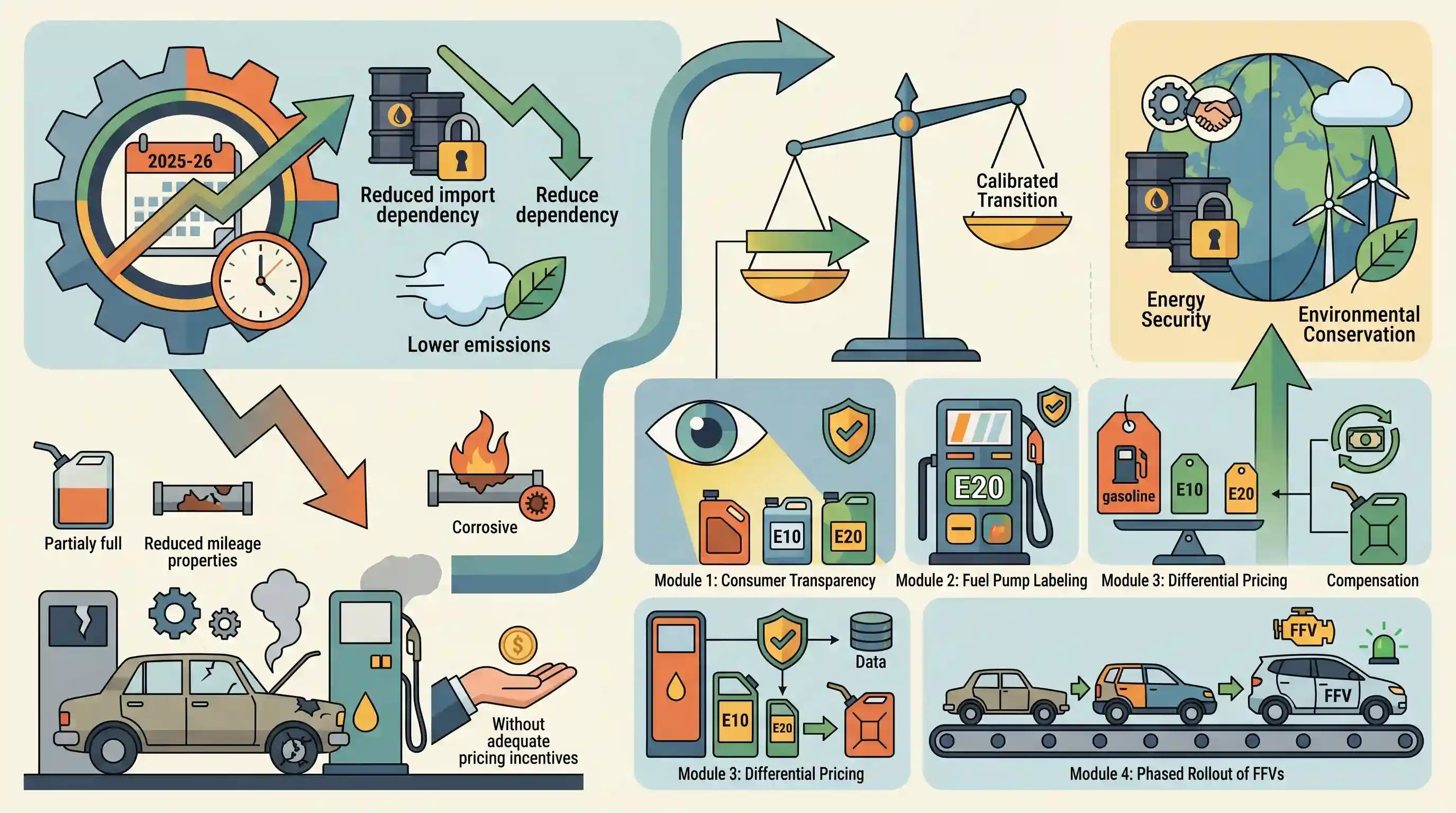
The transition to E20 (20% ethanol-blended) fuel in India is facing consumer resistance due to concerns over reduced mileage and potential engine damage in older, non-compatible vehicles. While the government expedited the E20 target to 2025-26 to reduce crude import dependency and lower emissions, consumers are bearing the brunt of the lower energy density and corrosive properties of ethanol without adequate pricing incentives. To ensure a smooth transition, India can learn from Brazil's calibrated approach, which involves consumer transparency, distinct fuel pump labeling, differential pricing to offset mileage drops, and the phased rollout of Flex-Fuel Vehicles (FFVs).
Key Points
- India's expedited target to achieve 20% ethanol blending in petrol (E20) by 2025-26 has sparked consumer concerns regarding decreased fuel efficiency and potential damage to older, non-compatible engine components.
- Ethanol possesses lower energy density compared to pure petrol, leading to a noticeable drop in mileage, while its corrosive nature poses risks to rubber and plastic parts in older vehicles.
- Brazil's successful ethanol integration offers a template, highlighting the importance of a calibrated transition featuring transparent labeling, consumer awareness, and Flex-Fuel Vehicles (FFVs) capable of running on any blend up to E100.
- Addressing the backlash requires Indian policymakers and Oil Marketing Companies (OMCs) to introduce distinct labeling at fuel pumps, ensure availability of lower-blend fuels for older vehicles, and implement differential pricing to compensate for mileage loss.
Important Terms
National Policy on Biofuels

A 2018 framework (amended 2022) categorizing biofuels (1G, 2G, 3G) and advancing the 20% ethanol blending target to 2025-26 to reduce import dependency and manage agricultural surplus.
UPSC context
GS III (Environment/Economy): Renewable energy targets, import substitution, and waste-to-wealth strategies.
Ethanol Blended Petrol (EBP) Programme
A 2003 initiative mandating Oil Marketing Companies to blend ethanol with petrol. It aims to enhance energy security, cut forex outflows, and boost farmer income via diversified crop usage.
UPSC context
GS III (Economy/Energy): Energy security, Forex savings, and the 'Food vs Fuel' debate.
Flex-Fuel Vehicles (FFVs)
Vehicles with modified internal combustion engines and sensors designed to run on petrol, pure ethanol, or any combination of the two, allowing flexible fuel usage.
UPSC context
GS III (Science & Tech/Environment): Decarbonization of transport and India's transition to a low-carbon economy.
E20 Fuel
A fuel blend of 20% ethanol and 80% petrol. It offers higher octane but lower energy density, requiring engine compatibility to avoid corrosion or mileage loss.
UPSC context
GS III (Environment): Fuel chemistry, energy efficiency challenges, and milestones in India's climate commitments.
Oil Marketing Companies (OMCs)
Public sector entities (e.g., IOCL, BPCL, HPCL) that procure ethanol from distilleries and manage the nationwide blending and retail distribution of petrol under government mandates.
UPSC context
GS III (Economy): Role of PSUs in implementing national energy policies and supply chain management.
Society of Indian Automobile Manufacturers (SIAM)
The apex body representing the Indian automotive industry, coordinating with the government on emission norms, fuel compatibility standards, and the transition to green mobility.
UPSC context
GS III (Economy): Industry-government collaboration and manufacturing sector challenges in technology adoption.
Prelims Trap
"Blending ethanol with petrol increases the energy density and fuel efficiency of standard vehicles."
Ethanol actually has lower energy density than petrol, leading to a 2-7% drop in fuel efficiency (mileage). It is added to reduce emissions and import dependency, not boost mileage.
Static Concepts Connected
What are the four generations of biofuels?
- First Gen (1G): Produced directly from food crops like sugarcane, maize, and starch.
- Second Gen (2G): Produced from non-food crops and agricultural waste (lignocellulosic biomass, stems, husks).
- Third Gen (3G): Derived from specially engineered algae, offering high yield without arable land competition.
- Fourth Gen (4G): Genetically engineered crops or algae designed to capture carbon, acting as a direct carbon sink.
What are the key provisions of India's amended National Policy on Biofuels?
- Advanced Targets: The E20 (20% ethanol blending in petrol) target was advanced from 2030 to the Ethanol Supply Year 2025-26.
- Wider Feedstock: Allows use of surplus rice (via FCI), maize, and damaged food grains for ethanol production to boost supply.
- Export Regulations: Promotes indigenous production of biofuels in Special Economic Zones or Export Oriented Units for export under specific conditions.
Cross-Topic Patterns
Ethanol feedstock vs. Food Security
Diverting maize, surplus rice, and sugarcane for ethanol production sparks the "fuel vs. food" debate, directly impacting inflation and agricultural cropping patterns, especially favoring water-guzzling crops.
PLI Scheme & Auto Component shifts
The shift to Flex-Fuel Vehicles (FFVs) necessitates replacing corrosive-prone rubber and plastic parts, linking the E20 transition directly to India's Production Linked Incentive (PLI) scheme for Auto components.

Expect a 2026 Prelims question on E20 combining its chemical properties (hygroscopic, lower energy density) with biofuel feedstocks.
Linked PYQs · 3
Linked PYQs · 3
- 2009PrelimsGS1
In the context of alternative sources of energy, ethanol as a viable bio-fuel can be obtained from
- 2022MainsGS3
Do you think India will meet 50 percent of its energy needs from renewable energy by 2030 ? Justify your answer. How will the shift of subsidies from fossil fuels to renewables help achieve the above objective ? Explain.
- 2025PrelimsGS1
Consider the following types of vehicles : I. Full battery electric vehicles II. Hydrogen fuel cell vehicles III. Fuel cell-electric hybrid vehicles How many of the above are considered as alternative powertrain vehicles?
