Kumki Elephants Deployment for Human Wildlife Conflict Mitigation
Source:theprint ↗
Why It Matters
Mitigating human-wildlife conflict is an escalating ecological and governance challenge. AP's specific strategies like the use of 'Kumki' elephants and the 'Hanuman Project' serve as important localized environmental case studies, highly relevant for APPSC Prelims questions focusing on state geography, wildlife conservation, and biodiversity.
Summary
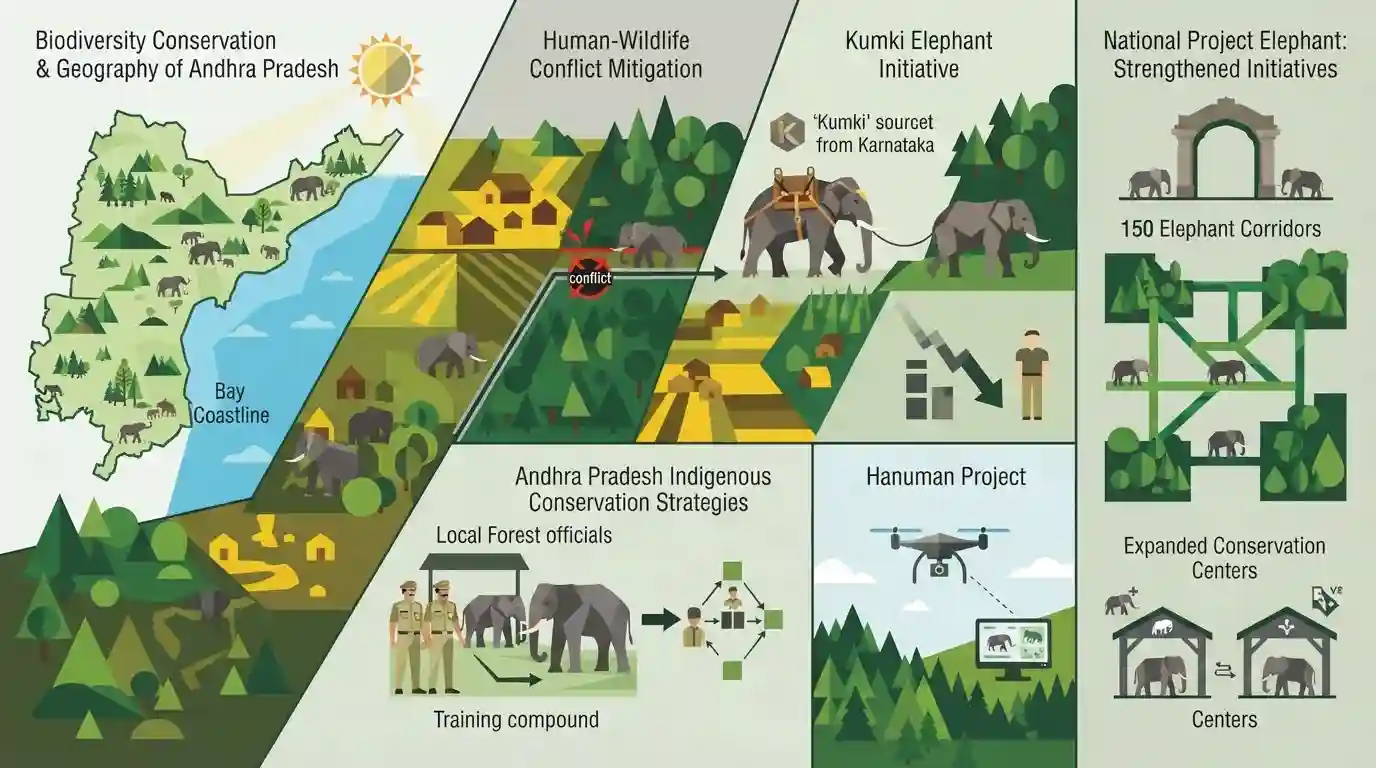
Andhra Pradesh Deputy Chief Minister Pawan Kalyan highlighted the state's efforts to mitigate human-elephant conflicts during an International Elephant Day seminar in Visakhapatnam. The state has successfully utilized 'Kumki' elephants sourced from Karnataka in conflict zones like Chittoor and Parvathipuram Manyam, significantly reducing human casualties. Andhra Pradesh is also advancing indigenous conservation strategies, notably training its own kumki elephants and deploying the technology-driven 'Hanuman Project' for rapid wildlife rescue. Nationally, Project Elephant is being strengthened with the identification of 150 elephant corridors and an expansion of conservation centers.
Key Points
- Andhra Pradesh is prioritizing the mitigation of human-elephant conflicts (HEC) using 'Kumki' elephants (trained captive elephants) sourced from Karnataka, which have reduced human deaths by 70%.
- AP plans to independently train two kumki elephants annually, with one named 'Jayanth' already deployed in the Parvathipuram Manyam district.
- At the national level, elephant conservation centres have grown from 26 to 33 since 2014, and 150 elephant corridors have been identified across India to protect habitats.
- The AP Government launched the 'Hanuman Project' in March to manage human-wildlife conflicts, deploying 93 quick response vehicles and seven wildlife ambulances.
Important Terms
Hanuman Project

The "Healing and Nurturing Units for Monitoring, Aid and Nursing of Wildlife" is an Andhra Pradesh initiative deploying rapid response teams and ambulances to mitigate human-wildlife conflict.
UPSC context
Important for GS Paper 3 (Environment & Ecology), highlighting state-level, rapid-response mitigation strategies for man-animal conflicts.
Project Elephant
A Centrally Sponsored Scheme launched in 1992 to protect elephants, their habitats, and corridors. It focuses on mitigating human-elephant conflict and preventing illegal ivory poaching.
UPSC context
Essential for GS Paper 3 (Biodiversity), testing knowledge of national frameworks that protect keystone species and manage ecological corridors.
Andhra Pradesh Government
The state administrative authority advancing indigenous conservation strategies, such as importing and training 'Kumki' elephants and deploying the technology-driven Hanuman Project for wildlife rescue.
UPSC context
Maps to GS Paper 2 and 3, showcasing decentralized, state-specific approaches to environmental governance and biodiversity conservation.
Prelims Trap
Kumki elephants are specially designated wild elephant herds relocated by the government for habitat expansion.
Kumkis are not wild elephants; they are specially trained captive Asian elephants used by Forest Departments to rescue or drive away wild herds from human settlements.
Static Concepts Connected
What are the key institutional features of Project Elephant?
- Launch & Type: Launched in 1992 as a Centrally Sponsored Scheme to protect elephants, their habitats, and corridors.
- Current Scale: It manages 33 notified Elephant Reserves across India, with the latest being the Terai Elephant Reserve in UP.
- Core Objectives: Aims to mitigate human-elephant conflict and ensure the welfare of captive elephants in India.
What is the conservation status of the Asian Elephant?
- IUCN Red List: Endangered. Population faces severe threats from habitat fragmentation, linear infrastructure development, and human-wildlife conflict.
- WPA 1972: Listed under Schedule I, granting the species the absolute highest legal protection against hunting and capturing in India.
- CITES: Listed in Appendix I, completely prohibiting international commercial trade in the species or its derivatives (ivory).
Cross-Topic Patterns
Tech-driven Wildlife Management
AP's 'Hanuman Project' mirrors the broader national trend of deploying technology, like the AI-based 'Gajraj' early warning system by Indian Railways, to prevent wildlife casualties.
Transboundary Ecological Corridors
Conflict mitigation in AP depends heavily on the Rayala Elephant Corridor. UPSC frequently tests species linked to multi-state contiguous habitats (e.g., Nilgiri Biosphere Reserve).

Expect a multi-statement prelims question combining Elephant Reserve statistics (33 total), the definition of 'Kumkis', and WPA status.
Linked PYQs · 1
Linked PYQs · 1
- 2024APPSC_PRELIMSGS1
Match the following : | List-I (Wildlife Sanctuary in Andhra Pradesh) | List-II (Region) | |---|---| | A. Coringa | I. Kurnool | | B. Gundla Brahmeswaram | II. Kadapa | | C. Rollapadu | III. East Godavari | | D. Sri Lankamalleswara | IV. Kurnool and Prakasam | Choose the correct answer using the codes given below : Code: A B C D
